
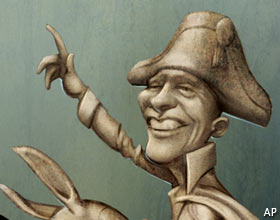
On January 20, the day after Scott Brown’s upset victory in the Massachusetts Senate race, Barack Obama suggested that he might just have to settle for a more modest health care reform package than the one Democrats had been pushing for a year.
Recommended Stories
George Stephanopoulos, interviewing Obama for ABC News, summed up the public views of health care. Voters, he said, are “saying now they want your health care plan to go away. It’s just not popular. The majority are opposed.” So, Stephanopoulos asked, what is your plan now?
“I would advise that we try to move quickly to coalesce around those elements of the package that people agree on,” Obama said.
Stephanopoulos asked if this meant that health care reform would be scaled back.
Obama said he wouldn’t get involved in legislative strategy, but reaffirmed that the way forward was to focus on “core elements” of reform. So, yes, it would be scaled back.
Scott Brown had campaigned as the 41st vote against Obama’s health care reform—the man who would keep Democrats from overcoming a GOP filibuster. In a very practical way his election imperiled health care. More than that, though, was the sense that Brown’s election—in navy blue Massachusetts, to a seat long occupied by the father of health care reform, Ted Kennedy—changed the political dynamics in Washington. Many commentators pronounced the death of Obamacare.
The push for health care has been costly for Obama. The more he explained his plans for comprehensive reform, the less the American people liked them. A year after he came into office with record favorability ratings, Obama found his own popularity on a steady downward trajectory. An NBC/Wall Street Journal poll taken in January 2009, found that only 14 percent of Americans had either a “somewhat negative” or a “very negative” view of him. A year later, those negative numbers had jumped to 35 percent, and Obama’s overall approval ratings in several polls were upside down. More voters disapproved of his performance than approved.
So when Obama hinted to Stephanopoulos that he might scale back his health care plans, his words were seen as a nod to the new political reality.
Adam Nagourney of the New York Times explained it on the Charlie Rose Show.
Even fellow Democrats and enthusiastic health care reform proponents were discouraged. “If you lose Massachusetts and that’s not a wakeup call, there’s no hope of waking up,” said Indiana senator Evan Bayh. “Look,” said Connecticut senator Christopher Dodd, “it didn’t work, this process.”
And yet on January 22, at a town hall in Elyria, Ohio, Obama reversed course. “I’m not going to walk away just because it’s hard,” he said. “This is our best chance to do it. We can’t keep putting this off.”
His determination raised two obvious questions. How would he do it? And, given the high degree of difficulty and the near-certain political damage of winning or losing, why would he try?
The last two weeks have answered the first question: Obama will pass a health care bill by any means necessary.
And why?
Because Obama sees himself as Ronald Reagan, not Bill Clinton. Reagan was a transformative president who accomplished big things. Clinton, whose signature domestic policy initiative—health care—failed, was not.
On October 22, 2006, Obama was on Meet the Press. He had appeared on the show before and disclaimed any intention of running for president, pledging to serve out his term as senator. He used this second appearance to reopen the door to a bid and offered his thoughts on presidential greatness.
Great presidents, he said, do big things.
Obama continued:
Obama dilated further in an interview with the Reno Gazette-Journal on January 14, 2008. “I think Ronald Reagan changed the trajectory of America in a way that, you know, Richard Nixon did not and in a way that Bill Clinton did not,” he said. (Hillary Clinton and John Edwards predictably distorted the statement for use in the Democratic primaries.)
Obama’s hope was to take liberalism into the mainstream the same way that Reagan had conservatism. In his mind, he had the political skills to do it.
“I think that we’re shifting the political paradigm here,” he told the Gazette-Journal.
Health care might make Obama a transformative president. But Democrats in Republican districts and swing districts are not likely to be calling Obama to campaign for them this fall.
Stephen F. Hayes is a senior writer at The Weekly Standard.