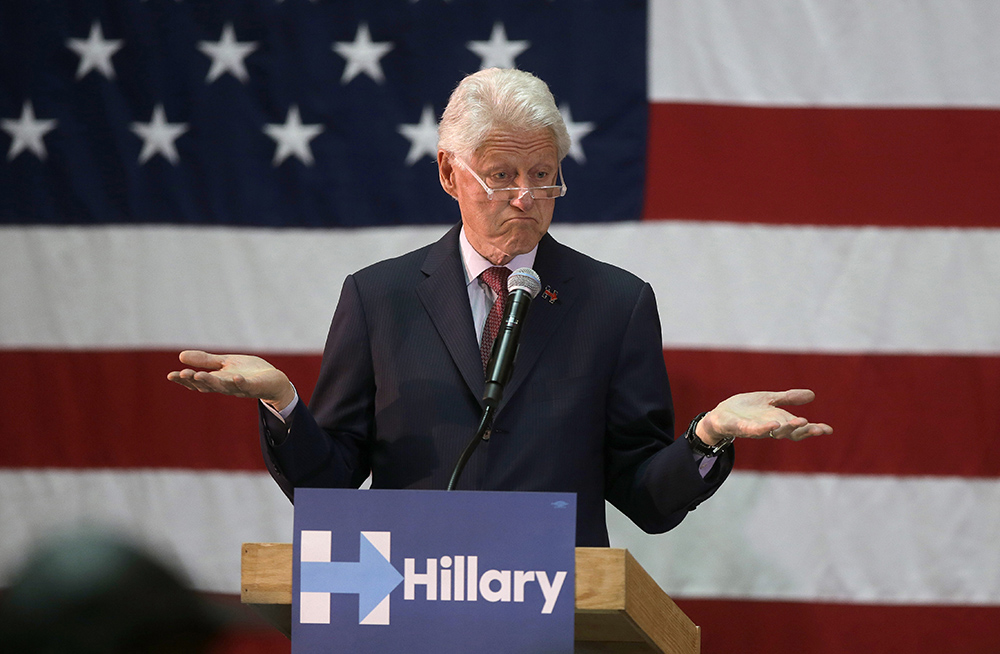
Bill Clinton cannot decide how he feels, or at least what he should say, about his legacy on crime, and in particular his signing of the Violent Crime Control and Law Enforcement Act more than 20 years ago.
Colloquially known as the Crime Bill, the 1994 law lengthened prison sentences, expanded the use of the death penalty and gave states more money to hire police and build more prisons. It also included an assault weapons ban and funding for inner-city after-school programs.
Last summer in Philadelphia, the former president told an NAACP audience that by signing the bill he had probably made the problem of mass incarceration “worse.”
But he struck a different tone last week. Back in Philly stumping for his wife, Clinton launched a vigorous defense of the crime bill, sparring for 10 minutes with Black Lives Matter protestors. Far from destroying black communities, as the protestors argued, Clinton insisted that the law bolstered them by taking child-murderers and crack dealers off their streets.
By the next day, Clinton had changed his tune once again, claiming that he “almost want[ed] to apologize” for his comments of the previous day.
Clinton’s ambivalence is understandable. It highlights the difficulty in discerning the efficacy of public policies. It also demonstrates the difficulty of speaking candidly about an issue in which race plays an important role and on which human lives depend.
The Crime Bill was a bipartisan response to a rise in violent crime. Its defenders claim it was a primary factor in the subsequent drop in crime. “Because of that bill, we had a 25-year low in crime, a 33-year low in the murder rate, and listen to this, because of that and the background check law, a 46-year low in the deaths of people of gun violence,” Clinton said last week.
But while the law undoubtedly contributed to those declines, most experts say they had more to do with other factors, such as developments in policing techniques and technology as well as economic, social and even environmental forces beyond the scope of the criminal justice system. Notably, the decline in violent crime began before the Crime Bill became law.
What no one can argue is that the law contributed to an enormous rise in the nation’s prison population. And it’s from there that much black anger stems, and where it is justified.
Since the era of mass incarceration began three decades ago, the prison population has shot up 400 percent, to roughly 2.3 million people, the largest in the world. America has 5 percent of the world’s population but 25 percent of its prisoners. That statistic alone probably tells us something has gone wrong with our criminal justice system, even though it also points toward serious problems, too, with our deteriorating culture and social cohesion.
Fortunately, a consensus has formed that too many people are being placed in prison for too long and at too high a cost, both financially and morally. When ex-offenders leave prison, too many aren’t prepared for reintroduction into society.
A bipartisan coalition of lawmakers, activists and academics agree that the old approach of warehousing prisoners isn’t working and that reform is desperately needed. Any issue upon which President Obama, the ACLU, Rand Paul and the Koch brothers agree deserves our careful attention.
It is undeniable that the erosion of trust that has taken place between police and the black communities must be restored. Black Lives Matter and other activists are not wrong when they say that mass incarceration has helped destroy black communities. But they are also not completely right if they ignore or deny other causes just as obvious.
The criminal justice system is not inherently racist, despite the incidents of racial discrimination by police that do occur. If anything, a policy of deliberate benign neglect by law enforcement for the sole purpose of incarcerating smaller numbers would do greater damage to black communities than to anyone else. Blacks are, after all, disproportionately the victims of violent crimes.
FBI statistics show that about 90 percent of blacks murdered in single-victim crimes are murdered by other blacks. (A similar number is true of white murder victims.) As Clinton put it while shouting at protestors during his defense of the crime bill last week, “You are defending the people who killed the lives you say matter. Tell the truth!”
Telling the truth means acknowledging that mass incarceration did more harm than good. But for the protestors, it also means realizing that by aiming their fire at law enforcement to the exlusion of all other and numerically more serious problems, they are not hastening but delaying the day when this societal ill is resolved.
