

Loyola hopes its depth, speed help vs. Ohio State
As a No. 15 seed in the NCAA tournament, Loyola faces a daunting history Thursday night in Pittsburgh against No. 2 Ohio State.
Recommended Stories


The last time a No. 15 won an NCAA tournament game was 2001, when Hampton stunned Iowa State. Since then No. 15 seeds have gone 0-40. The average margin has been 16 points.
Metro Atlantic champion Loyola (24-8) vs. Big Ten powerhouse Ohio State (27-7) is a typical 15-2 pairing — uninvited guest vs. blue blood.
| Close calls |
| Since Hampton upset Iowa State in 2001, No. 15 seeds have gone winless in the NCAA tournament. Some of the games, however, have been close and memorable. |
| 2010 » Villanova 73, |
| Robert Morris 70 (OT) |
| 2008 » Duke 71, Belmont 70 |
| 2006 » Tennessee 63, |
| Winthrop 61 |
| 2003 » Kansas 64, Utah St. 61 |
| 2003 » Wake Forest 76, |
| East Tennessee St. 73 |
“We see them on TV. They’re a great team,” Loyola junior Bobby Olson said. “They’re not a No. 2 seed. They’re a No. 1. They were picked this year to win the national championship.”
No one picked Loyola to win anything. With two NBA prospects in the lineup, Iona was the overwhelming choice to capture the MAAC. But the Gaels stumbled in the conference semifinals, opening the door for the opportunistic Greyhounds.
Loyola is an odds-and-ends collection of frontcourt transfers from higher-level programs and guards whom coach Jimmy Patsos calls the “second-best players on their high school teams.”
One of those is Olson, who played at Georgetown Prep with Markel Starks (Georgetown). Another is point guard R.J. Williams, overshadowed at St. Frances Academy by Greg Lewis (Rutgers) and Wayne Sparrow (Richmond).
Ohio State has no such second bests. One of the Buckeyes, freshman Amir Williams, is a McDonald’s All-American who has yet to crack the rotation. If he was at Loyola, he would be the Greyhounds’ best player.
“I told our guys, ‘They’re better than us.’ But we’ve got some things going for us,” Patsos said. “They’ve got six [rotation] guys. We’ve got eight. We want to play fast. They want to play slow.”
Teams that are physically overmatched in the NCAA tournament usually try to slow the pace. Fewer possessions can create more random results. But uptempo is the style Patsos learned in his 13 seasons as an assistant to Gary Williams at Maryland, and it has helped him recruit a better brand of player to the Baltimore school.
Forcing Ohio State to play Loyola’s style will be difficult. The Buckeyes have two of the most effective tempo-setters in the nation in point guard Aaron Craft (8.6 ppg, 4.6 apg), often called the best on-ball defender in college basketball, and center Jared Sullinger (17.6 ppg, 9.3 rpg), perhaps the nation’s top low-post scorer.
If it comes to trench warfare, Loyola is prepared. The Greyhounds have more size, depth and pedigree than most small-conference schools. Against the 6-9, 265-pound Sullinger, Patsos can play him with Maryland transfer Shane Walker (6-10, 225), Xavier transfer Jordan Latham (6-8, 250) or former starter Julius Brooks (6-9, 225). If Patsos needs more quickness against the All-American, he can shift his best player, Northeastern transfer Erik Etherly (6-7, 225), over from the four spot.
“It’s gonna be a group effort. You gotta keep a fresh body on him all game,” Etherly said. “We’ll try to make him shoot over us instead of taking easy shots.”
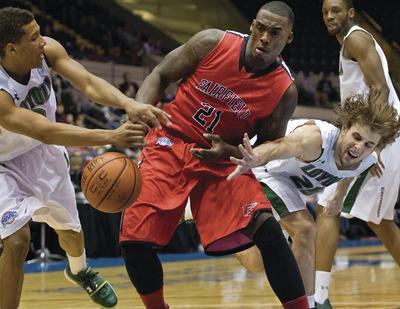
Loyola is taking positives from its ugly 48-44 win over Fairfield in the MAAC championship game. The game was played in the knock-down, drag-out style of the Stags.
“Fairfield is a big physical team. Ohio State’s a big, physical team,” Etherly said. “Hopefully we can grind it out like we did against Fairfield. Obviously Ohio State is a much tougher opponent.”
