

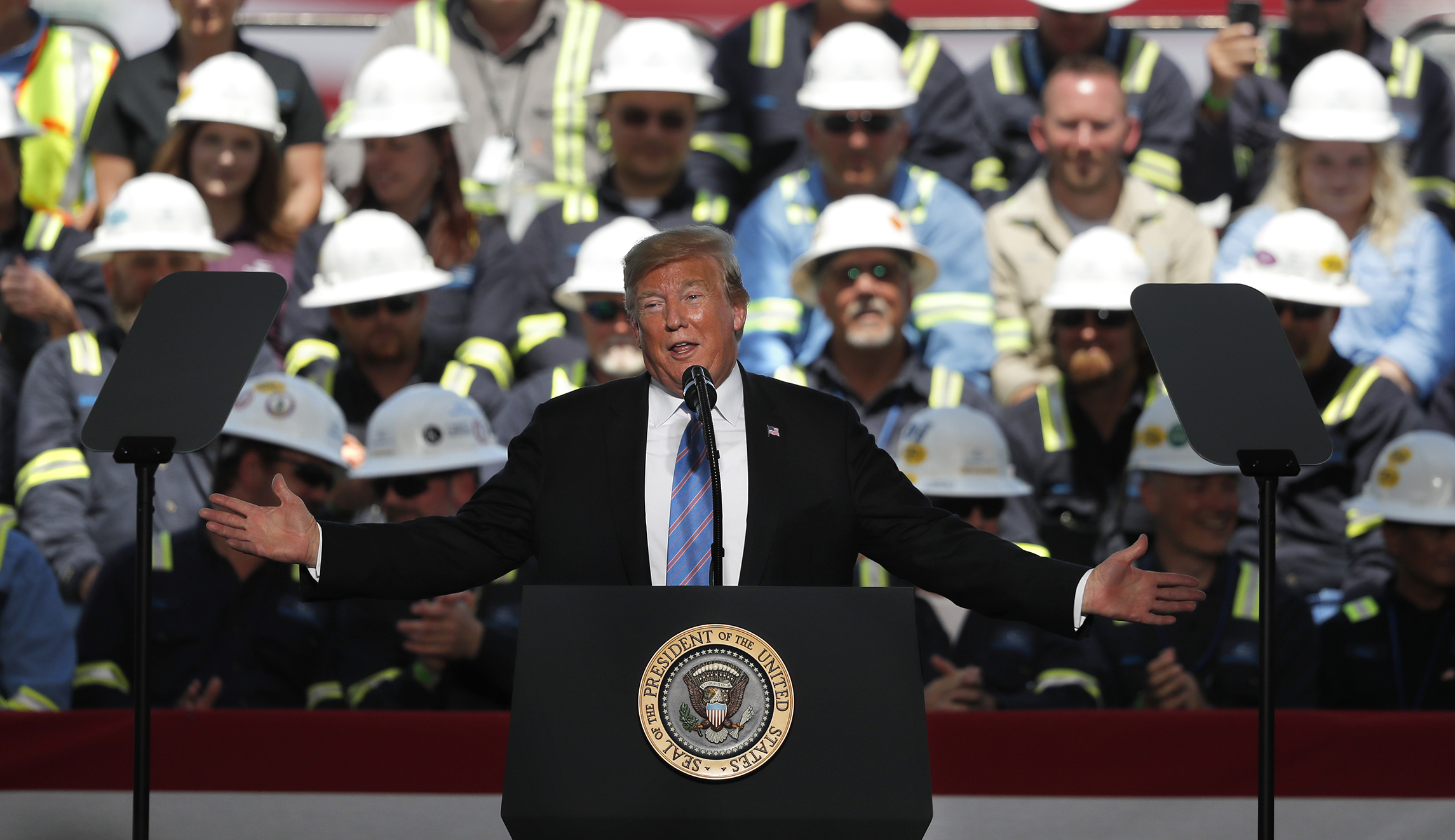
Put your hands together — it is Infrastructure Week!
That’s why President Trump held a Rose Garden press conference-like event with a sign declaring “No Collusion. No Obstruction.” Infrastructure Week is also why Democrats went around shouting “cover-up!” to every camera and every reporter in Washington.
Recommended Stories


Of course, three weeks ago was also Infrastructure Week. Remember? Back when Attorney General William Barr testified on Capitol Hill while Democrats called for his impeachment?
You may also recall that Infrastructure Week in 2018 when Trump’s infrastructure rally veered to Roseanne Barr riffs. Or the earlier 2018 Infrastructure Week when Trump’s lawyer Michael Cohen told the New York Times he paid a porn star $130,000 in hush money after an affair with Trump.
All of these, of course, are the children of the June 5, 2017, Infrastructure Week, which Trump kicked off by firing FBI Director James Comey.
We could stay true to the spirit of Infrastructure Week and editorialize on Trump’s angry rants or the Democrats’ strategy of flooding the zone with investigations. But instead, we will do something different: talk about infrastructure.
[Read more: Trump to Pelosi and Schumer: No infrastructure deal unless the investigations stop]
Trump has had two different ways of talking about his infrastructure ambitions. Sometimes, he talks about what a great builder he is, how he imagines remaking cities in the ways you’d expect a commercial real estate developer to dream. Other times, he sounds conservative. He speaks of devolving power to states and focusing on maintaining what we have rather than initiating new boondoggles such as high-speed rail.
If the administration and Congress are ever able to do anything on infrastructure, Trump would be well-served to stick to the conservative route.
Neither the Constitution nor the economics of the situation suggest that roads ought to be funded by the federal government. States and localities can and ought to buy the asphalt, decide where to pour it, and figure out how to fund it. A real infrastructure reform would reduce federal spending on roads and rails to bare bones — just enough to fund inherently national projects.
Between dynamic tolling, gas taxes, mileage-based-vehicle taxes, congestion fees, and market-priced parking, states will find that they can shift the cost of the highways to the users of the highways. If roads can’t pay for themselves, that might be a market signal that that a road doesn’t serve an economic use. Sure, a state can maintain or build a road for social, environmental, or other purposes, but roads that are supposedly good for the local economy ought to pay for themselves.
The point is that Uncle Sam should let states figure this out for themselves.
Also, a smart infrastructure bill will resist the California temptation of massive projects with uncertain budgets and endless operating costs.
In other words, the ideal infrastructure bill will not be a big, beautiful, glorious thing. It will be small and humble.
An infrastructure bill doesn’t have to be thrilling. Infrastructure Week is exciting enough as it is.
