

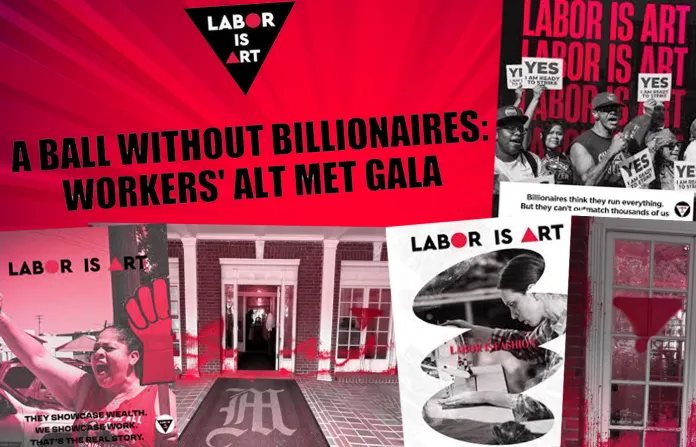
Walking through Midtown Manhattan, I stopped at a set of construction doors plastered with large posters from a campaign called Laboris.art — a Service Employees International Union project. It is paid for by SEIU’s Committee on Political Education, the union’s federal political action committee, and tied to its “Ball Without Billionaires” counter‑programming for this year’s Met Gala. The slogans read “Billionaires Can’t Buy Power” and “Labor Is Power.” Standard left‑populist messaging, until you notice the logo at the bottom of the poster: a crisp inverted red triangle.
That symbol is antisemitic, and it carries two hate‑filled histories — both histories of murder.
Stay informed.Stay ahead.
Join Washington Examiner for unlimited access to the news, analysis, and commentary that matter most.
Already a member? Log in
The first is the Nazi concentration camp badge system. Beginning in 1937, the SS sewed color‑coded inverted triangles onto prisoner uniforms to mark inmates by the alleged grounds for incarceration. Red designated political prisoners. Pink marked gay men. Green marked criminals. Black marked “asocials,” including Roma and other marginalized groups. Jews were forced to wear a yellow Star of David, often combined with a colored triangle for those assigned a second category. The triangle was the bureaucratic tag of industrialized cruelty: the small piece of cloth that signaled who could be beaten, starved, or sent to die.
The second history is more recent. Since October 2023, the inverted red triangle has appeared at protests, encampments, posters, and stickers, often alongside open support for Hamas. It has been used to target Jewish organizations and public figures. It was lifted directly from Hamas propaganda videos, where the symbol marked Israeli soldiers and civilians for attack. In current usage, it functions as a target marker.
The Nazi version classified Jews for death. The Hamas version marks Jews for death. The same shape, the same color, the same purpose — separated by 80 years. Now, a clear derivative is pasted across construction doors in Manhattan as if it were a corporate logo.
When the German American Bund filled Madison Square Garden on Feb. 20, 1939, under a portrait of President George Washington flanked by swastikas, roughly 100,000 New Yorkers met them in the streets to say no. That is the American answer to rampant religious discrimination.
Today, that answer is wobbling, and the silence is coming from the top. The Laboris.art posters are not anonymous fly‑posting. They are paid for by SEIU COPE, the PAC of the second‑largest union in the country, as part of a coordinated counter‑event to the Met Gala. The campaign and its accompanying “Ball Without Billionaires” fashion show have been favorably covered by Fast Company, CNN, Business of Fashion, and Sourcing Journal. None of that coverage has remarked on the logo.
New York City has seen this exact symbol before, and it knew what it was. In June 2024, vandals painted inverted red triangles on the Brooklyn Heights home of Anne Pasternak, the Jewish director of the Brooklyn Museum, alongside a banner reading “White Supremacist Zionist.”
Then‑Mayor Eric Adams went on X with the photographs and called it “a crime, and … overt, unacceptable antisemitism.” Gov. Kathy Hochul (D-NY) described it as “an abhorrent act of antisemitism.” Then-Comptroller Brad Lander said the perpetrators were “way over the line into antisemitism.” The NYPD investigated the incident as a hate crime; a woman was later arrested and charged. Two months later, when the same symbol appeared on the Brooklyn Heights co‑op of Columbia University’s chief operating officer, the NYPD again investigated, and the Jewish Community Relations Council of New York described the act as “straight out of the 1930s Nazi playbook.” That was the baseline: when the symbol appeared on a Jewish New Yorker’s door, the city named it.
Today, the same symbol functions as a corporate logo for a major union’s political campaign, plastered across Midtown construction doors. New York Mayor Zohran Mamdani spent Met Gala day promoting “Work of Art,” a portrait series profiling six garment, retail, and warehouse workers, released through i‑D magazine by his office on the same theme, on the same day as the SEIU campaign whose posters carry the triangle. The mayor has said nothing about the symbol. Neither has SEIU. When the city stops naming the symbol, the street keeps printing it. The construction doors are downstream of the doorway at Gracie Mansion.
New York City has the authority to act. NYC Construction Code §3307.4.6 prohibits any sign, pictorial representation, or advertising message on a construction protective structure unless required by law; the Department of Buildings enforces it. Administrative Code §10‑119 covers lampposts and mailboxes, with fines from $75 to $300 plus removal costs. A printed website on the poster makes enforcement straightforward.
There are three steps the city could take to make clear that religious discrimination and antisemitism are entirely unacceptable. First, DOB and the Department of Sanitation should establish a coordinated enforcement detail focused on illegal postings on scaffolding, sidewalk sheds, and construction fencing — a natural extension of the city’s own “Get Sheds Down” initiative, the program launched in 2023 to remove the long-standing sidewalk sheds that have come to define New York’s streetscapes.
Second, the City Council should amend §10‑121 to escalate penalties when illegal postings incorporate symbols tied to designated terrorist organizations or Nazi‑era atrocity iconography. The First Amendment protects speech; it does not require the city to tolerate vandalism that carries it. Third, DOB should require general contractors — already responsible for maintaining sidewalk sheds — to remove unauthorized postings within 24 hours and report repeat offenders.
RESTORING AMERICA — THE WORLD MUST CHOOSE: STAND WITH AMERICA OR YIELD TO IRAN
Construction doors wrapped in a death symbol tell us something about what we are willing to accept. No American should have to walk past them on the way to work.
Not in this country. Not on our streets.