

Former President Barack Obama’s Afghanistan strategy and rhetoric are haunting President Joe Biden’s move to end the longest war in U.S. history by September.
In 2009, Biden’s former boss surged thousands of additional troops at the Afghanistan crisis, vowing to be resolved about what remains an elusive clear victory. Even late in his second term, though Obama wanted to leave, he explained his decision to keep forces there in a July 2016 speech, canceling plans to cut U.S. troops there from 8,400 to about 5,000 by stating the higher force level would “allow us to continue to provide tailored support to help Afghan forces continue to improve.” He called the Taliban’s territorial and political gains a “threat.”
Recommended Stories



“My decision today also sends a message to the Taliban and all those who have opposed Afghanistan’s progress: You have now been waging war against the Afghan people for many years. You’ve been unable to prevail,” Obama said then. Five years later, his always-loyal vice president is making one of the biggest gambles yet of his presidency by, as his chief spokeswoman put it, expecting the Taliban to become suddenly more of a partner and less of a threat.
The Obama comparisons over what will likely be a signature foreign policy moment for Biden has exacerbated the competition Biden reportedly feels to be a more consequential president than his former boss as “46” tries to emerge from the still-popular “44’s” shadow.
‘PREMIUM FOR CALM’: BIDEN’S CONSOLER IN CHIEF TONE WILL BE TESTED BY MIDTERM CHAOS
Neither Biden nor his team is “an extension of Obama,” according to Obama White House and State Department alumnus Tom Cochran. And the Afghanistan conflict is “a multigenerational forever war” and “a losing situation, regardless of the decision,” insisted Cochran, now a partner at public affairs firm 720 Strategies.
“I don’t see this as altering objectives for the appearance of a win. It’s been 20 years, and soldiers deployed today weren’t born nor remember 9/11,” he said. “I think the administration has made it clear that it doesn’t end our commitment to Afghanistan.”
Democratic consultant Peter Fenn underscored that Biden, Obama, and even former President Donald Trump understood America’s “role of ‘endless world policeman’ is long gone.”
“We have to recognize that there are other ways to influence foreign policy and to achieve democratic results. More often these days, it is best we lead by example,” he said.
Biden’s September deadline, coinciding with the 20th anniversary of al Qaeda and Osama bin Laden’s Sept. 11, 2001, terrorist attacks in the U.S., extends the timeline Trump agreed to last year with the Taliban to pull U.S. troops out of Afghanistan by May 1.
Trump’s deal was scrutinized by the likes of then-Senate Majority Leader Mitch McConnell over the risks it would create a stability vacuum in the region and trigger regressions in democratic and women’s rights gains made in the country. Now the minority leader, McConnell this week redirected his criticism toward Biden.
“It is a retreat in the face of an enemy that has not yet been vanquished and abdication of American leadership,” McConnell said. “A reckless pullback like this would abandon our Afghan, regional, and NATO partners in a shared fight against terrorists that we have not yet won.”
When asked about Biden’s choice, reported to have been made contrary to military advice, a Republican-aligned source recounted an Obama-era exchange with one of the former president’s chairmen of the Joint Chiefs of Staff.
“We were discussing how the Obama White House had shifted away from the generals and were increasingly resistant to their advice after feeling ‘duped’ by the surge advice. He told us the president’s view of the generals as one of ‘that hog won’t slaughter itself,'” the source said. “You can find this sentiment reflected pretty accurately … by presidents of both political parties — including Trump.”
In 2009, Obama laid out his plan to begin bringing service members home from Afghanistan. In July 2011, he announced he was deploying another 30,000 personnel to the country.
In his “New Way Forward” speech, given at West Point after a protracted policy review, Obama detailed how he aimed to curtail the Taliban’s influence in Afghanistan, better protect the Afghan people, and pressure the country to invest in its own military capacity and effective governance.
“The message that we send in the midst of these storms must be clear: that our cause is just, our resolve unwavering,” Obama said at the time.
As his vice president, Biden had advised Obama against the troop surge. And more than a decade later, 2,500 service members are still based in Afghanistan.
Obama praised Biden’s strategy this week, despite his limiting America’s scope in Afghanistan to stopping another terrorist incident from being plotted within its borders.
“After nearly two decades of putting our troops in harm’s way, it is time to recognize that we have accomplished all that we can militarily, and that it’s time to bring our remaining troops home,” he wrote. “I support President Biden’s bold leadership in building our nation at home and restoring our standing around the world.”
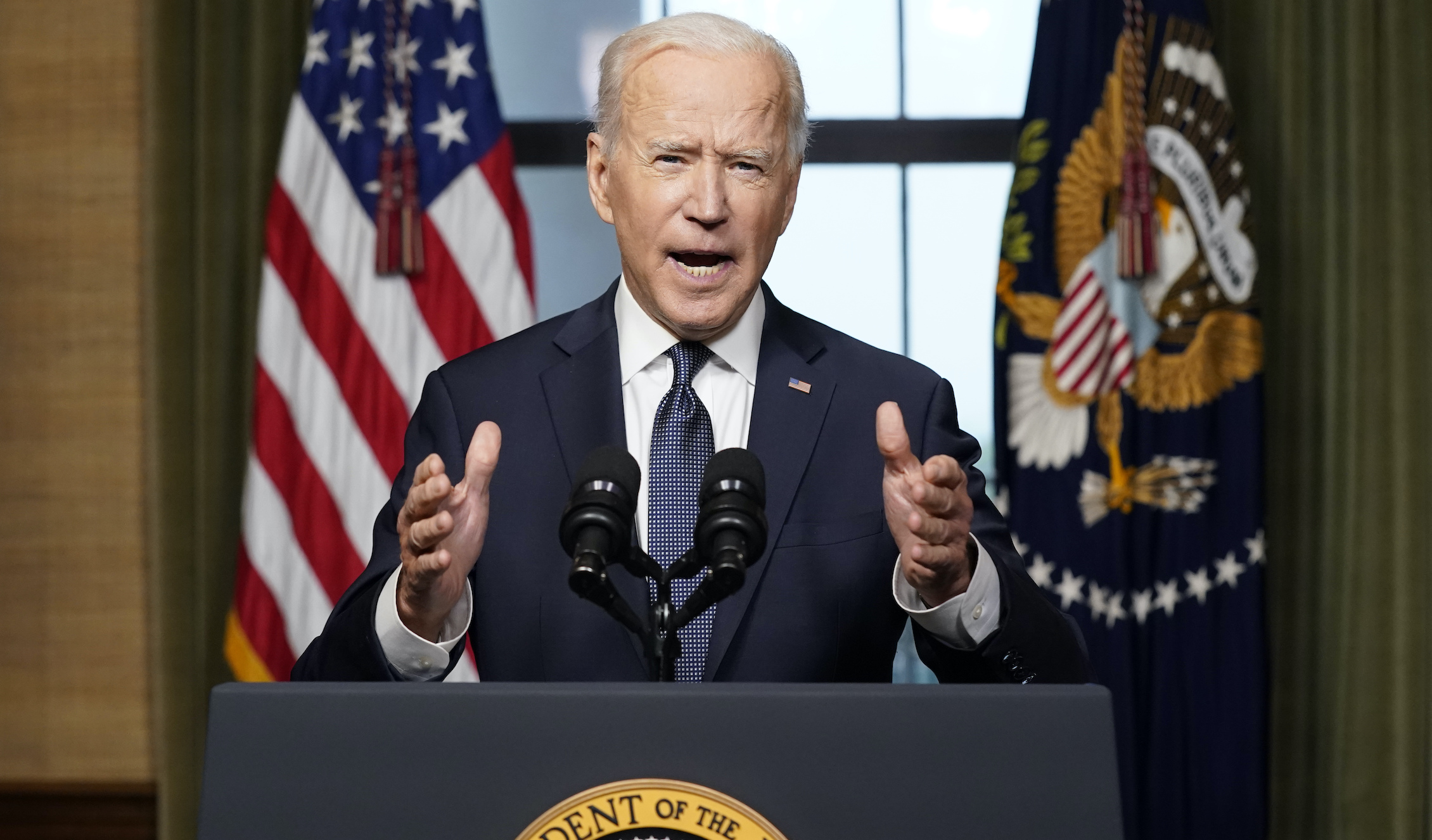
Biden outlined his plan Wednesday in an address, which aides circulated to reporters via an email titled “Remarks by President Biden on the Way Forward in Afghanistan.” In it, he justified not placing conditions on the drawdown effort, which will end a conflict that has cost the lives of more than 2,200 Americans and around $2 trillion.
“We delivered justice to bin Laden a decade ago, and we’ve stayed in Afghanistan for a decade since,” Biden said. “Since then, our reasons for remaining in Afghanistan are becoming increasingly unclear, even as the terrorist threat that we went to fight evolved.”
He went on, “I’m now the fourth United States President to preside over American troop presence in Afghanistan: two Republicans, two Democrats. I will not pass this responsibility on to a fifth.”
During a pointed interaction in the briefing room, Psaki contended military personnel were first dispatched to Afghanistan “to disrupt terrorists,” such as those working with al Qaeda, from using the country “as a safe haven.”
CLICK HERE TO READ MORE FROM THE WASHINGTON EXAMINER
“It was to deliver justice to those who attacked us. We feel we have done that,” she said. “We are looking at the circumstances on the ground. We are looking at what’s in our national interest. We are looking at where we actually see threats around the world but also opportunity, and part of his assessment as commander in chief is that having a presence there is not in our interest.”
