

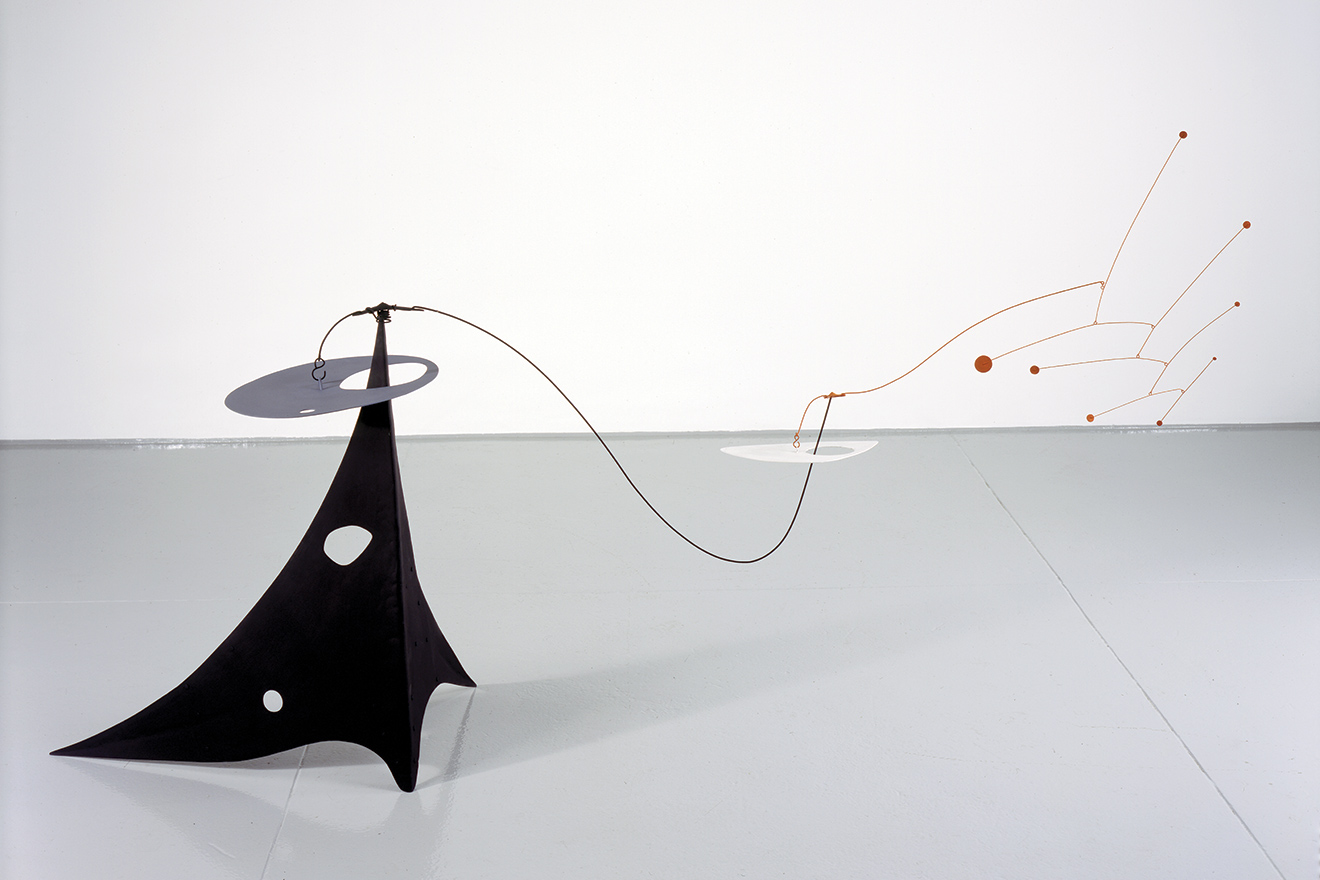
In the past 100 years, no visual artist has contributed more to the sum total of human happiness than Alexander Calder. If you think about it, this generating of happiness, to the extent to which it retains any cultural prestige these days, is seen as the domain of musicians and writers far more than of painters and sculptors; rather, since the rise of modernism, vexing the public has been the more likely mission of visual art. But if the works on view in the Whitney’s current Calder: Hypermobility exhibition, devoted to his kinetic sculptures, are among the most revolutionary of the past century, they present themselves with such grace and modesty and charm that even small children, knowing nothing of vanguardist aesthetics, respond with all the delight that Calder clearly wanted them, and us, to feel.
Calder’s ability to communicate with children was, in part, a consequence of his own famously childlike nature. At his birth, in 1898, he weighed in at 11 pounds, and for the next 78 years, his large and usually overweight frame did nothing to dispel the impression of a big baby. “Powerful but not agile, fat but not tubby,” is how a friend describes him in the first installment of Jed Perl’s new biography, Calder: The Conquest of Time, which seems well on its way to being the definitive work on the man. But it was Calder’s demeanor, even more than his corpulence, that suggested the overgrown man-child. His affinity for play was not unique among modernists—Jean Dubuffet and Joaquín Torres-García, to name only two, mined similar terrain—but Calder’s thorough absorption in it, his appearing to find nothing adorable or noteworthy about it, distinguishes him from all his contemporaries.
Stay informed.Stay ahead.
Join Washington Examiner for unlimited access to the news, analysis, and commentary that matter most.
Already a member? Log in
