

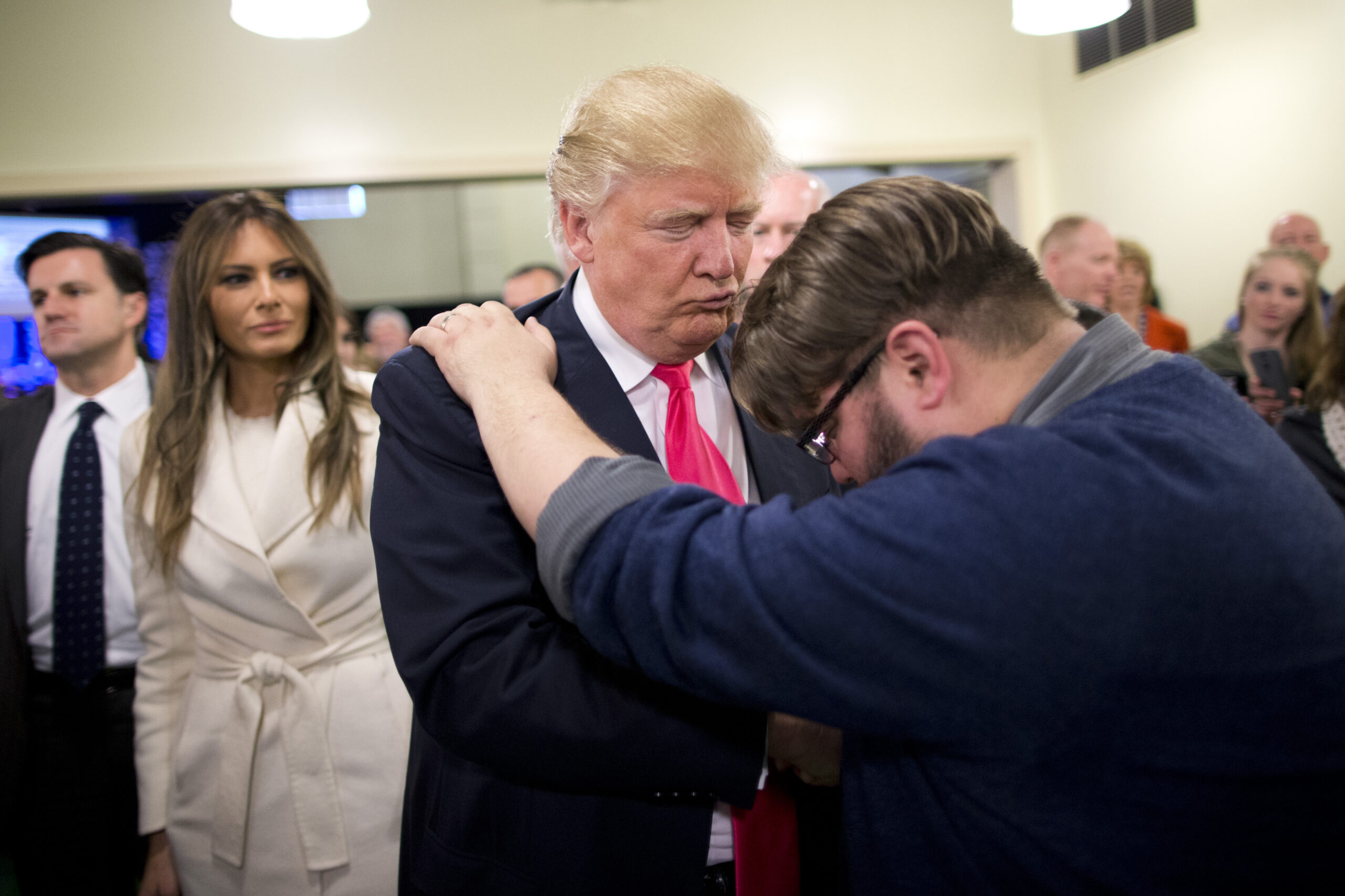
Conservative Christians haven’t been able to get to church regularly because of the social distancing requirements in place to combat the coronavirus. A key question facing Republicans in November is whether they will get to the polls.
There is little doubt that white evangelicals remain President Trump’s strongest demographic, but even among this group, turnout fluctuates. In a close election, as strategists in both parties expect 2020 to be, that can make a big difference. Republican campaign guru Karl Rove estimated that 4 million Christian conservatives stayed home in 2000, costing George W. Bush the popular vote and nearly the presidency, so they made boosting their turnout a major priority in the reelection race four years later — when 1 out of every 3 votes cast for Bush came from a white evangelical.
Recommended Stories

Last month, the organization Faith Wins held a Zoom conference call with over 750 pastors and religious community leaders from 49 of the 50 states featuring Reince Priebus, the former Republican National Committee chairman and Trump’s first White House chief of staff, aimed at mobilizing turnout through evangelical churches. The group encourages pastors to take a four-part pledge — “to vote my values;” “to register voters in my place of worship;” “to inform others who on issues that have impacted faith and families;” and “to mobilize fellow pro-faith voters to turn out and vote their values on Election Day.”
The voting registration drives are nonpartisan, as are those conducted by the conservative Faith and Freedom Coalition, the Ralph Reed-chaired organization that has pledged to register 5 million new voters this year and get 18 million to the polls. But the target audience may be even more likely to vote Trump than in 2016, when he won 81% of white evangelicals.
“Obviously, he’s won a lot of people over on the issues,” said Chad Connelly, Faith Wins’ founder and a former South Carolina Republican Party chairman.
A Northern Virginia pastor who requested anonymity to speak candidly agrees. “I still don’t like the way he talks or acts,” the pastor said. “But he has been as good on the issues as any other Republican president, maybe better.”
Four years ago, there was widespread skepticism about Trump. He had been pro-choice on abortion. His personal life was closer to Bill Clinton’s than Billy Graham’s. He had no record of social conservatism. Many religious conservatives preferred Ted Cruz in the primaries. Trump had to recruit lesser-known pastors to stand by him, though Liberty University President Jerry Falwell Jr., son of the founder of the Moral Majority, one of the first important national Christian Right groups during the Reagan years, became a prominent early supporter.
Trump has largely won them over. According to Pew Research Center, two-thirds of white evangelicals say it is important to have a president who stands up for their beliefs, and 8 in 10 say Trump has fit the bill. They believe Trump has helped rather than hurt evangelical interests by a 52-point margin. And 3 out of 4 say they mostly agree with him on the issues.
“Jesus isn’t running,” Connelly said. “By definition, we’re always voting for the lesser of two evils.”
Hispanic Protestants, especially evangelicals, are also more Republican and have helped prevent the Latino vote from becoming more heavily Democratic during the Trump years. The Trump campaign also held a virtual event this week featuring some of the black pastors who support the president, as well as retired baseball star Darryl Strawberry and senior campaign adviser Katrina Pierson.
In addition to compiling a socially conservative record, Trump has made increasing use of religious language in his speeches, especially to Christian audiences. At Thursday’s National Day of Prayer service, Trump vowed to defeat the “invisible enemy” that is the coronavirus with God’s help. “Once again, we call on our Creator to guide us through these very complex steps,” Trump said. Vice President Mike Pence, an evangelical, joined a roundtable on reopening churches and other religious services in Iowa on Friday.
Evangelicals have faced heavy criticism for their support of Trump. Conservative writer David French, an evangelical himself, argued they had abandoned their commitment to personal character and competent governance. Democratic pundit Ed Kilgore speculated in New York magazine that evangelicals liked Trump’s “hatefulness.” The New York Times published an op-ed arguing that evangelical hostility to science had crippled the country’s coronavirus response.
“People are shocked by the hostility to the president,” Connelly said. “I’ve had pastors tell me they’ve left churches over people being less rude.”
