

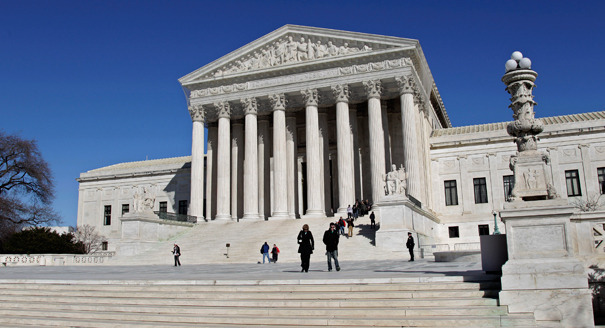
Today’s decision by the Supreme Court to hear challenges to the constitutionality of the national health care law was largely expected, but by no means inevitable. As President Obama’s health care legislation moved toward final passage, rumblings about potential legal challenges to Obamacare were dismissed by many as frivolous claims that would be laughed out of courtrooms. The mere fact that the highest court is not only taking up health care challenges by 26 states led by Florida and the National Federation of Independent Business, but granting them such a lengthy hearing, is a testament to how far we’ve come since late 2009, when opponents of the law began crafting their legal strategy.
Georgetown Law professor Randy Barnett, one of the early intellectual architects of the legal challenges to Obamacare, was encouraged by today’s announcement.
Recommended Stories


“The Supreme Court has repudiated the view that this is an easy case or frivolous claim,” Barnett, who is a lawyer for the NFIB, said in a phone interview with the Examiner. “By granting five and a half hours of oral arguments, they have definitively rejected that view. The Supreme Court does not grant five and a half hours to hear easy cases or frivolous claims.”
Barnett also noted that the Court would take up all of the major claims brought by opponents of the law. That means the justices will not only consider whether the individual mandate exceeds Congress’s power under the Commerce Clause, but also weigh the constitutionality of the provision that forces cash-strapped states to expand their costly Medicaid programs.
“It is somewhat surprising that they took that issue,” he said of the Medicaid challenge, given that all lower courts have rejected it.
Opponents of the health care law were dismayed last week when conservative Judge Laurence Silberman, of the D.C. Circuit Court, upheld the law, despite acknowledging that it would be hard to see limits to federal power if it stands.
“I think Judge Silberman’s opinion serves more as a warning than a guide as to what the Supreme Court may or may not do,” Barnett said. “A warning (that) if you uphold the mandate, the consequences are what Silberman says, there are no limits.”
Barnett chalked up Silberman’s decision* to a split among conservative legal minds about whether courts can and should identify and administer limits on federal power. One side has traditionally argued against it. But in recent decades, another class of legal scholars has pushed courts to return to the view that the founders intended to limit federal power to those specifically mentioned, or enumerated, in the constitution.
In the 1995 U.S. vs. Lopez decision, the Supreme Court’s majority ruled that the Gun-Free School Zones Act couldn’t be justified on Commerce Clause grounds, and in doing so recognized a distinction between “economic” and “non-economic” activity. That was the first decision since the New Deal to find any limits to Congress’s powers under the Commerce Clause.
Those challenging the health care law have argued that the individual mandate would be unprecedented because it regulates “inactivity.” That is, the law does not regulate individuals already engaging in commerce, but forces them to enter the stream of commerce. The Obama administration has argued, with mixed success, that health care is “unique” because virtually all individuals eventually need health care. But opponents have countered that the idea of health care being “unique” is arbitrary and not a constitutional principle that future courts could apply.
Barnett noted that three current justices (Clarence Thomas, Antonin Scalia and Anthony Kennedy) voted to limit the Commerce Clause in the Lopez decision, as well as the 2000 U.S. vs. Morrison decision, which ruled that the clause could not be used as the constitutional basis of the Violence Against Women Act.
On the other hand, both Scalia and Kennedy, in the Gonzales vs. Raich case, agreed that the federal government could use its Commerce Clause power to bar individuals from growing medical marijuana, even if state law allowed it. (Barnett argued against the government when this case came before the court.) But those challenging the health care law have said the Raich decision doesn’t apply in this case, because an individual cultivating marijuana was still engaging in some form of activity – a condition that doesn’t apply to those who simply have not purchased health insurance.
The Commerce Clause views of chief justice John Roberts and justice Sam Alito are less known, though some have pointed to their decision in U.S. vs. Comstock for clues. In that case, the Court ruled that Congress had the power to enact the Adam Walsh Protection and Safety Act, even though it was leading to indefinite civil confinement of convicted sex offenders.
Roberts signed on with the majority opinion in that case, but Barnett argued that even though he disagreed with the decision, it was relatively limited in scope, and based on five “considerations” that wouldn’t contradict any of the arguments being made by those challenging the health care law.
He also pointed out that Kennedy and Alito filed separate concurring opinions in the case that suggest both believe in setting limits on federal power.
Though legal experts will spend the coming months parsing all of the writings of the various justices for signs of where they’ll come down, the reality is that it’s hard to predict. The health care law raises a novel and unprecedented issue, something that was reinforced today when the court agreed to grant five and a half hours to hearing oral arguments.
Barnett said he did not expect to participate in oral arguments, but would continue to work on writing the NFIB’s briefs.
*Note: For more on this, check out Barnett’s blog post arguing that Silberman’s ruling shouldn’t be seen as a template for the Supreme Court.
