

• Follow reporter John Keim on Twitter for updates
• Insider emails: Get the Redskins Report
Recommended Stories


The decision wasn’t a hard one, not after what they saw on film. Michael Vick made plays with his arm. He made plays with his legs. He won games. Nor was it a hard decision based on what the Falcons knew: They needed a franchise quarterback.
So then-Atlanta coach Dan Reeves did what he had done eight years earlier in Denver to get John Elway: He shipped a bundle of picks to another team to acquire a rookie quarterback.
“There wasn’t any question in our minds that they would be great players,” Reeves said. “That makes it an easy decision. If you aren’t sure of those factors, if there’s any question about it, it would be difficult.”
Three years later, New York Giants general manager Ernie Accorsi wanted quarterback Eli Manning. Despite the presence of other top quarterbacks in that particular draft — Philip Rivers and Ben Roethlisberger — Accorsi traded multiple picks to acquire Manning, the top pick in the draft (after selecting Rivers at No. 4). Two Super Bowls later, Accorsi’s bold move looks smart.
| Trading up for QBs in the top 5 |
| Ryan Leaf |
| The deal » In 1998, San Diego traded two first-round picks, a second-round selection and three-time Pro Bowl running back/returner Eric Metcalf to Arizona, moving from third to second. |
| The verdict » Ugh. Leaf busted. The Chargers did not post a winning record for the next six seasons. |
| Michael Vick |
| The deal » In 2001, Atlanta moved from No. 5 to No. 1 by sending San Diego a third-round choice, a second-rounder in 2002 plus receiver Tim Dwight. |
| The verdict » Mixed. Vick thrilled fans in his six seasons, but the Falcons made the playoffs only twice (reaching the NFC Championship in 2004). |
| Eli Manning |
| The deal » In 2004, New York sent San Diego Philip Rivers, whom the Giants selected No. 4, plus a third-round pick in ’04 as well as a first and fifth in 2005. |
| The verdict » Success. Manning has played a huge role in two Super Bowl seasons. |
| Mark Sanchez |
| The deal » In 2009, New York sent Cleveland the 17th overall pick, a second-round choice and role players defensive end Kenyon Coleman, quarterback Brett Ratliff and safety Abram Elam. |
| The verdict » |
| Mixed. Sanchez has reached two AFC Championship games, but he has a lot to prove — as Eli Manning once did. – John Keim |
“If you ever get the chance to get the great quarterback, go get him,” Accorsi recently told ESPN Radio. “There’s a tremendous risk, but if you’re right I don’t think there’s a price that is too high. If … it turns out to be a bust it sets you back five, six, seven years.”
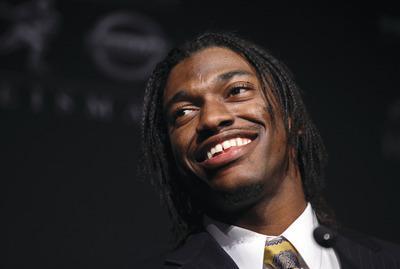
This is what the Redskins are facing after sending four picks to St. Louis on Friday night — the No. 6 overall, a second-rounder and first-round picks in 2013 and 2014 — in exchange for the second overall pick in April. They’re now in position to select Baylor’s Heisman Trophy winning quarterback Robert Griffin III.
Former scout and current draft analyst, Russ Lande of GM Jr. and the Sporting News, rates Griffin as his top quarterback in the draft — ahead of Stanford’s Andrew Luck.
“I understand Luck is probably more prepared to be in a traditional offense because he’s played in one,” Lande said, “and anybody who hasn’t played in a traditional offense [like Griffin], there will be an adjustment period, no question. But I’m betting on how he’ll be in five years.”
Another scout said, “This guy has a chance to be a special franchise QB.”
One AFC front office executive said Griffin’s mobility makes him a good choice in Redskins coach Mike Shanahan’s offense, which helped John Elway win a Super Bowl. Reeves agreed. In a stretch zone system, among other things, a mobile quarterback freezes the backside end’s pursuit with the threat of a bootleg. Reeves saw that with Elway, particularly under Shanahan.
“[His mobility] sets up with the run game so well,” Reeves said. “It was so difficult to defend the run game with the ability [Elway] had to get outside the pocket [on bootlegs].”
Reeves’ rationale for wanting Vick and Elway apply to Griffin. He can hurt teams in multiple ways because of his speed. The Falcons could have selected Drew Brees, but they felt he would struggle behind their weaker line.
“In both cases I felt like they would make us better because of their ability to make plays outside the pocket,” Reeves said. “It would make us better quicker. Both guys had the unbelievable ability to make people account for them. That opens the passing game more.
“It makes your offensive line better. … [Defenders] want to stay in their lanes because they can hurt you so bad when they get out of the pocket making big plays. Those guys created a lot of problems. I see similarities in Griffin with Mike and John, and this Griffin kid can throw the heck out of it, too.”
Denver traded its first-round choice — it had selected tackle Chris Hinton fourth overall — quarterback Mark Herrmann and its first pick in 1984 to get Elway, whom the Colts selected first overall. The Falcons shipped the fifth overall pick, their third-rounder, a second-rounder in 2002 and receiver Tim Dwight to San Diego for the top choice.
New York traded its first pick (fourth overall) and a third-rounder in 2004 plus a first and fifth in 2005. Washington also paid a steep price.
“It’s the price you’ve gotta pay if you want a young quarterback that has a chance to be your franchise quarterback,” said former Chicago director of college scouting Greg Gabriel, who was with the Bears when they traded for Jay Cutler. “I thought New York probably overpaid, but … you get two world championships with that guy playing quarterback [and] it’s a great trade.”
