
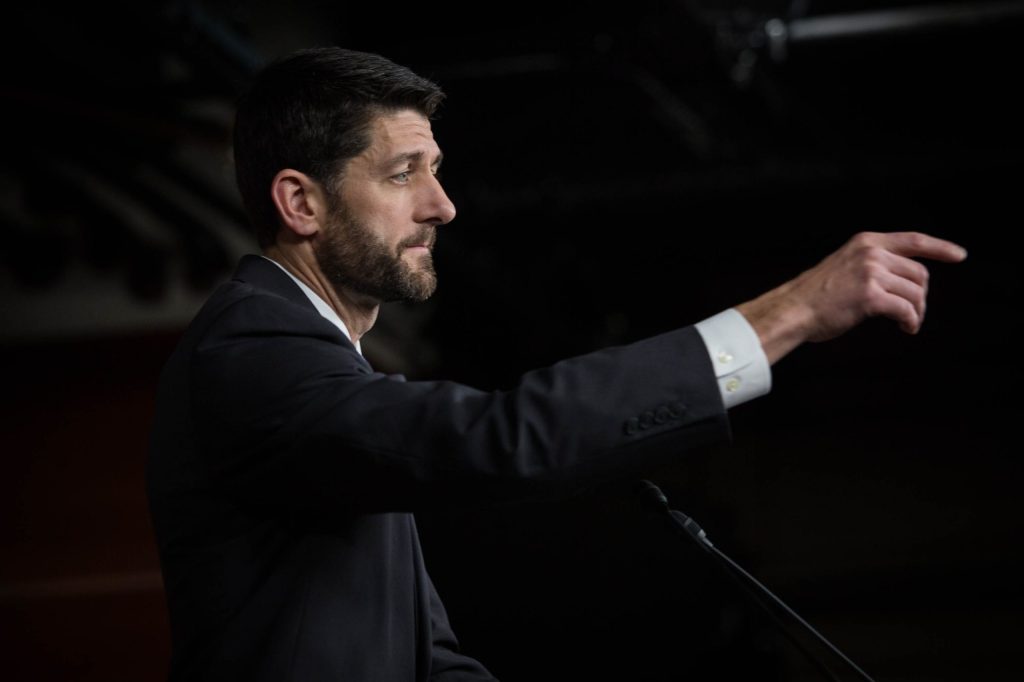
House Speaker Paul Ryan said Friday he plans to reduce the power of the speakership and disperse authority to rank-and-file lawmakers, who have for years clamored for a greater say in legislation and policy decisions.
Ryan, in a wide-ranging interview with reporters about his first seven weeks as speaker, said lawmakers in 2016 will play a much bigger role in deciding legislative language, amendments and determining whether or not a bill passes, even if it means letting measures fail on the House floor.
Recommended Stories
The approach would abandon the historically top-down management style practiced for decades by House speakers in both parties.
“I’m actually trying to decentralize power,” Ryan, a Wisconsin Republican, said in his office as the House prepared to gavel to a close for the year. “I’m trying to give up power from this job.”
Ryan said he was elected speaker after promising members he would use a ground-up approach to governing.
He said lawmakers, not the GOP leadership, will write the legislation and amendments beginning in 2016. Some of the time, Ryan said, legislation will be defeated on the House floor, which in the past has been considered a mark of GOP leadership failure.
“I expect a bill, or bills, to come up and fail,” Ryan said. “What this place always used to do is try to predetermine everything, down to the amendment, and I just don’t think the speaker’s office should have that kind of power. I think that is should be decentralized and pushed out to the membership.”
House lawmakers will also participate in listening sessions about a potential bill authorizing the president to use military force (AUMF) against the Islamic State, Ryan said.
While Ryan did not promise specific legislation, he said House Foreign Affairs Committee Chairman Ed Royce, R-Calif., will oversee the sessions with lawmakers to see where they stand and whether the House should take up an authorization bill.
Republicans have rejected an authorization plan sent from President Obama in February, saying it would limit his ability to defeat the Islamic State.
“I think it would be a good symbol of American resolve to have a new AUMF to go after ISIS, to truly defeat and destroy ISIS,” Ryan said. “But we will not pass an AUMF that is designed to tie the hands of the next president.”
Ryan on Friday presided over passage of a $1.1 trillion spending bill that garnered considerable conservative criticism because it left out key GOP policy riders. But it nonetheless won 150 Republican votes, far more than past omnibus spending packages that were steered by Ryan’s predecessor, John Boehner.
Ryan credited listening sessions and other steps he took to include Republican lawmakers in the process that were missing under Boehner, who resigned on October 30.
“Since we restored that fairness to the process and I’ve done everything I said I was going to do, people are relieved,” Ryan said. “They now realize the outcome doesn’t have to be perfect and it may not be everything they want but I think people are turning over a new leaf. I think people see it’s a culture change.”
Boehner’s unexpected retirement announcement in September, Ryan said, “threw the place into a bit of chaos” that left members worried Congress would “seize up and come to a screeching halt.”
Ryan said he spent the last seven weeks restoring normalcy and getting lawmakers involved in areas where they felt sidelined.
“What we tried to do was put the train back on the tracks,” Ryan said, “Restore a more open process, a more open process and more deliberative process.”
Ryan pointed to the passage of major bipartisan legislation during the past seven weeks, including the spending and tax package, a bill rewriting the “No Child Left Behind” law and a multi-year measure authorizing federal funding for transportation projects, as big successes.
“We have more work to do for sure, but I’m very happy with how the last seven weeks have gone,” Ryan said.
Ryan, the former Republican vice presidential nominee, said he wants to play a unifying role for the party in 2016. He acknowledged voters are anxious and the party is divided between traditional Republicans and outsider candidates including Donald Trump, who is leading in the GOP polls.
“The core of the conservative movement is yearning to be unified around a bold, conservative, specific agenda,” Ryan said. “And that is what I’m going to do. My goal is to help unify the conservative movement so we can unify the Republican party and we can give the country a clear choice, so that the citizens of this nation can choose in 2016 what kind of country they want to have in the 21st century.”