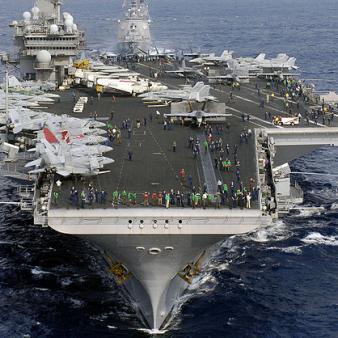
As he showed in the final presidential debate, President Obama’s understanding of the U.S. Navy—or for that matter, any navy—is suboptimal. His explanation about Navy carriers “where planes land on them,” and “ships that go underwater, nuclear submarines,” left out the largest single group of naval combatants: surface ships. The omission is important because of surface ships’ ability to defend against ballistic missiles and their pivotal role in protecting carriers and submarines. Surface ships also carry the weight of visiting foreign ports, showing the flag, and establishing and maintaining cooperative relationships with other navies around the world. These tasks have in common the goal of reassuring allies, making new friends, and ultimately preserving an international order favorable to the self-governance and classically liberal principles for which the U.S. stands. The same tasks are all conducted during peace and deliberately aimed at preserving it.
This is hardly news. The godfather of American naval strategic thought, Admiral Alfred Thayer Mahan, wrote in 1890 that “the workings” of the “power of the sea” are “more silent than the clash of arms.” He meant that a powerful navy’s unseen influence was at least as important in preserving peace as it was in the more dramatic job of winning a war.