

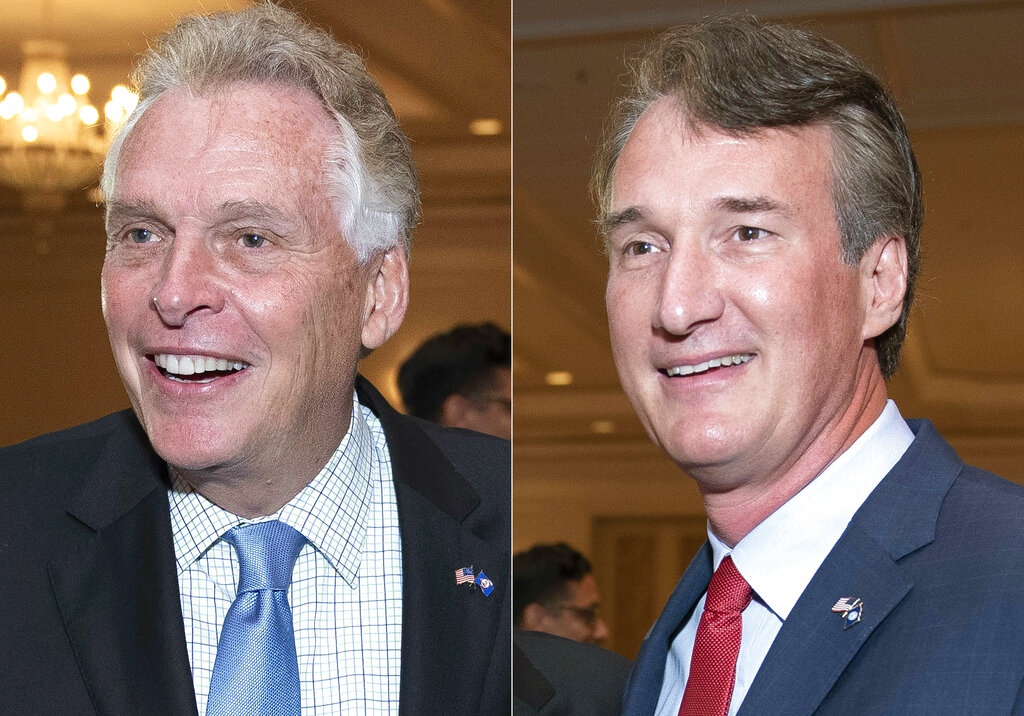
A Democratic effort to tie Republican gubernatorial candidate Glenn Youngkin to former President Donald Trump in the Virginia governor’s race has fallen flat, with Youngkin’s victory buoyed by a fight over education in schools and leaving in question the former president’s ability to act as a foil to Democratic voters.
Trump “has taught Republicans how to win,” said Republican political strategist Shaun Kenney. “I think it would be difficult to imagine four or five years ago the sort of citizen uprising we’re seeing in Loudoun County without Donald Trump.”
Recommended Stories


Kenney, a former executive director of the Virginia GOP, said Trump’s impact on the race “isn’t so much you like him or love him, but that Republicans no longer feel afraid to fight against monoliths such as public education which were once feared in Virginia politics and is the issue that is going to get Youngkin over the top.”
BIDEN FACES DOUBTS ABOUT HIS ABILITY TO LEAD DEMOCRATS TO VICTORY AS VOTER PESSIMISM SETS IN
Youngkin made a final appeal to the voters of Loudoun on the day before the election Monday, testing the success of his message on the role of parents in shaping the public education of their children, an idea that came to dominate the race. Pitting Republicans and Democrats against each other and putting parents at the fore, the issue will likely feature prominently in next year’s midterm elections.
Trump, who endorsed Youngkin early in the race, on Monday touted the Virginia Republican as a “fantastic guy” during a virtual telerally, telling supporters to “get out and vote” and affirming that the two “get along very well together and strongly believe in many of the same policies.”
For his part, Youngkin has sought to keep his distance from the former president, holding him at arm’s length throughout the campaign.
Youngkin was not at the rally, though McAuliffe claimed he was.
It was the latest instance of the Democratic governor seeking to tie Youngkin to Trump, a tactic of diminishing returns now that the former president is no longer in office.
Counting down the final hours of the race, McAuliffe said that far from providing a boost, Democratic voters’ “fatigue and exhaustion from Trump” had been an issue for Democrats in the race. “People are still motivated,” McAuliffe told CNN, but “from a political perspective,” he said he wished the former president was still on Twitter.
Whether this would have shifted the dynamic of the race isn’t clear.
McAuliffe’s effort to nationalize the race, hitching his opponent to Trump, tapping into culture war fights over classroom pedagogy, and attempting to stir voter enthusiasm by campaigning alongside prominent Democrats, may have done little to shift the outcome.
“With Trump out of office, I don’t think he is the foil for Democrats that he had been previously,” said Mark Rozell, dean of George Mason University’s Schar School of Policy and Government. “Democrats will need to give a positive reason for people to vote for them.”
Rozell suggested McAuliffe may have spent too much time blasting the former president and attempting to link him to Youngkin. Instead, the Democrat “needed to say more about his past record as a governor, what he achieved, and what he will do with a second shot at the office.”
By contrast, Youngkin, a political newcomer, waged a campaign focused on kitchen table issues, including education, taxes, and the economy.
“Voters looked at Youngkin and did not see Trump,” Rozell added.
Education emerged as a defining issue — just not in the way McAuliffe may have hoped.
A retort during a televised debate became fodder for Republican ads when McAuliffe asserted, “I don’t think parents should be telling schools what they should teach.”
The issue came up in pre-Election Day surveys and was raised again and again in exit polls.
Rozell said that the momentum in the race’s final weeks overwhelmingly shifted Republican, mainly due to McAuliffe’s remarks on education.
“It was a turning point,” he said. “If you take the comment literally, it sounds like he is saying parents have no role.”
The former Democratic governor attempted to capture an education wave of his own, charging that Youngkin wanted to ban books and handing out copies of Toni Morrison’s Beloved in rebuke to a Youngkin campaign advertisement about parents weighing in on classroom curricula.
The Democrat never overcame it, Rozell said. “It became a Youngkin advantage issue,” sealed by “one sentence by Terry McAuliffe in the last debate.”
Biden’s 10 percentage point victory against Trump in Virginia last year may have given Democrats a false sense of security, Rozell added.
“He is underwater in Virginia now,” he said, noting that much of the vote last year “was anti-Trump.”
That’s one reason why this race “probably was always more competitive from the beginning than people thought,” Rozell said. “You know, Virginia is not a D+10 state.”
To stir supporters, Democrats drew comparisons between a Youngkin-led Virginia to states such as Texas, where Democrats have protested a law that has sharply curtailed abortions.
Vice President Kamala Harris riffed on the issue during a campaign event with McAuliffe last month, picking out a sign from the crowd and reading it aloud.
“That’s right. ‘Don’t Texas Virginia,’” she said.
McAuliffe even charged that Youngkin “wants to ban abortion.”
In addition to Harris, former President Barack Obama, Atlanta Mayor Keisha Lance Bottoms, and former Georgia gubernatorial nominee Stacey Abrams sought to boost turnout for McAuliffe in the race, as did Biden.
CLICK HERE TO READ MORE FROM THE WASHINGTON EXAMINER
The slew of Democratic heavy-hitters did little to counter Virginia voters’ social and economic concerns and the collapse of Democratic inroads in the state.
“With gasoline $4 a gallon, Trump was a lot better than Biden,” said Kenney.
