

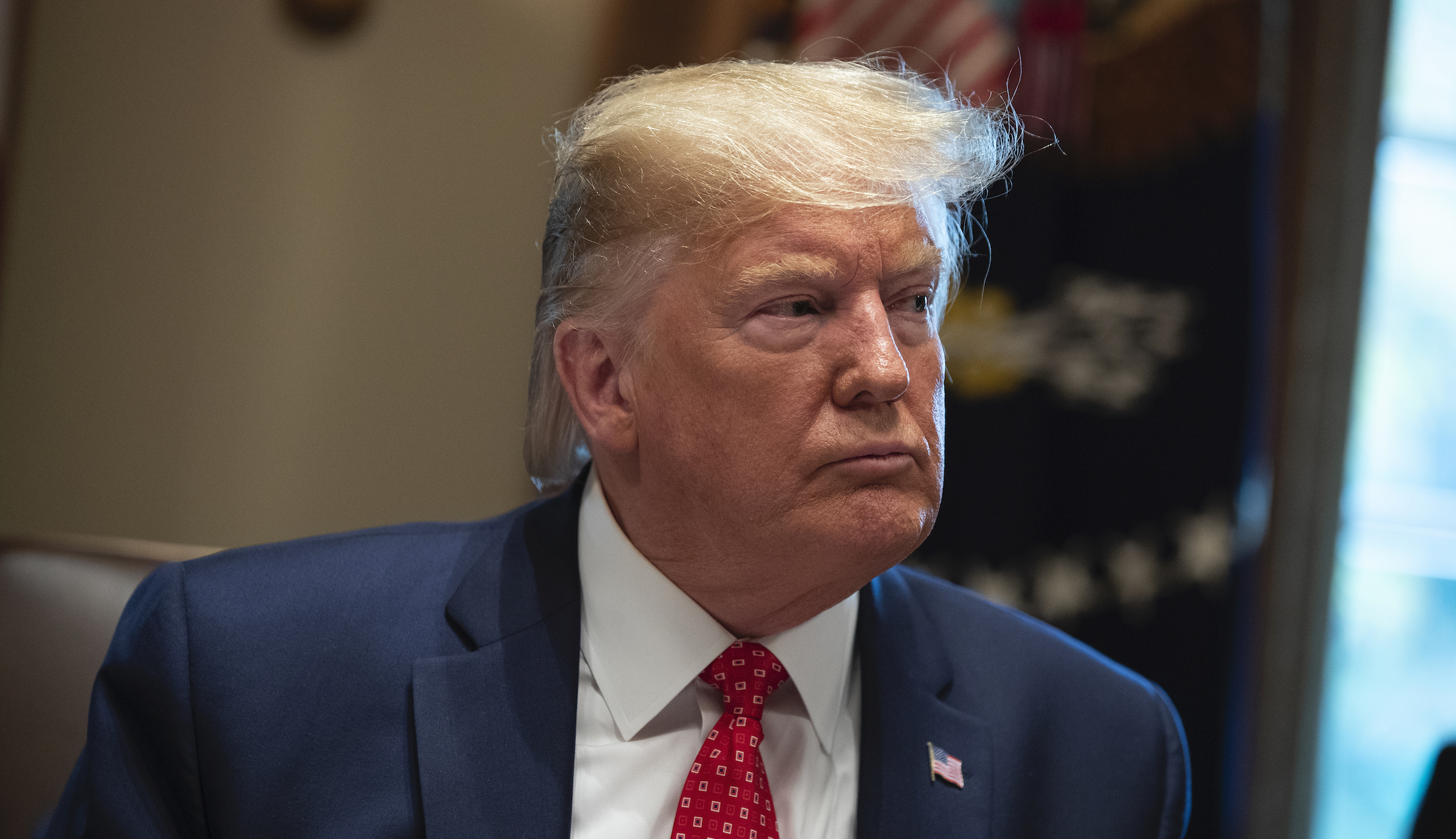
After saying they could not accept a quid pro quo, House Republicans say it no longer matters if President Trump tied $400 million in military aid earmarked for Ukraine to Kyiv agreeing to investigate Democratic rival Joe Biden.
The evolving Republican position on impeachment comes as key witnesses testify publicly about allegations Trump abused his power in dealings with Ukraine, with some government officials lending credibility to accusations by House Democrats that the president demanded a quid pro quo of Kyiv. When the claims first surfaced in a whistleblower complaint, Republicans said that, if true, they might be forced to consider impeaching Trump.
Recommended Stories


That’s off.
Republicans now say proof that Trump conditioned military aid to Ukraine to an investigation of Biden, a top 2020 contender, his son Hunter, and the Democratic Party would not shake their opposition to impeachment. The money was released without such a deal, and, Republicans emphasize, federal law gives presidents broad discretion to withhold foreign aid.
“Asking people to do something in order to get the foreign aid, that’s a relatively common occurrence with all of our foreign aid. You could say all of our foreign aid is quid pro quo,” Texas Rep. Mike Conaway, a Republican member of the House Intelligence Committee, told the Washington Examiner on Tuesday.
Rep. Tom Cole confirmed that his colleagues are not concerned about the existence of a quid pro quo the way they were in late September, when the lone piece of evidence was the summary transcript of a telephone call between Trump and Ukrainian President Volodymyr Zelensky made public by the White House. “It doesn’t matter much anymore,” the Oklahoma Republican said.
In the transcript, Trump appeared to ask Zelensky to investigate Democrats, including Biden and his son Hunter, a highly paid board member of a Ukrainian gas company during his father’s tenure as vice president. Trump also appeared to ask Zelensky to investigate an alleged plot to defeat then-GOP nominee Trump in 2016 that some Republicans claim was hatched by Ukrainian and Democratic officials.
Trump adamantly rejects the allegations, saying there was no quid pro quo. Republicans have generally agreed.
“Is there anything about their conversation that merits throwing out the votes of 63 million people? That’s the bottom line,” Rep. Mario Diaz-Balart, a Florida Republican, said.
But should incontrovertible evidence to the contrary emerge, possibly as early as Wednesday, when U.S. Ambassador to the European Union Gordon Sondland testifies, the president is unlikely to lose much support on Capitol Hill, if any. A House Republican estimated that, even in the presence of a clear and unmistakable “smoking gun” implicating Trump in a quid pro quo, there are maybe 10 GOP congressmen that would consider impeachment.
“Even if the Democrats’ fact pattern that they’ve laid out turns out to be 100% correct, it does not matter,” a second House Republican said, requesting anonymity to speak candidly. “The law permits the president to withhold money.”
House Republicans are charging Democrats with abandoning the bipartisan impeachment process embraced by the GOP in 1998, with President Bill Clinton, and in the early 1970s, when Democrats initiated proceedings against President Richard Nixon. This unfairness, Republicans say, has unified their party against impeachment.
And the Republican message has clearly shifted as more information has been uncovered.
Highlighting federal law, which gives presidents discretion over the release of foreign aid, is a new House GOP talking point. Senior Republican House aides and party strategists say it is a part of a transformation in messaging that is likely to end with Trump’s congressional allies conceding that there was a quid pro quo but asserting it was not wrong, let alone an impeachable offense.
A House GOP aide described the change in messaging this way: “It has gone from ‘There is no quid pro quo’ to ‘There’s a quid and a quo but not a pro’ to ‘Even if there was a quid pro quo, it’s not that bad, this is just how things are done — you can say it’s bad, but it’s not impeachable.”
