

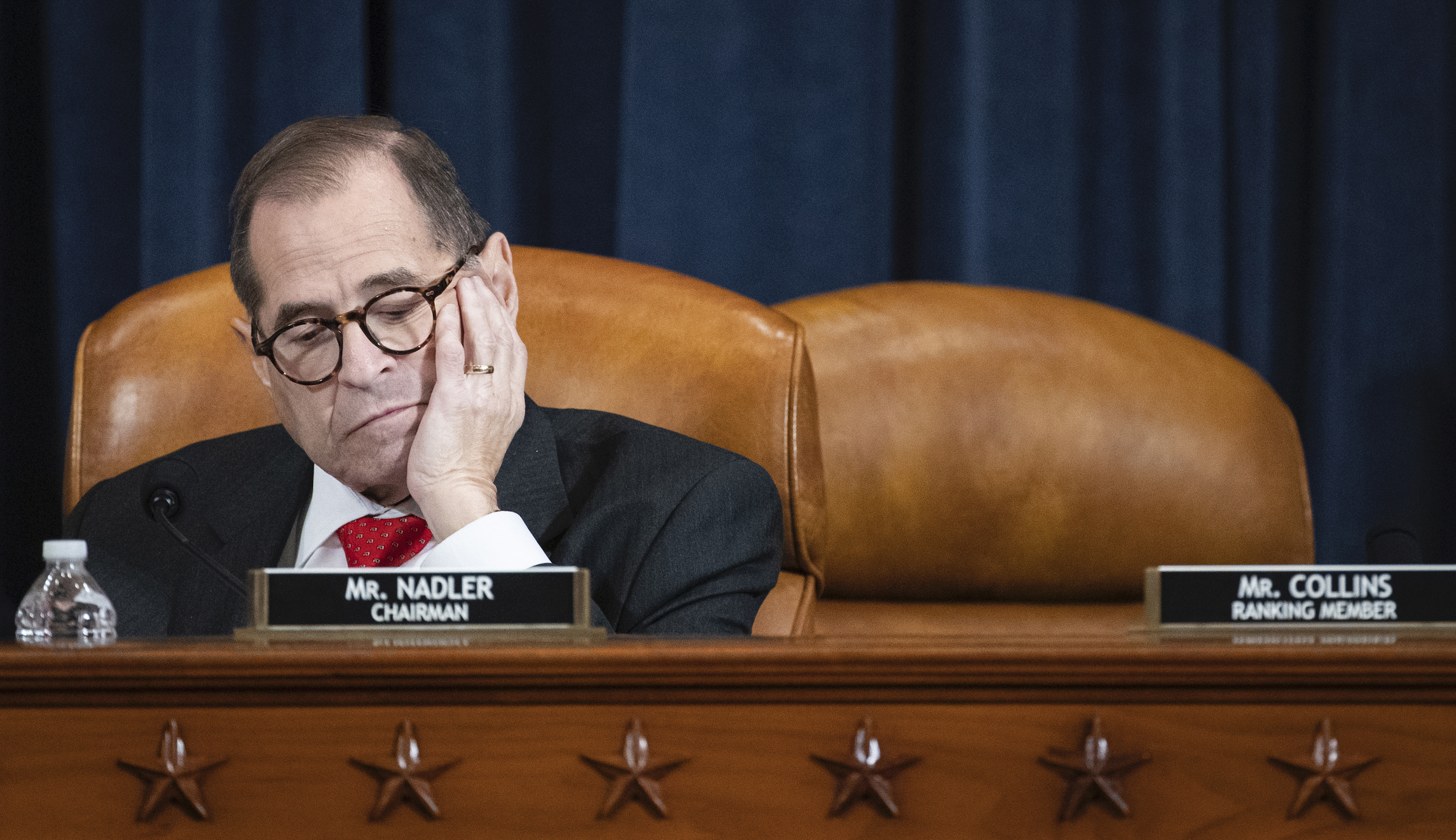
Congressional Republicans see Democratic desperation on impeachment, arguing that summoning constitutional scholars to the House Judiciary Committee reveals fear that the case against President Trump could crumble.
Four law professors are slated to testify on Capitol Hill on Wednesday, ostensibly to provide constitutional justification for Trump’s impeachment on grounds he abused his power in dealings with Ukraine. Republicans contend Democrats would have immediately called fact witnesses who could bolster the allegations against the president if impeachment was on firm ground politically.
Recommended Stories


“They’re having a problem,” Rep. Doug Collins of Georgia, the top Republican on the House Judiciary Committee, told reporters. Wednesday’s hearing, the congressman said, “is simply just a filler because Jerry Nadler didn’t know what else to do.” Nadler, a New York Democrat, is chairman of the committee.
“I don’t see the value of having [four] law professors versus one,” said Republican Lindsey Graham of South Carolina, chairman of the Senate Judiciary Committee. “It seems to me that they’re trying to make the case that under the constitutional standard, this fits.”
With the House Democratic report, which presents detailed allegations against Trump, on impeachment now public, congressional Democrats and party operatives dismissed Republican claims of their desperation.
In interviews, they said the rationale for pursuing impeachment was stronger than when it was first revealed in September that Trump asked Ukrainian President Volodymyr Zelensky to investigate political rival Joe Biden in what Democrats charge was a quid pro quo for $400 million in military aid from the United States.
Pointing to information uncovered during the investigation, overseen by House Intelligence Committee Chairman Adam Schiff of California, Democrats waved off risks of a political backlash should voters determine that impeachment was too extreme a response to the president’s actions.
Rep. Elaine Luria, a freshman Democrat from a Virginia House district carried by Trump in 2016, said she feels “much more convinced” now about the need to pursue the impeachment of the president than when she first decided to support the process in late September. Luria credited “all of the facts that transpired” during the intelligence panel’s impeachment hearings last month for “reconfirming” her resolve.
With the shift to the House Judiciary Committee, responsible for drawing up articles of impeachment, Democrats said calling constitutional scholars to testify first is a necessary step.
“We want to educate the American people on what the framers intended the standards of impeachment to be,” said Rep. Ted Lieu, a California Democrat assigned to the panel. “The Intelligence Committee did the fact-finding, the Judiciary Committee is going to apply the law to the facts.”
The lineup of educators includes law professors Noah Feldman of Harvard, Pamela Karlan of Stanford, and Michael Gerhardt of the University of North Carolina. All three are expected to offer a constitutional pretext for the case Democrats are making for impeachment. The Trump campaign issued a press release with information suggesting partisan Democrats oppose the president.
A fourth witness, George Washington University Law School professor Jonathan Turley, said he believes the case for impeachment could be made if Democrats take more time and call more witnesses.
But their political affiliations could be less problematic than their professional expertise, said Lara Brown, director of the Graduate School of Political Management at George Washington University. Brown, a historian who studies American government, said political scientists would be more effective at making the case for impeachment to voters than will constitutional lawyers.
“Too often, people who are trained as attorneys … frame things, and view controversies within the framework: ‘Is it a crime?’” she said. “But the framers had a more expansive understanding of what the oath of office held the occupant to — that there was a moral standard.”
