
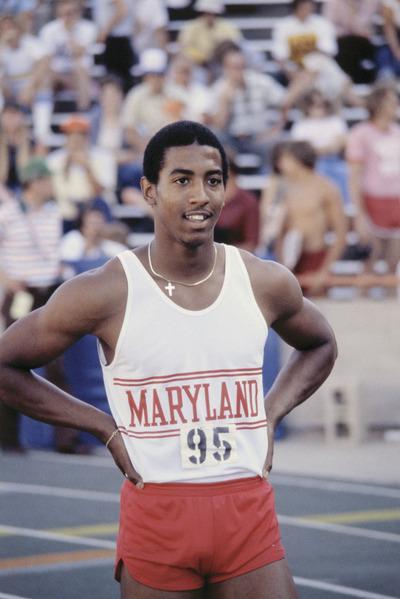
There was a time when Maryland basketball — the rulers of the Maryland sports roost — were trying to convince high school basketball star Ralph Sampson to come to College Park. So who did the school call on to show Sampson the campus? A football star? Another basketball player?
No. They had a track athlete show Ralph Sampson around campus.
Recommended Stories
Granted, that athlete was the great Renaldo Nehemiah.
“I remember thinking, ‘Wow, here I am representing the school trying to lure the best player in the country here,’?” Nehemiah said. “I was a track guy recruiting Ralph Sampson.”
It was a measure of the status of men’s track and field during that era.
That status disappeared years ago, and now it appears the sport may as well.
A school committee has named men’s track and field among the sports on the chopping block to reduce a $3.5 million athletic department deficit.
The final decision will be made by school president Wallace Loh.
Which could mean years from now, when young kids come to College Park and hear that the school used to have a track team that won 26 indoor and outdoors ACC championships (from 1956 to through 1979 it won the ACC championship every season), they will wonder how something so great could no longer exist.
Dreams, the answer will be. Big dreams for Maryland sports that have turned into a nightmare for the Terrapins athletic program.
“They are paying the consequences of being overzealous,” Nehemiah said. “We are not Penn State or Alabama. Some of the aggressive upgrades on campus look great to recruits, but they couldn’t sustain it with performance, and now they are just hemorrhaging money.
“We should know who we are,” Nehemiah said.
And for years, Maryland was a track and field powerhouse, a cornerstone program at the school. Nehemiah, who as a hurdler won three NCAA titles at Maryland during his time there in the late 1970s under Hall of Fame coach Frank Costello, emerged as the country’s top track star. He was denied his chance to compete in the 1980 Olympics in Moscow because of the boycott. He went on to play in the NFL for the San Francisco 49ers.
The program began to decline in the 1980s and took a big step backward in the 1990s.
“It was not fully funded, and it saddened me to see it struggling,” Nehemiah said. “Now, in the aftermath of the financial crisis, it was only a matter of time before it would be one of the programs up for elimination.”
If track and field is cut, is it gone for good?
“Hopefully at some point we will recover,” Nehemiah said. “I hope it is not the end for track and field at the University of Maryland, the end of a program with such a storied past and rich tradition.”
Examiner columnist Thom Loverro is the co-host of “The Sports Fix” from noon to 2 p.m. Monday through Friday on ESPN980 and espn980.com. Contact him at tloverro@washingtonexaminer.com.