
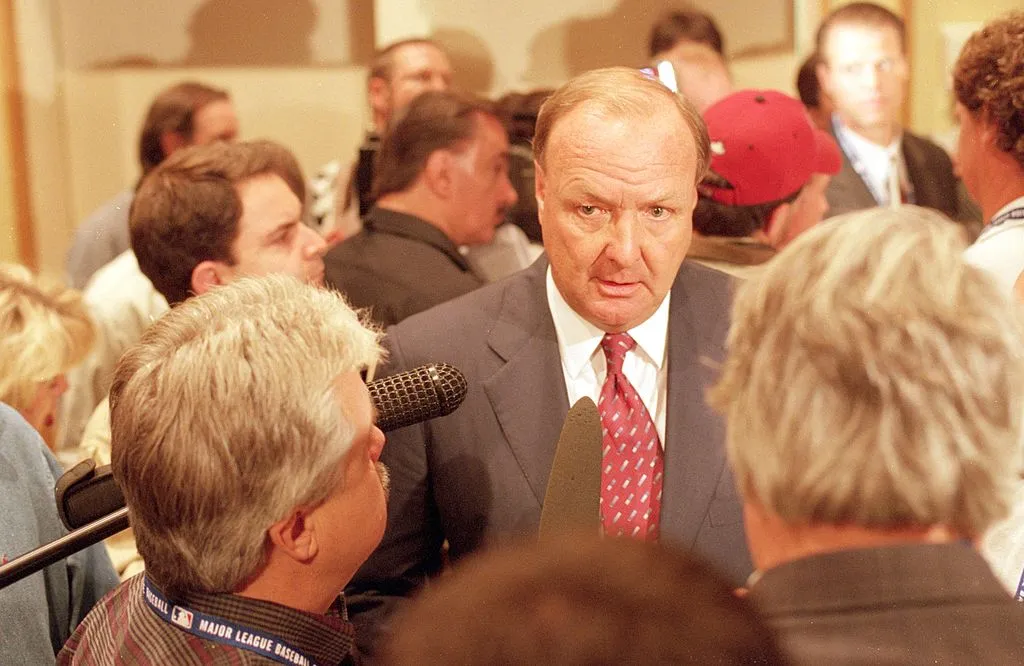
Few sports owners are forever attached to one player — and one contract — the way Tom Hicks was to Alex Rodriguez. In December 2000, at baseball’s winter meetings in Dallas, the Texas Rangers owner handed the 25-year-old shortstop a 10-year, $252 million deal that shattered every record in professional sports. The price tag was so staggering that it actually exceeded, by $2 million, what Hicks had paid just 30 months earlier for the entire franchise itself. Rodriguez rewarded his faith with three straight American League home-run titles and a 2003 MVP trophy, but the Rangers never finished higher than third during Rodriguez’s time with the team.
When Hicks’s empire collapsed a decade later, and the team went to bankruptcy auction in court, the largest unsecured creditor turned out to be… Rodriguez, still waiting on deferred money. No signature in sports history has ever clung to its signer quite so stubbornly, or so publicly.
Real journalism.Trusted by millions.
Unlimited access to in-depth reporting, expert analysis, and the stories that shape our country.
Already a member? Log in
Thomas Ollis Hicks was born on Feb. 7, 1946, in the oil refinery town of Port Arthur, Texas. A teenage disc jockey with a quick laugh and quicker timing, he worked his way through the University of Texas on a scholarship, graduated with an accounting degree, and then earned an MBA at the University of Southern California. The 1980s leveraged-buyout boom found him perfectly cast: brash, tireless, and unafraid of debt. In 1984, he cofounded Hicks & Haas; five years later, the firm morphed into Hicks, Muse, Tate & Furst, one of the decade’s most feared private-equity predators. Hicks’s specialty was the “buy-and-build” roll-up, most spectacularly in soft drinks, where he stitched together dozens of regional Dr Pepper and 7Up bottlers into a colossus that eventually sold pieces for billions. By the late 1990s, he was a certified Dallas billionaire with a private Gulfstream, a mansion on Strait Lane, and an itch for louder applause than any closing dinner could provide.
Sports delivered the roar he craved. In December 1995, he bought the Dallas Stars — then just two years removed from Minnesota and fresh off a last-place finish — for $82 million. Hicks attacked hockey the way he attacked bottlers: spend heavily, upgrade everything, and dare the market to keep up. He lured Brett Hull with a then-shocking free-agent contract in 1998, pushed through the $420 million American Airlines Center that still anchors downtown Dallas, and watched his team seize seven division titles, two Presidents’ Trophies, and, in June 1999, the Stanley Cup. Hull’s triple-overtime, toe-in-the-crease goal against Buffalo remains the signature moment of Sun Belt hockey; Hicks hoisting the Cup on the ice in victory green is the image many Dallas fans still carry. The Stars returned to the final in 2000 and, even after the championship glow dimmed, remained perennial contenders for the rest of his ownership.
Baseball seduced him next. In 1998, he led the group that bought the Rangers from then-Texas Gov. George W. Bush. The honeymoon was sweet, with 95 wins and a division title in 1999, but the Rodriguez contract blew the payroll into the stratosphere and the supporting cast into the bargain bin. Four straight last-place finishes followed. Hicks eventually slashed spending to the bone and traded Rodriguez to the New York Yankees after his agreed-upon trade to the Boston Red Sox for Manny Ramirez was voided (As a Red Sox fan, to this day I still thank God and the MLB Players Union for blocking that trade!). In a bittersweet turn for Hicks, the Rangers reached their first World Series the very season after he was compelled to surrender the team in a 2010 bankruptcy sale.
Hicks’s reach extended to England, where a 2007 joint purchase of Liverpool Football Club with George Gillett turned toxic almost immediately. Broken promises about a new stadium, mounting debt, and fan protests that included burning U.S. flags outside Anfield ended with another forced sale in 2010. “I clearly failed to connect with the supporters,” he admitted years later in a rare moment of public contrition.
OBITUARY: PAUL TAGLIABUE, 1940-2025
Dallas never turned on him the way Liverpool did. He helped fund the dazzling Santiago Calatrava-designed Margaret Hunt Hill Bridge, donated land for an elementary school that bears his name, and left the city an arena that transformed its skyline. A UT regent from 1994 to 1999, an Army Reserve paratrooper in his youth, and during President Donald Trump’s first administration, a commissioner of the American Battle Monuments Commission, Hicks was a fixture in conservative power circles. His eldest son, Thomas O. Hicks Jr., cochaired the Republican National Committee finance committee. When news of his death broke this past week, the president’s son, Donald Trump Jr., posted on X: “Tom Hicks Sr. was a great American, an incredible businessman, and a great guy. He will be truly missed.”
Hicks spent a lifetime swinging for fences others wouldn’t approach. As he once grinned about the Rodriguez deal, “Hell, if you’re going to dream, dream big — why stop at a home run when you can shoot for the stars?” He missed as often as he connected, but no one ever had to ask whether the man in the owner’s box was awake. He was all in, every pitch, every period, every bloody pound sterling.
Daniel Ross Goodman is a Washington Examiner contributing writer and the Allen and Joan Bildner Visiting Scholar at Rutgers University. Find him on X @DanRossGoodman.