
Is a Korean reality show the last honest sport?

The beauty of Physical: Asia, a televised sporting event-cum-reality show that originated in Korea before spinning off to this international franchise, is that it cannot be gamed. Most sports today, after all, are all about the numbers. You can see it in the way people watch sports now, eyes on their second screens, checking lines and prop bets while the actual game unfolds somewhere in their peripheral vision. Everything’s got an angle. Gamblers and number-crunchers run the show. But Physical: Asia keeps bringing back the old ways.

This season’s premise was simple: 48 athletes from eight nations compete in challenges they cannot prepare for, testing strength and endurance in combinations that change every episode. There’s no meta to learn and no film to study, no way to game the system through analytics departments or roster optimization. South Korea, Japan, Thailand, Mongolia, Indonesia, Turkey, Australia, and the Philippines each sent six-person squads to fight for national pride and one billion units of Korea’s currency, the won, worth some $680,000. The challenges ranged from king-of-the-mountain brawls on shifting sand dunes to hauling cargo from a sinking ship to dragging iron balls while tethered at the waist. In each event, these elite sportsmen either had it or they didn’t.

Physical: Asia ranked in Netflix’s global top 10 for non-English TV and recorded 3.6 million views in a single week. The franchise shows no sign of slowing, with a U.S. spin-off already announced that hopefully won’t dilute the product overmuch by deluging us with brainless jock cliches intermingled with WNBA-style girlboss rhetoric. The appeal must stay the same: no shortcuts, no way to buy your way to the top, no meta to memorize. Each challenge arrives fresh. All you can do is be strong, be fast, be tough, be willing to suffer, and hope that’s enough.

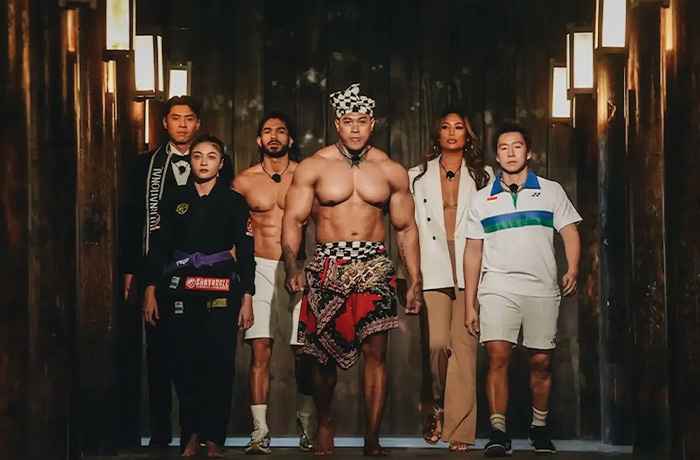
Team Indonesia in Netflix’s Physical: Asia. (Courtesy of Netflix)
Team Indonesia in Netflix’s “Physical: Asia.” (Courtesy of Netflix)

The formula worked 40 years ago when World’s Strongest Man saw British shotputter Geoff Capes and American arm wrestler and pig farmer Cleve Dean hauling refrigerators across U.S. television screens. It works today in Seoul, staged across sand and steel, watched by millions who recognize authentic competition when they see it. American sports gave that up somewhere along the way, trading purity for gambling revenue and analytics and whatever culture-war ideology seemed fashionable enough to slap on center court that week. The Koreans kept it. The view from there looks better than anything we’ve got.

The team format added dimensions that the previous 100-person individual competition lacked. Each squad carried four men and two women, and the challenges rewarded teams that deployed members according to capability rather than ideology. Choi Seung-yeon, Korea’s top female CrossFit athlete, contributed an insane amount of endurance that let stronger teammates deploy power in shorter bursts. Japan fielded Nonoka Ozaki, a freestyle wrestler who took bronze at the 2024 Paris Olympics. She handled herself like a champ against other women and small men in the king-of-the-mountain scraps. Mongolia sent the hulking Adiyasuren Amarsaikhan, a female judoka who won silver at the Asian Judo Championships and was the first woman to beat the male competitors on Physical: Asia straight-up during the pillar hold event. These women were specialists whose skills sometimes solved problems that the men could not, which made them worth watching in ways the WNBA, with its insistence that women play the same game as men at inferior speed and explosiveness, never manages.

Mongolia emerged as the tournament’s most compelling squad despite finishing second to South Korea. Its roster blended bökh (traditional Mongolian wrestling), judo, basketball, MMA, volleyball, and circus arts into something that, thanks to competitors such as MMA champion Enkh-Orgil Baatarkhuu waxing nostalgic about the greatness of Mongol warriors past, felt connected to place and history. Captain Orkhonbayar Bayarsaikhan, a heavyweight bökh wrestler who won the President’s Cup in 2022, led with quiet authority and sumo-grade strength. Lkhagva-Ochir Erdene-Ochir, a Cirque du Soleil performer designated a national treasure in 2025, brought ridiculous body control skills that no other competitor possessed. During a challenge requiring athletes to hang from rings, his background in high-level acrobatics proved decisive. Even if there were time between events to do so, how could you prepare an analytics package for use against an eccentric circus artist who balances on 11-meter stacks of chairs for a living? You don’t. You just lose to him if the event requires hanging suspended in the air.

MAGAZINE: THE ETERNAL ARGUMENT OVER WHAT IS AND ISN’T A SPORT

The Cecil B. DeMille-grade production matched the ambition. The crew built sets across five soccer fields, using 1,200 metric tons of sand and 40 metric tons of steel. The design drew from Korean mythology: statues of the Haetae (mythical lion-like creatures), drums recalling the 1988 Seoul Olympics, structures inspired by Joseon dynasty palaces. Traditional Korean instruments scored the action. 

South Korea won the finale against Mongolia in a six-on-six match. Mongolia took the first round of the wall pushing match after quickly developing a coordinated strategy, but Korea adapted. Olympic skeleton gold medalist Yun Sung-bin and baby-faced ssireum (Korean traditional wrestling) champion Kim Min-jae began timing their pushes together, and Mongolia couldn’t answer. Korea took the second round, then the third, then the Iron Ball Dragging Match that followed. Team captain and UFC veteran Kim Dong-hyun wept afterward, having avenged his elimination from Physical: 100 Season 2. Amotti, the CrossFitter who won that season and now holds two Physical championships, said the shared victory felt different from winning alone. It looked different, too, with six thoughtful athletes draped in Korean flags crying together on a set built to honor their country’s history.

Oliver Bateman (@MoustacheClubUS) is a journalist, historian, and co-host of the What’s Left? podcast. Visit his website: www.oliverbateman.com.

Related Content