

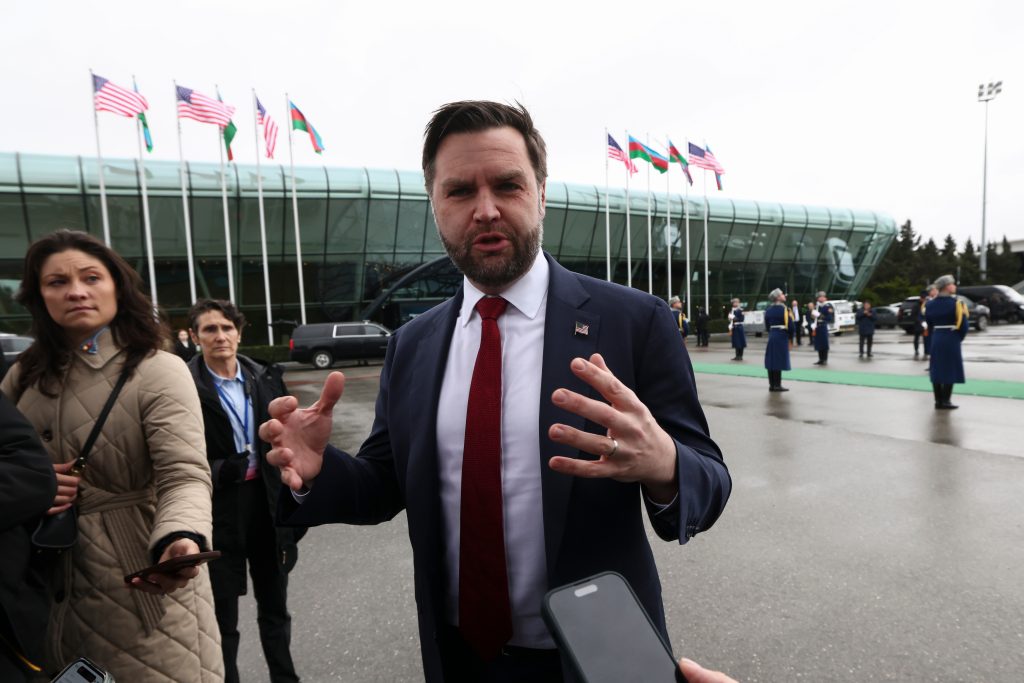
This week, Vice President JD Vance made a historic visit to the South Caucasus. He became the first sitting vice president to visit Armenia and, shortly thereafter, one of the highest-level U.S. officials to travel to Azerbaijan in decades. The timing of the trip was critical, coming amid a fragile but active peace process between Armenia and Azerbaijan and a broader effort by Washington to reassert leadership in a region long shaped by Russian influence.
Last August, President Donald Trump hosted a meeting at the White House that launched the most serious attempt in decades to end the conflict between Armenia and Azerbaijan. Fighting between the countries over territory internationally recognized as part of Azerbaijan has cost tens of thousands of lives and displaced more than a million people since the early 1990s. While that process created genuine momentum, Vance’s visit underscored both how far the parties have come and how much remains unresolved.
Stay informed.Stay ahead.
Join Washington Examiner for unlimited access to the news, analysis, and commentary that matter most.
Already a member? Log in
At the local level, confidence-building measures continue to advance cautiously. Armenian Prime Minister Nikol Pashinyan has adopted a pragmatic view that his country’s long-term prosperity depends on improved economic relations with its neighbors, including Azerbaijan. For its part, Azerbaijan, having regained territory lost in the 1990s, increasingly recognizes that regional stability requires moving beyond a conflict-driven mindset. Grain shipments to Armenia now transit through Azerbaijan, along with deliveries of Azerbaijani oil products and fuel, steps that would have been politically unthinkable just a few years ago.
Yet two major unresolved issues remain at the center of the peace process, and it remains unclear whether either was addressed in substantive detail during Vance’s private discussions.
The first is the Trump Route for International Peace and Prosperity, which would establish a transit corridor between mainland Azerbaijan and its exclave of Nakhchivan through Armenian territory. While all sides publicly reiterated their support for regional connectivity and transit integration, there were no concrete announcements regarding the route’s implementation. The corridor remains conceptually settled but practically stalled, and its realization will be essential for unlocking the economic benefits envisioned by the peace framework.
The second unresolved issue concerns Armenia’s constitution, which, according to Baku, contains language interpreted as maintaining territorial claims against Azerbaijan. This remains a fundamental obstacle to a final peace agreement. It is interesting to note that Vance appeared to offer implicit political support for Pashinyan ahead of Armenia’s elections. It is unclear how this may be perceived domestically, but it is a clear sign that the White House believes Pashinyan is the Armenian leader capable of seeing the peace process through, including the politically sensitive step of amending the country’s constitution.
Beyond the peace process itself, the visit marked an important recalibration of U.S. bilateral engagement with both Armenia and Azerbaijan.
In Armenia, Vance emphasized the importance of foreign investment and highlighted how regional transit integration could unlock economic growth and attract international capital. These themes resonate with a younger generation of Armenians, who increasingly see their country’s future aligned with the West rather than Moscow. During the visit, the United States and Armenia also signed an agreement on cooperation in civilian nuclear energy, a sensitive but strategically significant step that signals deepening trust and long-term engagement.
This enhanced U.S. involvement comes as Armenia reassesses its dependence on Russia. Moscow remains deeply entrenched through military basing, joint air-defense arrangements, and a long history of border-guard involvement along Armenia’s frontiers. Still, recent Armenian efforts to assert greater sovereignty at select border points suggest a gradual, if cautious, shift away from Russia’s security orbit.
In Azerbaijan, the visit produced one of its most concrete outcomes: the signing of a new strategic partnership agreement with the U.S. Vance publicly praised Azerbaijan’s military capabilities and highlighted its role as a counterterrorism partner. This acknowledgment served as a reminder that Baku has, in the past, been a reliable security partner and that the Trump administration is interested in rebuilding and expanding that cooperation.
Azerbaijan’s strategic geography, bordering Russia to the north, Iran to the south, and the Caspian Sea to the east, makes it a critical gateway to Central Asia. As Washington places renewed emphasis on trade, connectivity, and access to critical minerals across Eurasia, Azerbaijan’s role as a transit and logistics hub becomes increasingly important. Deeper U.S. engagement — economically, politically, and strategically — would strengthen Azerbaijan’s integration with the Euro-Atlantic community while advancing core U.S. interests in Central Asia.
IN FOCUS: IT’S DEJA VU ALL OVER AGAIN AT NOTRE DAME
The peace framework launched at the White House last August remains historic. It signaled a shift toward U.S.-led diplomacy in the South Caucasus and laid the groundwork for regional economic, energy, and trade integration. Vance’s visit demonstrated that the U.S. remains committed to this process, even as key obstacles persist.
A stable and secure South Caucasus serves vital U.S. strategic interests. The road ahead will be difficult and politically fraught, but sustained American engagement offers the best chance of translating a historic opening into lasting peace.
Luke Coffey is a senior fellow at the Hudson Institute.
Efgan Nifti is the CEO of the Caspian Policy Center.