

The U.S. military has used both missiles and drones in striking more than 2,000 targets in Iran through the first days of the war, while relying on sophisticated air defense systems to protect its Middle East bases and personnel from retaliatory strikes.
There are more than 50,000 U.S. military personnel in the Middle East and more troops are heading into the region. Prior to the war, the Pentagon moved the Gerald R. Ford carrier strike group and its associated ships into the Middle East.
Recommended Stories


On offense
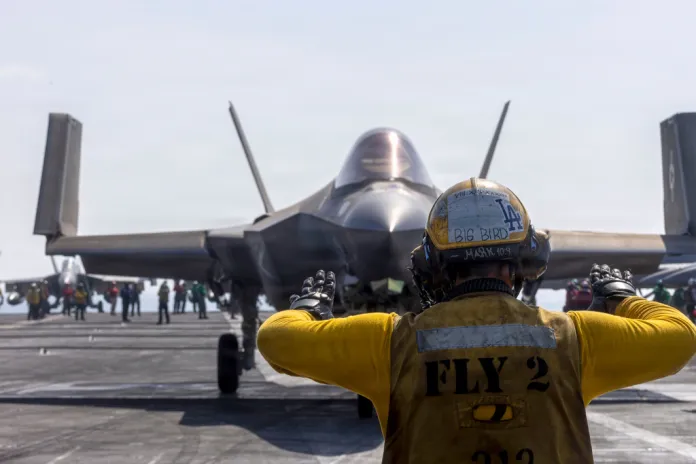
The Ford carrier strike group, along with three destroyers and more than 5,000 additional service members, joined the USS Abraham Lincoln carrier strike group, which includes the Carrier Air Wing 9 and destroyers USS Frank E. Petersen, Jr., USS Spruance, and USS Michael Murphy in the region ahead of the commencement of the war.
U.S. warships in the region initiated the operation last Saturday with the launch of Tomahawk cruise missiles, while American ground forces from outside the country used the High Mobility Artillery Rocket System.
The U.S. military also used B-1 bombers, B-2 stealth bombers, F-15 fighter jets, F-16 fighter jets, F-18 fighter jets, F-22 fighter jets, F-35 stealth fighters, EA-18G electronic warfare planes, RC-135 reconnaissance aircraft, and A-10 attack jets participating in the operation. These aircraft have a range of capabilities and responsibilities, ranging from gathering intelligence to jamming communications on the ground, to carrying out the actual strikes. In total, more than 200 fighter aircraft are involved in the mission. Three F-15 fighter jets were shot down in Kuwait in a “friendly fire” incident earlier this week.
The B-2 bombers are the most powerful platform in the Air Force, and they often deploy from their home at Whiteman Air Force Base in Missouri, just as they did for last year’s Operation Midnight Hammer, targeting three of Iran’s nuclear facilities.
The U.S. also used low-cost one-way attack drones for the first time in combat, which CENTCOM said was the first time the American military used them in combat. The U.S. drones were actually modeled after the successful Iranian Shahed drones, which have posed problems for American defenses.
These drones, which are made by Spektreworks, have a wingspan of 8.2 feet, are 9.8 feet in length, and have a max payload of 40 pounds. They have a range of 444 nautical miles, according to a company fact sheet.
Also for the first time, the United States used the new Precision Strike Missile, a short-range ballistic missile. A U.S. Central Command video purportedly showed the new missiles being launched from a wheeled M142 High-Mobility Artillery Rocket System launcher.
An American military submarine sank an Iranian Navy frigate, IRIS Dana, off the coast of Sri Lanka using a single Mark 48 torpedo, marking the first time a U.S. submarine took out an enemy vessel since World War II, Caine said.
The U.S. had largely been using standoff munitions, such as cruise missiles and short-range ballistic missiles fired from land, sea, and air, but if the U.S. can get uncontested airspace, which defense officials said could happen in days, it will allow them to begin overhead bombing using GPS-aided free-fall weapons, such as gravity bombs.
“More bombers, fighters are arriving just today,” War Secretary Pete Hegseth said on Wednesday. “And now with complete control of the skies, we will be using 500-pound, 1000-pound, and 2000-pound GPS-and-laser-guided precision gravity bombs, which we have a nearly unlimited stockpile.”
On defense
The U.S. has utilized both the Patriot interceptor missile systems and the THAAD anti-ballistic missile systems to defend against incoming Iranian fire. Iran has targeted the United Arab Emirates, Qatar, Kuwait, Bahrain, Oman, Jordan, Iraq, and Saudi Arabia in addition to Israel.
“Our integrated air and missile defense network is performing exactly as it’s intended,” Caine said. “U.S. Patriot and THAAD batteries, along with ballistic missile defense-capable Navy destroyers, continue to coordinate and execute intercepts with precision and consistency. Collectively, these systems have intercepted hundreds of ballistic missiles targeting U.S. forces, our partners, and regional stability.”
There are also Aegis Ballistic Missile Defense systems on the destroyers.
The number of ballistic missiles Iran is firing is down 86% since the first day of fighting, with a 23% decrease over the last 24 hours, while their one-way attack drone shots are down 73% from the opening days, Gen. Dan Caine, the chairman of the Joint Chiefs of Staff, said on Wednesday.
President Donald Trump has downplayed concerns about U.S. stockpiles even as his administration’s efforts to expand the defense industrial base predate the current conflict.
“The United States Munitions Stockpiles have, at the medium and upper medium grade, never been higher or better – As was stated to me today, we have a virtually unlimited supply of these weapons,” the president said. “Wars can be fought “forever,” and very successfully, using just these supplies (which are better than other countries finest arms!). At the highest end, we have a good supply, but are not where we want to be.”
Defending against the Iranian one-way attack drones has posed a more difficult challenge for the U.S.’s defensive capabilities.
One of those drones evaded Kuwaiti and U.S. air defenses and hit a tactical operation center, killing six U.S. service members.
HOW THE IRAN CONFLICT WAS LAUNCHED: ‘OPERATION EPIC FURY IS APPROVED. NO ABORTS. GOOD LUCK’
The Pentagon revealed the identities of four of them on Tuesday: Capt. Cody A. Khork, 35, of Winter Haven, Fla.; Sgt. 1st Class Noah L. Tietjens, 42, of Bellevue, Neb.; Sgt. 1st Class Nicole M. Amor, 39, of White Bear Lake, Minn.; and Sgt. Declan J. Coady, 20, of West Des Moines, Iowa.
“We expect to take additional losses, and as always, we will work to minimize U.S. losses,” Caine told reporters on Monday. “But, as the secretary said, this is major combat operations.”
