
As soon as the networks declared Donald Trump the winner of the 2024 presidential election, attention shifted to 2028. Most of the focus so far has been on the Democrats. Which, when you think about it, makes sense.
Recommended Stories
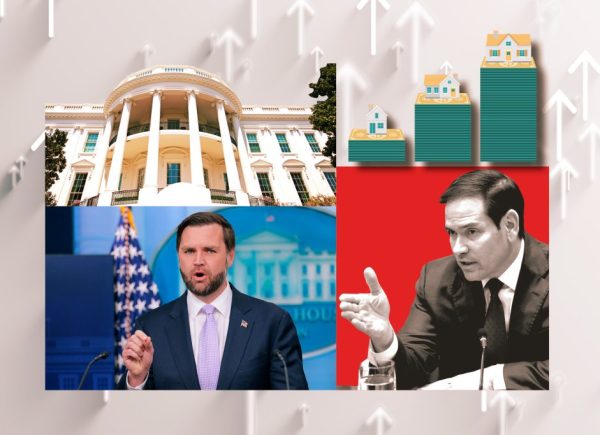
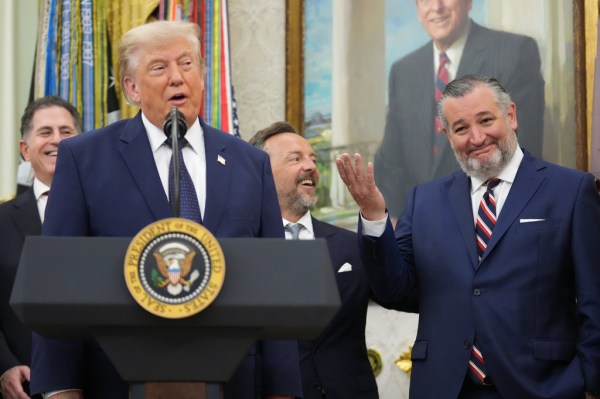
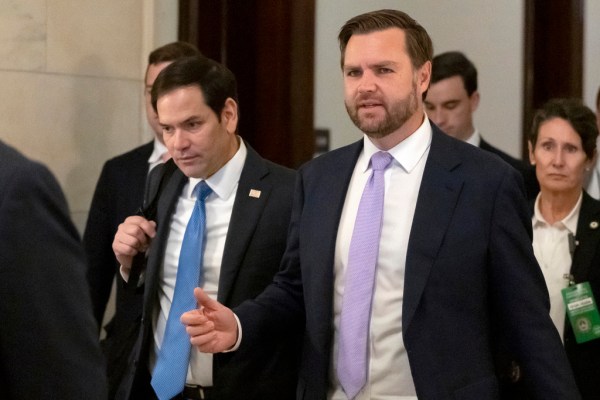
For one thing, that’s where the action is. As the out party, their primary will be an open contest. Because it will be a wide-open race to once again succeed Trump, two dozen candidates may be underestimating the size of the field. It’s anticipated that the field will include many of the party’s biggest names, such as Gov. Gavin Newsom (D-CA), Rep. Alexandria Ocasio-Cortez (D-NY), and former Vice President Kamala Harris. But another reason, maybe the biggest, the Democrats have all the juice for 2028 is that the Republicans have none at all.
The GOP primary has seemed like a foregone conclusion since the day President Trump was sworn into office again. Sure, JD Vance is the sitting vice president, and when the incumbent vice president seeks the nomination, he invariably gets it. Vance, however, is no mere heir presumptive. He is the most lopsided favorite, the biggest lock, not since 2000 or even 1988, but maybe ever. That’s how he’s being treated, anyway. With a massive lead in the polls and more chatter now about prospective running mates than potential rivals for the nomination, he should be.

Yet just because the race feels like it’s over before it’s even begun, that doesn’t mean there won’t be one. Someone will challenge Vance for the Republican nomination, even if they have no shot at winning. The question is who. Who becomes the vessel that the GOP opposition will try to deploy in a kamikaze attack to sink the MAGA dreadnought and end its awful dominion over the party. Who, in other words, will be the Nikki Haley of 2028?
The first person we can rule out is Haley herself. Soon after she dropped out of the 2024 race, she accepted a sinecure with a D.C. think tank. She has scarcely been seen or heard from since.
Nor will it be Marco Rubio. The secretary of state has claimed he won’t run if Vance does. Moreover, there has been a great deal of scuttlebutt already that the two of them will form a ticket. No one has encouraged the notion more than their boss, who has repeatedly stated his preference that Rubio “get together with JD.” An unnamed adviser who’s discussed the matter with the president told Axios last month that Trump’s ideal ticket is Vance-Rubio — “and to be clear, that’s Vance on top.”
Unless, that is, Trump knocks him down. At a Feb. 28 Mar-a-Lago fundraiser, Trump asked the crowd who they’d prefer he support. The 25 donors were almost unanimous for the nation’s top diplomat, one of the attendees told NBC News. Trump, the Wall Street Journal reported, has of late grown more enamored of Rubio, particularly as he has focused on foreign policy in 2026. For now, Vance retains the president’s favor. Given his notoriously wandering eye, there’s no guarantee Vance keeps it. Yet for Trump to abandon his vice president would, in some sense, be an admission that he chose poorly in selecting him. Would he really do that?
Perhaps he won’t have to. According to the Washington Post, Vance has said privately he’s still undecided about 2028. Usha Vance is expecting their fourth child this summer, and that may be giving him pause. Running for president with four children under 10 would be a considerable burden on him and his family. The circumstances, though, will never again be this favorable. You’re only the sitting vice president of a termed-out president once. The opportunity is simply too good to pass up. Which is why, ultimately, he almost certainly won’t.
Another unlikely contender is Donald Trump Jr. He is popular with his father’s supporters and is a logical choice to be his father’s figurative and literal heir. Yet that idea has never attained critical mass. There’s been no clamor, no groundswell for Trump to pass his crown to his eldest son. When Don Jr. is included in polls, he routinely trails Vance by double digits. Not to mention that he was one of the loudest voices urging his father to make Vance his running mate and remains one of his strongest advocates. This isn’t to say he won’t try to claim the mantle one day, but that day isn’t in 2028.
We can also dismiss Trump’s other 2024 rivals. Ron DeSantis has continued compiling an outstanding record as governor of Florida, but the buzz and excitement that marked his entry into the last race have dissipated. Vivek Ramaswamy, if he’s fortunate, will still be finding his way in Ohio’s governor’s mansion. Doug Burgum got what he wanted out of his no-hope campaign, trading in North Dakota’s governorship for a spot in Trump’s cabinet, leading the Interior Department. Chris Christie swore he’d jump in only if he could beat Trump, then did so anyway, crashing out before a single vote was cast. He’s sure to contemplate trying again. But even an ego as large as his isn’t big enough to overcome Republican voters’ abiding revulsion. As for ex-Arkansas governor Asa Hutchinson, I won’t kick a man while he’s down by mentioning his risible farce of a campaign. South Carolina Sen. Tim Scott’s 2024 effort was such an afterthought that I almost forgot him.
No one who wants a future in Republican politics will run in 2028. Arkansas Gov. Sarah Huckabee Sanders? Nope. Arkansas Sen. Tom Cotton? Ditto. Sen. Josh Hawley of Missouri? No dice. Texas Sen. Ted Cruz? Forget it, suggestions last fall notwithstanding. And so on. Only someone who has no standing in the party today and therefore no expectation of playing a role in it tomorrow will take the plunge.
All these names and more I haven’t mentioned have too much political acumen and savvy to embark on a campaign against Vance that would be doomed from the start. Their only accomplishment is liable to be undermining their prospects by turning Republican voters against them for running a campaign that, like Haley’s in 2024, would attract some of the least popular elements in the party, who would try to transform it into a stalking horse for their anti-Trump revanchism.
Such is what any non-Vance candidacy is likely to be, whether by design or destination. Few Republicans would voluntarily incur that taint. Hence, anyone who did enter would be someone who either cannot be sullied by that black mark or for whom it would be a badge of honor. There are three groups within the wider Republican universe about whom this can be said: the factional fringe, the Never Trumpers, and the restorationists. From these three groups is any actual challenge to Vance likely to be drawn.
Tulsi Gabbard and Robert F. Kennedy Jr. can both fairly be described as belonging to the factional fringe. But the fringe they belonged to was the Democratic Party’s, whose presidential nomination they sought in 2020 and 2024, respectively. Now, they’re members of Trump’s Cabinet. There’s been some speculation about both, more so Kennedy, as 2028 prospects. But, ironically, Trump’s need to absorb their modest constituencies has defanged them as a future threat. They’re no longer outsiders. They’ve lost that luster. A Kennedy running on his record as part of the government is a far cry from Kennedy the gadfly and activist.
The factional threat, if one arises, will originate from what can be described as the more MAGA than thou crowd. It will throw someone up who’ll promise a return to the true MAGA path after Trump went astray. I, its avatar will say, am the real heir of MAGA, not Vance. Recently resigned Georgia Rep. Marjorie Taylor Greene, who went from being dismissed as a kook when she was regarded as the manifestation of MAGA’s id, to enjoying the proverbial “strange new respect” from the media after she turned on Trump over the Epstein files and his refusal to support her for statewide office, fits this bill.
So does Thomas Massie. The Kentucky congressman has long been a burr under Trump’s saddle, their mutual antagonism exploding after Massie helped pass the law forcing the government to release the Epstein files. So aggrieved has Trump become with his Bluegrass State bete noire that he has resorted to making insinuations about the death of Massie’s first wife, casting aspersions on his second, and vociferously backing Massie’s primary opponent. If Massie loses, he’ll be out of office in January with nothing to do. Greene already is, having quit just after the New Year. A spite candidacy from either to sabotage Vance by peeling away the most hardcore MAGA voters can’t be ruled out.
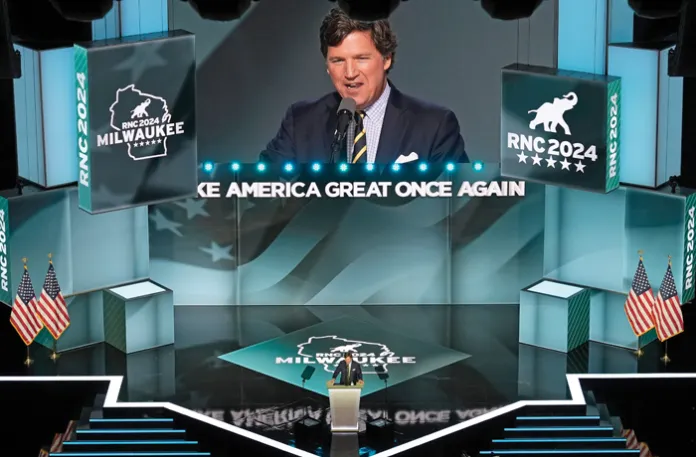
The person best poised to run such a campaign, though, one intended to punish Vance for Trump’s deviations from MAGA, is longtime Fox News host turned “just asking questions” podcaster Tucker Carlson. His isolationism, dalliances with antisemitic and anti-American voices, and po-faced impassivity as he lets his guests spew the most ludicrous conspiracy theories without the least pushback, place him firmly on the furthest fringe of MAGA. Yet the president did promise “no new wars,” and with some of the faithful condemning the nascent conflict with Iran as a betrayal of that pledge, should the hostilities become protracted or even devolve into the dreaded “quagmire,” Carlson is arguably in the best position to capitalize. He barely cracks 2 or 3% when his name is included in polls, and his post-Fox News baggage could fill a cargo ship. Carlson would legitimately be the type of factional candidate we have seen time and again, one who runs not to win but to make a point, to express dissent or dissatisfaction on behalf of a portion of the base, or to force the party establishment to confront an issue it has done its best to avoid since it divides the party.
The biggest question about the Never Trumpers might be whether they can still be considered part of the GOP at all. Many have become Democrats in all but name, even as they delude themselves and the public by pretending they’re still Republicans. Ex-representatives Adam Kinzinger of Illinois and Liz Cheney of Wyoming are the most prominent figures here, but it’s an open question whether either would bother mounting a campaign given their deep unpopularity with the GOP rank-and-file and the amount of resources they’d have to expend just to garner low double digits in New Hampshire, get obliterated on Super Tuesday, and then drop out. Former Illinois Rep. Joe Walsh, Gov. Mark Sanford of South Carolina, and ex-Massachusetts Gov. William Weld all ran in the Never Trump lane in 2020 and were humiliated for their troubles. An expressly Never Trump campaign doesn’t seem to be in the cards for 2028. Not least because, without Trump on the ballot, there wouldn’t be much point.
Which brings us to the final group, the “restorationists.” They’re not MAGA, but they aren’t Never Trump, either, despite some affinities with it. Thus, they’ve managed for the most part to remain in good standing in the GOP, albeit not always in Trump’s good graces. I call them restorationists since they represent what’s left of the pre-2015 Republican Party, the rump of Reaganite and Bush-era conservatism, the restoration of which is their adherents’ goal.
Mitt Romney is this wing’s beau ideal, but the Massachusetts governor-turned-Utah senator saw his influence in the GOP destroyed for opposing Trump, and he retired from Washington as Trump was returning to it. John Curtis, Romney’s successor in the Senate, would seem to be another contender. But perhaps having learned from Romney’s example, he has not been nearly as vocal of a Trump critic as predicted.
Larry Hogan was importuned repeatedly to oppose Trump in 2020, but being smarter than those exhorting him, thought better of committing career suicide and passed. Instead, surprisingly proving himself to be a loyal party man, the former Maryland governor ran for the Senate in 2024. He fared better than any Republican in years, yet still lost.
Two of Hogan’s gubernatorial counterparts can expect their phones to ring off the hook with entreaties from the donor class. Chris Sununu of New Hampshire and Georgia’s Brian Kemp declined Senate races where they’d have been favored because, the whispers hint, both men have visions of themselves sitting behind the Resolute Desk. Those visions are as close as they’ll ever get. Virginia’s Glenn Youngkin is sure to have his ears melted by Republicans beseeching him to turn the clock back to 2015. Scratch him off the list. He’s too smart to answer their calls; he knows the imprimatur of the pre-Trump consultants is a stain he could never erase.
If an upstart candidacy emerges from the Senate, perhaps Rand Paul will be the one taking up that mantle. Kentucky’s soon-to-be senior senator told Chuck Todd earlier this month that he has thought about it and will decide after the midterms.
“There needs to be a free-market wing of the Republican Party,” Paul said.
And I want to be part of trying to ensure that still exists.” Paul’s brand of libertarian anti-populism is definitely not in favor in the GOP at the moment. Running as its standard-bearer might, as the Washington Examiner’s Jim Antle suggested, “help him carve out a distinct lane for himself during a fight for his party’s future.” But Paul flamed out when he ran in 2016, and today those embers seem closer to being doused for good than rekindled.
Who, then? Three names stand out, though there is no guarantee any of them takes the leap into oblivion.
One is Don Bacon. An unapologetic interventionist abroad who has criticized Trump for not taking a harder stance against Russia over Ukraine, champion of more immigration, and strident foe of Trump’s tariffs, the retiring Nebraska congressman is a textbook pre-Trump Republican. He’s also a tailor-made protest candidate. He has a distinct yet modest national profile, but lacks any dedicated following of his own. Since he is virtually unknown outside of political circles, his campaign would be driven by the cause and not his personality.
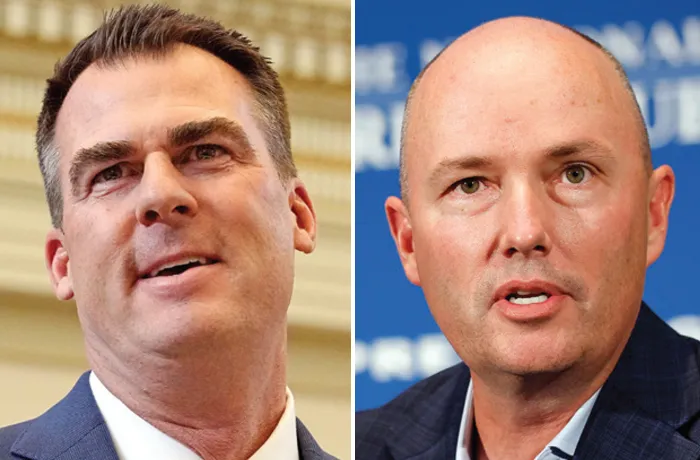
So too, from this perspective, are Govs. Kevin Stitt of Oklahoma and Spencer Cox of Utah. Stitt, whose term is ending, rebuked Trump in October for sending National Guardsmen from one state to another without the second state’s approval. More recently, he made noise by criticizing the Trump administration’s immigration enforcement actions in Minnesota as infringing on states’ rights, and mocked the idea that Democrats desire open borders in order to create new voters while rejecting the president’s demands for a nationalized election system. Stitt has been a staunch supporter of Trump, but might he try to turn his plea for the Republican Party “to get back to integrity” once Trump departs the scene into action by standing against Vance?
Cox is a curious character. On one hand, he has spearheaded Utah Republicans’ revenge against the Utah Supreme Court for redrawing the state’s congressional map by adding two seats to it and creating an entirely new court for reviewing legislation. On the other, he is reviled by the base for vetoing a ban on boys in girls’ sports and for once offering his “preferred pronouns” at a town hall with students. Cox has forsworn any presidential aspirations. Yet joint appearances with Josh Shapiro, his Democratic counterpart in Pennsylvania, to appeal for increased civility and warn about the dangers of political violence raise eyebrows — as do profiles in national publications like Politico explicitly adjuring him to run.
Bacon, Stitt, and Cox seem the likeliest suspects, not because they have any chance, but because they are in the mold of the kind of candidate who’d tilt at a field of industrial wind turbines. Their purpose wouldn’t be to win, but to remind the Republican Party writ large, its leaders and its voters, that “we’re still here.” The risk is that, in so doing, they prove once and for all that “we” is even fewer than anyone imagined, most of all themselves.
Even incumbent presidents get primary challengers. Someone, therefore, will pursue the damn fool idealistic crusade of taking on Vance and attempt to occupy the factional, RINO, establishment, or Never Trump lane. But barring the most unforeseen of unforeseeable circumstances, just as in 2024, it will be a lane to nowhere.
Varad Mehta is a writer and historian. He lives in the Philadelphia area. Find him on X @VaradMehta.