

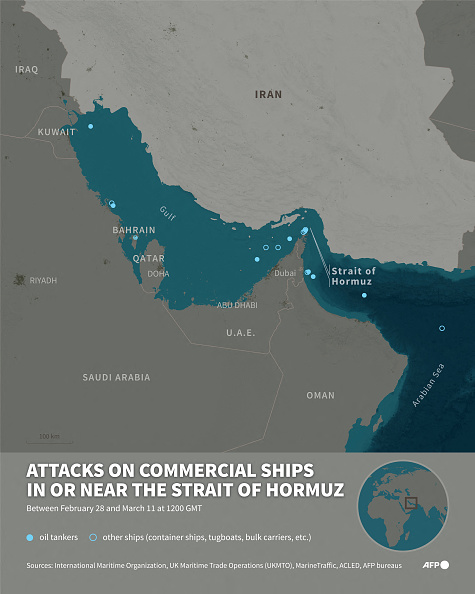
In announcing a ceasefire with Iran on Tuesday evening, President Donald Trump said the United States would “suspend” planned strikes on Iran’s power plants and bridges for two weeks. In exchange, Iran pledged the “complete, immediate, and safe opening” of the Strait of Hormuz.
Yet, aside from allowing four non-tanker cargo ships to pass on Wednesday, and a handful on Thursday, the strait has remained effectively closed. Iranian leaders moved the goalposts. According to state media reports, they claimed that Israel’s strikes on the Iranian-backed militant group Hezbollah in Lebanon constituted a breach of the ceasefire — despite the agreement making no mention of Hezbollah.
Stay informed.Stay ahead.
Join Washington Examiner for unlimited access to the news, analysis, and commentary that matter most.
Already a member? Log in
This was not a misunderstanding. It was a strategy.
Hezbollah began attacking Israel in October 2023, following the outbreak of the Israel-Hamas war in Gaza — another war brought to us by Iran.
For more than two years, Israel has faced sustained rocket fire from this terrorist group while also firing back. Israel did not start this war. Clearly, it has the right and, in fact, the obligation, to defend its citizens.
By invoking Hezbollah now, Iran is attempting to retrofit the ceasefire to its advantage, tying the reopening of one of the world’s most critical shipping lanes to a completely separate conflict.
With much of Iran’s military capability degraded after five weeks of war, its control of the Strait of Hormuz is its last, best point of leverage. By choking off this narrow corridor, it can hold the world hostage.
With the upper ranks of the Islamic Revolutionary Guard Corps decimated, the paramilitary force is now being run by former mid-level officials who have survived the war. Having sidelined the country’s civilian leadership, the Guard is widely seen as calling the shots inside Iran. While it rejected the idea of a ceasefire outright, civilian leaders were also opposed. Tehran’s eventual acceptance likely reflected mounting external pressure, particularly from China, which depends heavily on uninterrupted energy flows and bristles at the possibility of U.S. control of the strait.
Yet, despite its weak position, Iran remains defiant.
If Israel were to call Iran’s bluff and agree not to strike Hezbollah for the next 12 days — unless directly attacked — would Tehran suddenly honor its promise and fully reopen the strait? Probably not. More likely, the regime would simply find another pretext to restrain access.
On Thursday, the second full day of the ceasefire, traffic through the strait showed no change from the day before. The Wall Street Journal described crossings as “restricted, conditioned and controlled.” The New York Post reported that “300 ships” were waiting or stranded on either side of the strait.
In a lengthy post on LinkedIn, Dr. Sultan Ahmed Al Jaber, the United Arab Emirates’s Minister of Industry and Advanced Technology and the CEO of the Abu Dhabi National Oil Company, wrote, “This moment requires clarity. So let’s be clear: The Strait of Hormuz is not open.”
He attached a graphic that read, “Conditional passage is not passage. … No single country can control an international waterway.”
According to a report from Athens-based Xclusiv Shipbrokers, the Guard threatened that vessels attempting to leave the strait “without permission will be destroyed.” The Strait of Hormuz has been dubbed “the Tehran tollbooth” because the Guard is charging $1 per barrel of oil for safe passage. The toll is required to be paid in either cryptocurrency or Chinese Yuan.
Iran has every incentive to prolong ambiguity, to manufacture new conditions, and to extract concessions without delivering on its own commitments. That is not a bug in the agreement. It is the design.
Which raises a more uncomfortable question: Why did the U.S. agree to this ceasefire? At the moment, it appears to be a one-sided concession masquerading as diplomacy.
The U.S. appears to have traded concrete military leverage for assurances that can be reinterpreted — or ignored — at will. And it has done so without any credible mechanism to enforce the deal.
During an interview with NBC News on Thursday, Trump said he was “very optimistic” about further negotiations with Iran. He noted that Iran’s leaders “talk much differently when you’re at a meeting than they do to the press. They’re much more reasonable.
“If they don’t make a deal, it’s going to be very painful,” he said.
I do not doubt that, behind closed doors, Iran’s leaders are far more pragmatic than their public rhetoric suggests. Diplomacy often operates in that quiet space between posturing and possibility, where concessions are explored but rarely advertised.
It is also clear that there are layers to this situation that remain beyond public view. The president is privy to intelligence, assessments, and backchannel communications that shape decisions in ways outsiders cannot fully grasp.
But while Trump’s optimism is encouraging, the reality unfolding in the strait does not inspire confidence.
The Strait of Hormuz remains constricted, the ceasefire’s terms are being rewritten in real time, and the world’s most vital energy corridor is still being used as leverage rather than reopened as promised.
Until Iran demonstrates a genuine commitment to honoring its obligations through verifiable action, the administration may find that pursuing anything short of unconditional surrender risks conceding leverage without securing compliance.