

The U.S. military, as directed by President Donald Trump, began a blockade of maritime traffic entering and exiting Iranian ports on Monday, the latest maneuver from the president following the unsuccessful talks in Islamabad, Pakistan, over the weekend.
The president’s decision represents a new tactic that the military is employing, one in which it will try to remove Iran’s leverage over the waterway that has sent the global economy into a frenzy.
Recommended Stories


The waterways off Iran’s coast, which get really narrow in the Strait of Hormuz, are vital to global oil shipping, and the war, which started roughly six weeks ago, has caused significant economic disruptions.
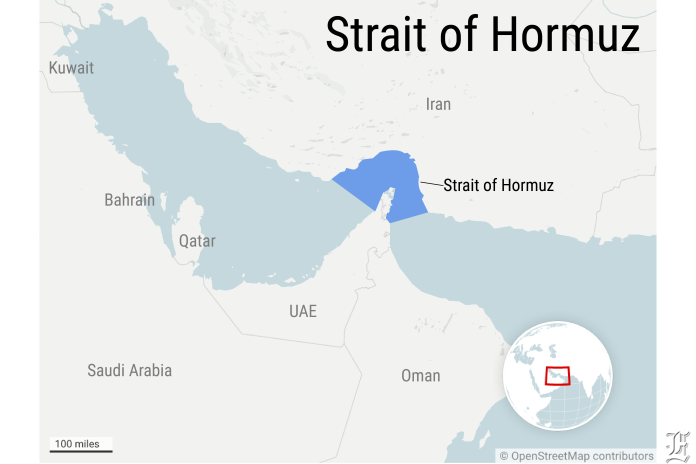
“The blockade will be enforced impartially against vessels of all nations entering or departing Iranian ports and coastal areas, including all Iranian ports on the Arabian Gulf and Gulf of Oman,” a statement from U.S. Central Command said. “CENTCOM forces will not impede freedom of navigation for vessels transiting the Strait of Hormuz to and from non-Iranian ports.”
Prior to the announcement of a two-week ceasefire last week, Iranian forces had largely shut down transit through the Strait of Hormuz, though Trump announced at the time that the deal was contingent upon Iran’s reopening of the strait, which has largely not happened.
Following Saturday’s negotiations in Islamabad led by Vice President JD Vance, the president announced that the Navy would also interdict ships that paid Iran to pass through the strait.
REVEALED: THE SIX US RED LINES IN TALKS WITH IRAN
“I have also instructed our Navy to seek and interdict every vessel in International Waters that has paid a toll to Iran,” Trump said. “No one who pays an illegal toll will have safe passage on the high seas. We will also begin destroying the mines the Iranians laid in the Straits. Any Iranian who fires at us, or at peaceful vessels, will be BLOWN TO HELL!”
In a subsequent social media post, the president reiterated those threats and added, “What we have not hit are their small number of, what they call, ‘fast attack ships,’ because we did not consider them much of a threat.”
Iran has threatened to respond with attacks of its own.
Iran’s Revolutionary Guard warned that “no port in the Persian Gulf and the Sea of Oman will be safe” if its own ports are threatened, Iranian state media said on Monday.
Trump has urged America’s NATO allies to get involved in helping force Iran to reopen the strait, but most of them have demurred, some of whom have taken the significant step of barring American troops involved in the war from stopping at their bases. The American president said in announcing the blockade, “Other Countries will be involved with this Blockade,” but did not specify who that would be.
“As regards the Strait of Hormuz, in the coming days, together with the United Kingdom, we will organize a conference with those countries prepared to contribute alongside us to a peaceful multinational mission aimed at restoring freedom of navigation in the strait,” French President Emmanuel Macron said on Monday. “This strictly defensive mission, separate from the warring parties to the conflict, is intended to be deployed as soon as circumstances permit.”
If the European talks don’t result in assisting U.S. forces, it will likely further anger Trump, who has frequently criticized the alliance for not showing up when the U.S. needs allied support. The only time the NATO alliance has enacted its crucial Article 5 provision was in the aftermath of 9/11.
HOW IRAN HAS CHANGED FROM THE START OF THE WAR UNTIL THE CEASEFIRE
There are still eight days left in the two-week ceasefire, though it’s unclear if the U.S. and Iranian sides intend to meet again before its expiration, and where. If not, it’s unknown if U.S. forces would resume the tempo of operations in the conflict they had been conducting prior to the deal.
U.S. and Israeli forces struck tens of thousands of targets in Iran over the course of the roughly five weeks of war, while Iran has demonstrated its capability to hit U.S. targets and bases and civilian infrastructures throughout the region into several Gulf countries.
