

In Focus delivers deeper coverage of the political, cultural, and ideological issues shaping America. Published daily by senior writers and experts, these in-depth pieces go beyond the headlines to give readers the full picture. You can find our full list of In Focus pieces here.
Within a 20-minute drive of home in a mid-sized city in a purple state, there are two Target groceries, a Walmart superstore, a Walmart stand-alone grocery, two Harris Teeters, Food Lion, Costco, Publix, two Aldis, a Lidl, a Trader Joe’s, Asian and Latin food specialty markets, a Fresh Market and probably others that have escaped my attention.
Recommended Stories


If the mood hits me, I can have vegan, non-GMO, ethically sourced snacks delivered or head to a Big Box store and load up on enough shelf-stable mac-and-cheese to keep them fed through the next decade. You probably have a similar situation because there are at least 76,000 supermarkets in the United States.
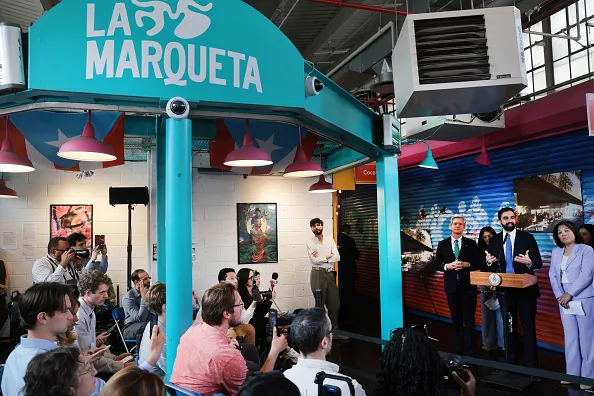
Nevertheless, leftists are constantly trying to convince us that we need government-run grocery stores. The latest person is New York City Mayor Zohran Mamdani, who has promised to open five city-run markets to combat “out-of-control” prices by getting rid of the “profit motive,” passing on the savings to consumers.
The first glaring problem with Mamdani’s contention is that the profit motive is the device that creates savings.
Mamdani says he looks “forward to the competition” from the private sector, and “may the most affordable grocery store win.” It’s not really “competition” when a government official untethered from the “profit motive” can use endless taxpayer subsidies to keep his business afloat.
The Mamdani Mart in Harlem, for instance, will be built on land already owned by the city, and it’s still going to cost $30 million according to the mayor, if government estimates are right, a rarity. In the real world, these exorbitant costs would be passed on to consumers. In the Mamdani world, the cost is tacked onto an already $5.4 billion budget deficit.
To put the cost into context, a new Aldi costs around $1.5 million to $3 million on average to construct, not including the cost of the land. Other chains might cost around $3 million to $5 million. Aldi keeps costs as low as possible because they are governed by the profit motive. An Aldi can be built as quickly as six weeks. Mamdani’s supermarket won’t be open until 2029. Maybe.
New York City could hand over $30 million to any major chain, and it would get at least three self-sustaining retail stores up and running within a year. Then again, Democrats could just stop placating their corrupt union donors by blocking Walmart from opening stores in the city, it would cost nothing.
When the state-run KC Sun Fresh supermarket opened in Kansas City, it was supposed to help alleviate the “food deserts.” At first, it was run by private grocers. But without the profit motive, they abandoned the project. By 2024, the supermarket was losing nearly $1 million dollars a year, averaging around 4,000 shoppers, down from 14,000. Those who showed up were confronted with empty shelves, unchecked shoplifting, and barely any healthy produce. It closed in 2025.
And when concerned with political considerations and bureaucracies rather than profit motives, you end up building retail establishments that aren’t needed. New Yorkers should demand their government work with the efficiency of a supermarket, not the other way around.
Within a mile of the site of the Mamdani’s new $30 million tax-funded supermarket in Harlem, there are, according to Google Maps, at least a dozen grocers, everything from an Aldi’s to a Whole Foods. It’s less than a nine-minute walk to a big supermarket from the proposed site and a three-minute walk to a fresh produce market.
If Mamdani wants more supermarkets in Harlem, he should work to cut the bureaucratic hell that potential business owners are forced to traverse to open a store. New York City is already home to one of the highest corporate tax rates in the country, yet Mamdani supports an effort to significantly increase them.
Without the profit motive, there’s no incentive to find efficiencies to cut costs or improve customer service. Without true competition, you get less for more. None of this is new information.
During the Cold War, the American supermarket was often held up as the model of prosperity. When the Soviet Union was petering out in 1989, Boris Yeltsin toured a Randalls in Houston, resulting in the famous pictures of the wide-eyed future Russian president perusing the wide variety of food available to average people living under capitalism.
Yeltsin said that “there would be a revolution” in the Soviet Union if people saw the availability. “Even the Politburo doesn’t have this choice,” he said, “Not even Mr. Gorbachev.”
Today, grocery chains are often depicted as predatory and monopolistic endeavors by Marxists like Bernie Sanders and Elizabeth Warren because it’s easy to rile up consumers who are agitated by inflation. Supermarkets have some of the lowest profit margins of any business in the country, usually around 1% to 3%. Successful chains stay competitive by adapting quickly, leaning on high-volume, high-turnover sales, cost-cutting, and intricate supply chains. Government isn’t exactly nimble.
THE UN’S AHISTORICAL TRANSATLANTIC SLAVERY RESOLUTION
There’s no doubt that living in dense urban areas is expensive. Mamdani Marts will almost surely make affordability worse. Many in the media depict Mamdani’s plan as a harmless effort to help poor people deal with the vagaries and inequities of capitalism with a few affordable grocery stores. Whatever, the government subsidies will become more expensive, crowding out value-producing “competitors.”
It’s a shame that American leftists have to relearn the most basic and obvious lessons of history and economics.
