

PITTSBURGH — Art Rooney II was standing on the pitch of the brand new U.S. Steel Community football field, located on the sprawling 178 acres where the men and women who lived in the slopes overlooking Hazelwood Works labored in the mill.
It doesn’t seem that long ago when those massive steel structures were churning out steel for over 100 years, playing a significant role in building this country.
Stay informed.Stay ahead.
Join Washington Examiner for unlimited access to the news, analysis, and commentary that matter most.
Already a member? Log in
Off in the distance stands the U.S. Steel Tower, the tallest building in Appalachia. Closer to the field are the skeletal remains, now repurposed to house Carnegie Mellon University and its innovators in robotics, advanced manufacturing, and artificial intelligence, who are now remaking the city and country once again.
Even the old roundhouse, built in 1887 and used by the railroads to drive commerce, has been transformed into an innovation hub, attracting the world’s top startups.
Rooney smiles as he takes it all in. The buzz for the past few months has been about the NFL Draft coming to the city. But the larger goal of positioning the city to be seen, experienced, and possibly untapped for generations to come, kicked off flawlessly Wednesday in this often forgotten working-class neighborhood.
“Pittsburgh is just built different,” Rooney said as he looked out at the convergence of a vivid black and gold field filled with young people from the neighborhood socializing with Steeler head coach Mike McCarthy.
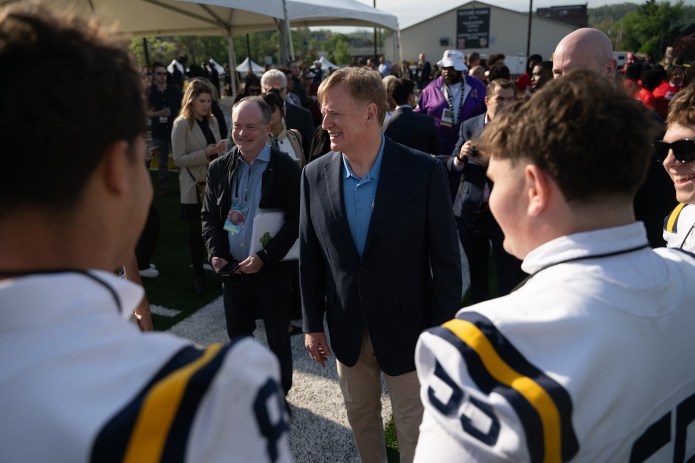
The future of this region’s potential is converging right in front of the world, Rooney says. He points to the innovators in robotics and AI at CMU, the U.S. Steel Tower in the city’s skyline, and the young people whose legacy of grit and hard work, passed down by their parents, can experience it all.
PERINO’S PURPLE STATE IS SPOT ON AT CAPTURING TODAY’S ROMANCE
“Ten years from now, one of these kids could be drafted by the NFL, or working in AI, or on robots, or working in the trades at the mill.”
Pittsburgh, football, grit, and steel have been intertwined for well over 100 years. Rooney jokes that the first draft for professional football likely came out of men such as his grandfather, Art Rooney Sr., going into the mills or the mines to find good, strong players.
“That’s probably right,” he said. “My grandfather, he had teams going back into the 1920s, which is when he first started to get teams organized and recruiting guys from all around different areas of the region.” Most of those men worked in the mills and mines.
Art Rooney Sr.’s first team was Hope-Harvey, then along came dozens of other names, including the Rooney Reds, the Pittsburgh Glyceum, the Pittsburgh Pirates, eventually settling on the Steelers after asking fans for suggestions.
He went with “Steelers” because a large chunk of the fan base was employed in the steel industry. Rooney said there were some ragtag teams in the early 1920s that his grandfather had organized, and they kept growing into semi-pro teams.
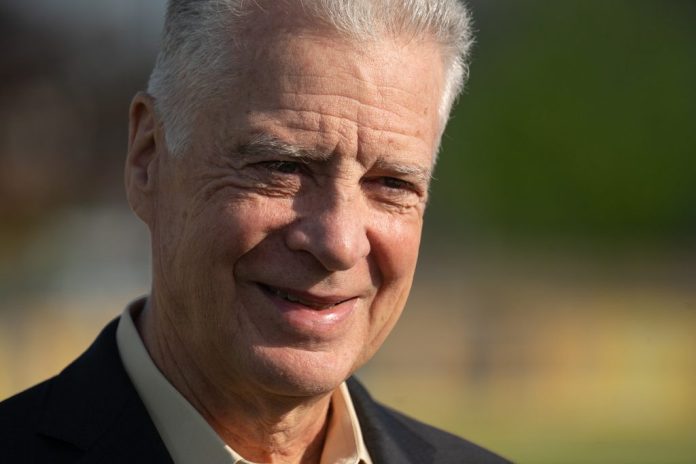
Many people forget that the first official professional football game was played right where the Steelers currently hold training camp, in Latrobe, Pennsylvania, back in Sept. 3, 1895, the first game where all players on both sides were paid.
Aaron Rodgers recently told Pat McAfee on his wildly popular NFL on ESPN show that one of the enduring things he loved about the Steelers was that the team honored the legacy of Latrobe by still going there. It was a throwaway line that many reporters missed, but it showed that Rodgers understood the deeper meaning and significance of place and honoring tradition.
While another team, the Allegheny Athletics, also from Pittsburgh, has stated that they held the professional football game in Pittsburgh in November of 1892, only one player, Pudge Heffelfinger, was actually paid.
HIGHMARK CEO’S PLEDGE TO LEAVE PITTSBURGH BETTER OFF THAN HE FOUND IT
Rooney said he wasn’t surprised that Rodgers understood that deeper meaning and paid homage to everyone who came before him, not just with the Steelers, but in the history of the game itself.
“It is great he appreciates what it is all about,” Rooney said of Rodgers.
Rooney said he is keenly aware of how much his family’s team, now in its 4th generation of Rooney family members being involved, held the city and the region together when steel collapsed in the 1970s. This was right at the same time that the Steelers finally started winning games — and not just playoff games, but Super Bowls, too. Lots of them.
“It was a difficult time in Pittsburgh and in western Pennsylvania, watching all those mills close and watching people move away,” he said of the mass exodus that halved the city’s population by 1980. “And we really were one of the few kind of bright spots that people hung onto, both people that were here, as well as people that moved away.”
It was then that the Steeler Nation was born, resulting in thousands of Steelers bars across the world. Places where people can come together and feel part of something that was meaningful to them and where the sons and daughters of the sons and daughters who had to leave can now raise a new generation of Steeler fans, passing the love of the city down to their children.
The NFL Draft inception began with Rooney. He looked around at the city he loved and saw that it was falling into decay after the impact of the COVID-19 pandemic and social strife. He went to the civic business leaders and asked for a favor: let’s convince the NFL to hold the Draft here.
The idea was that it would be a catalyst, not just to clean up the city, but also to draw businesses here and hang their shingle. The plan worked thanks to the CEOs of PNC Financial and Highmark, as well as a buy-in from Gov. Josh Shapiro.
Rooney said that this is an opportunity that doesn’t come along very often. “Maybe a once in a lifetime kind of opportunity for us to showcase our city and have people understand more about who we are and what we are,” he said.
“It’s an opportunity for us to tell our story again, talk about the roots of football being from this area,” he said. “And we’re still here playing football and trying to field a winning team year in and year out. Just like [how] Pittsburgh is on the cusp of rebuilding the country again with AI and robotics.”
THE EMOTIONAL DISPLACEMENT OF LOSING PART OF YOUR COMMUNITY
U.S. Steel President David Burritt was on hand Wednesday with Rooney and his son Dan, along with NFL Commissioner Roger Goodell, to cut the ribbon for the new facility of the U.S. Steel Community Field. The ground was designed not only for recreation and sports for young people, but also to revitalize a community that has been stuck as industry, commerce, basic services, and attention have left them without opportunity and investment.
Burritt had worked with President Donald Trump, Sen. Dave McCormick (R-PA), and Gov. Shapiro to pull together a historic deal with Nippon Steel that not only saved the industry from leaving the city permanently, but also found a brand new future with billions in investments for new technologies for the manufacturing giant. Burritt was moved by the appreciation from the community.
One year ago, the company faced shuttering. Now, Burritt smiled broadly as he walked onto the field.
“It’s a big day. It’s an exciting day. It’s an exciting day for U.S. Steel and for the community,” he said. “It’s really gratifying to see that we can do these kind of things like we’ve always wanted to do because we have this great partner with Nippon Steel, and because we also had an administration that understood how important foreign direct investment to the United States is.”
The event was a moment that bridged the past with the future. The families who walked down from the slopes, along with hundreds of teenagers, who were so excited to have something meaningful in their neighborhood as opposed to losing one more thing to “progress.”
One hundred years ago, Hazelwood was a bustling town. Hundreds of shops lined the business district. But by 1980, as the steel industry declined, so did the community. Stores were boarded up. If you could sell your house and get out, you did.
A unique moment is unfolding here, and many people are missing it. Thanks to the Richard King Mellon Foundation, Steelers Charities, CMU, the University of Pittsburgh, and U.S. Steel investing in placing not only the field here, but also the robotic and AI innovations center right where the mills once stood.
Pittsburgh has become the hub of energy, innovation, research, AI, advanced manufacturing, and steel. Once again, it is on the cusp of being the most important region in the country, not unlike what happened during the first industrial revolution when oil was discovered north of here and drove the era that transformed the world.
Burritt said that we have to protect the past, “but we don’t have to be constrained by it. But we have to protect it so that we have that foundation moving into the future, so that we can be glad for the values and the grit and the determination that got us to today.”
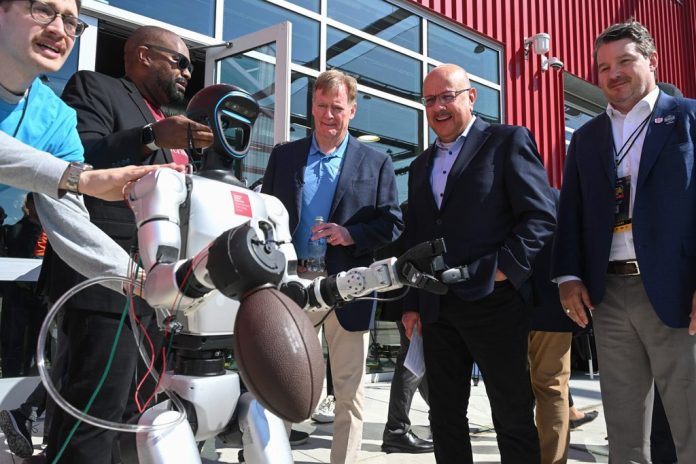
The opening of the field was followed by a tour led by CMU President Farnam Jahanian, who took NFL President Roger Goodell on a tour of the MetaMobility Lab.
Goodell, who attended college in western Pennsylvania, told the Washington Examiner how thrilled he was to bring the NFL Draft here. And not just because it is where football began, or because a historic number of players have been drafted from here, but because of how Pittsburgh comports itself when outside forces try to upend it.
“I can’t tell you how excited I am to be here at Pittsburgh, particularly Hazelwood, where so many things are happening all at once with football and with innovation,” Goodell said.
“Celebrating football is the perfect way to start draft week,” he said, before adding that “to see the field behind us, see these young players, including the girl soccer players here that I got to meet, there’s nothing better than watching kids be able to participate in sports, to compete, to learn some of the valuable lessons that we all use,” he said of the Oakland Catholic High School girls’ soccer team who were chatting it up with the commissioner.
PNC STEPS UP FOR PITTSBURGH’S NFL DRAFT
“That is what it’s all about,” Goodell said. “And this draft is about that. It’s about bringing the community together. It’s my favorite day of the year because every team gets better in the NFL, and it brings hope back. And hope is what we need to bring back. Not just to the NFL, to every team, but really to our community and our young people. I salute the partners that made all this happen.”
Goodell, who grew up in Jamestown, New York, 130 miles north of here, said that he knows the spirit of western Pennsylvania well. “I know what community means. People pull together, they focus, they drive partnerships, and do that here. And so that’s why we’re proud to have the draft here. We’re going to celebrate. Not just football, but we’re going to celebrate Pittsburgh. It’ll be a great few days.”
When Goodell left college here in 1981, the three-sport athlete who had to give up college football because of injuries wrote a letter to his father thanking him for college. He told his father his two missions in life: “The only thing I want to do in life, other than be the commissioner of the NFL, is to make you proud.”
What he learned in his time here, Goodell said, was how much people valued community, something that he saw in abundance again in Pittsburgh on Wednesday. “All built around tradition, innovation, hard work, and, of course, football.”
