

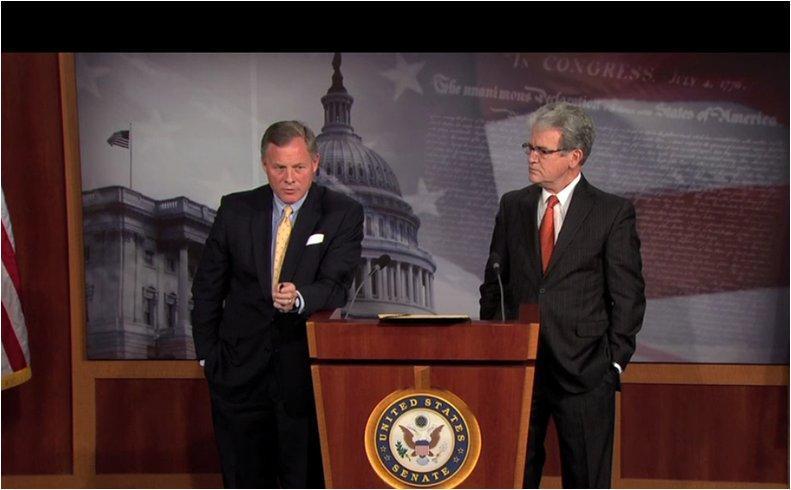
Two Republican senators on Thursday introduced a plan to quickly and drastically reform Medicare, calling on lawmakers and candidates to stop ducking the issue because of election-year politics.
“It is morally unacceptable to ignore the biggest elephant in the room, which will have a very negative impact on this country’s future, just because there is an election year coming up,” the plan’s co-author, Sen. Tom Coburn, R-Okla., said.
Coburn and Sen. Richard Burr, R-N.C., wrote the Senior’s Choice Act, which would reduce Medicare costs by raising the beneficiaries’ eligibility age and by allowing people to opt out and use competing private health care plans instead. It also cuts costs by increasing co-payments for the wealthy. The 60,000 millionaires who now receive Medicare would pay the full cost of Medicare Parts B and D premiums and have a higher deductible under the plan.
Medicare, which cost $523 billion in 2011, can’t be sustained as it is now, Coburn said. The portion of the program that pays hospitals could run out of money by 2016.
But with the Senate, House and White House all up for grabs in November, neither President Obama, congressional lawmakers, nor the Republican presidential candidates have dared to talk much about entitlement reform, in part, because the threat of reduced benefits rattles seniors who depend on Medicare and who vote in significant numbers.
“They are rightly afraid,” said Joseph Antos, an economics and health policy scholar at the American Enterprise Institute. “For the professional politicians, their goal is to get re-elected. And if you want to get re-elected, you can’t say anything that is going to drive away the people who reliably vote for you election after election.”
The Coburn-Burr plan attempts to right Medicare’s finances faster than any other existing proposal. Coburn said he is pushing for significant changes to the program that provides health care to seniors and the disabled now in hopes of forcing a debate over entitlement reform before 2013.
The plan, if enacted, would allow seniors to start shopping for competing health insurance plans as soon as 2016, four years earlier than a joint Medicare reform proposal offered earlier this year by Rep. Paul Ryan, R-Wis., and Sen. Ron Wyden, D-Ore.
The Coburn-Burr plan calls for increasing the age of eligibility by two months each year, beginning with people who were born in 1949, until the eligibility age reaches 67.
Antos said it makes economic sense to start the reforms more quickly because immediate cost savings are needed to keep Medicare solvent.
“This one doesn’t wait until 2022 for real reform to happen, and that is absolutely essential,” Antos said.
While Coburn and Burr admitted they had yet to round up any support in the Senate for their plan, they predicted it will serve as a blueprint for the kind of major Medicare reform they believe is both necessary and inevitable in the coming years.
“We believe there should be a sense of urgency in Congress to change this program and to do it now,” Coburn said. “If not, our challenge will be how to we provide benefits in a system that has gone bankrupt.”
