Flesh-eating maggots called New World screwworm move through Mexico toward US

Published April 19, 2026 8:00am ET


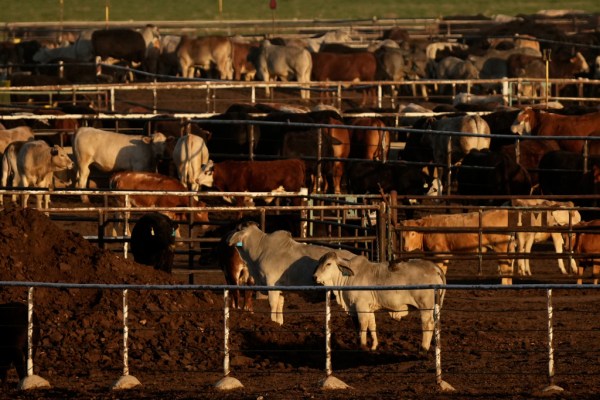
Federal and state governments are preparing a major response to a dangerous flesh-eating, parasitic fly present in Mexico as it inches closer to the U.S. southern border.

Texas Agriculture Commissioner Sid Miller said this month that the New World screwworm, a species capable of devastating livestock and infecting people, had been found 70 miles south of the U.S. border in Mexico after spreading from South America.

“The New World screwworm is not some distant problem. It is a direct and imminent threat to Texas, and we are treating it that way,” Miller said in a statement. “This is a high-stakes situation for our ranchers, our livestock industry, and our food supply, and we are moving aggressively to stay ahead of it.”

The federal government is working along the U.S.-Mexico border, preparing a massive response to the NWS. On Friday, Agriculture Secretary Brooke Rollins traveled to Edinburg, Texas, for the groundbreaking of a new sterile fly production site that will produce billions of flies that will be dispersed to help eradicate the bad ones once they cross the border.

Following the Texas facility groundbreaking, Rollins said the anticipated arrival of the screwworm was a serious concern to the country.

“The New World Screwworm threatens the health of our herds, the stability of rural economies, and the resilience of our supply chain,” Rollins said in a statement. “President Trump and his entire cabinet is committed to leveraging every resource necessary to contain this pest, protect American agriculture, and ensure the long-term security of our food supply chain.”

FILE - A New World screwworm larvae sits at rest in this undated photo. (USDA Agricultural Research Service via AP, file)
A New World screwworm larva. (USDA Agricultural Research Service via AP)

What is NWS?

NWS is a fly that lays eggs in a warm-blooded animal or person’s open wounds and body openings, including the ears, eyes, nose, mouth, and genitals. The eggs hatch into parasitic maggots that “burrow into and feed on living tissue or flesh,” according to the Centers for Disease Control and Prevention.

A fly will lay hundreds of eggs in a wound or body opening. The screwworm larvae have large mouth hooks that they use to “screw” themselves into the host’s tissue and dig deeper.

An outbreak can lead to secondary infection, sepsis, and death within seven to 14 days. 

Symptoms include feeling or seeing maggots moving within a skin wound; painful sores or wounds that worsen within days; bleeding from open sores; and a foul smell from the flesh-eating larvae.

Gaby Maier, a specialist for beef cattle herd health and production at the University of California Davis School of Veterinary Medicine, described it as being “out of a horror movie” for how the larvae feast on a living animal, according to a blog post by the University of California Agriculture and Natural Resources Department.

“I have talked to people who have seen these infestations in person, and they remember it from when they were young,” Maier said. “They say it was horrible — the smell of decomposing flesh in a live animal.”

The migration of NWS

The U.S. has fought the NWS for decades, dating back to the 1960s, when it was eradicated through the release of sterile male flies.

This species of fly began to spread in 2023 from South America through every country in Central America and Mexico, according to the CDC. In that time, more than 144,000 animal cases and 1,100 human infections have been reported, UC researchers found.

It is unclear how this species was able to travel into North America within a matter of years. 

However, it could be connected to illegal cattle trading across borders in the early 2020s or the deforestation of the Darién Gap, a jungle that is the sole land connector between South and Central America, according to the UC publication. Several million migrants traversed the Darien Gap, through Central America and Mexico, to get to the U.S. during the Biden administration. 

In June, a case farther south in Veracruz, Mexico, prompted the Department of Health and Human Services to shut down cross-border cattle trade.

In August, a case in Maryland was confirmed in a person who had recently traveled to El Salvador. A Department of Health and Human Services spokesperson said it was the “first human case of travel-associated New World screwworm myiasis (parasitic infestation of fly larvae) from an outbreak-affected country identified in the United States.”

The U.S. response

A potential outbreak was estimated by the Agriculture Department to cost Texas livestock producers $732 million annually and to result in up to $1.8 billion in losses to the state economy.

In California, dairy products and milk are an $8.6 billion commodity, and cattle and calves are a nearly $5 billion category in their own right.

The Agriculture Department has implemented a five-prong plan for federal, state, tribal, and local responders to handle NWS, including managing pests in infested animals and implementing fly surveillance and control measures.

Guarding against the maggots is also the responsibility of U.S. Customs and Border Protection, a federal agency within the Department of Homeland Security. CBP inspects people, goods, and vehicles at land, air, and sea ports of entry, and federal agents are also stationed between land ports of entry.

ICE ARRESTS UNDER TRUMP NEAR 457,000

CBP employs specialized agriculture specialists and canine teams that are trained to detect certain fruits, vegetables, and meat that are “high-risk carriers” of pests.

CBP did not respond to a request for comment.