Shades of 2006? What this election does, and doesn’t, have in common with Democratic wave 20 years ago

Published August 6, 2026 7:00am ET | Updated August 6, 2026 8:14am ET


Political analysts are looking to past election cycles to predict what might happen this year. Popular examples include 2018, the year of the midterm elections during President Donald Trump’s first term, and 2010, given the current tea party-like climate in the Democratic Party.

Top Cook Political Report editor Amy Walter goes back 20 years to 2006, the midterm elections that ended a dozen years of Republican control of the House, before which they hadn’t held a majority for 40 years.

As Walter notes, there are a number of similarities: George W. Bush, like Trump, was mired in an unpopular war and had a job approval rating below 40%; public perceptions of the economy were dire; Democrats enjoyed a comparable advantage in the generic congressional ballot; Republican House incumbents were wrapped up in sex scandals.

Then, there were Reps. Don Sherwood (who lost his reelection bid) and Mark Foley (who resigned) in 2006. Now, there are Reps. Cory Mills (R-FL) and Max Miller (R-OH) this year (TBD), with Rep. Chuck Edwards (R-NC) abandoning his reelection campaign on Wednesday.

Iran and Iraq are separated by one letter.

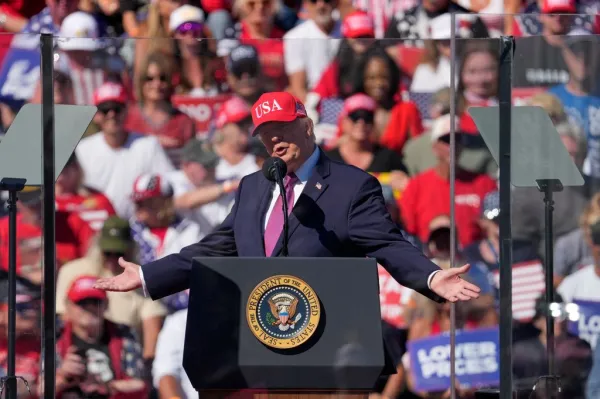
Trump, like Bush, is in his second term after winning the popular vote for the first time. 

Democrats like this comparison. They won 31 seats in the House and five in the Senate to take the majorities in both chambers. In 2008, they added to those majorities and saw Barack Obama elected president with the highest percentage of the popular vote in the 21st century. Democrats briefly even held a filibuster-proof Senate majority in 2009.

Trump undoubtedly dislikes this analogy because he wanted to repudiate Bush-style Republicanism. He defeated Jeb Bush and 16 other Republicans to win the nomination in 2016, and he effectively ran the Cheneys out of the GOP by 2024.

There are important differences as well. Iraq had been going on longer by 2006 than the Iran conflict has been up to this point, as Trump frequently notes, and there have been fewer American casualties.

Inflation, the biggest economic concern right now, largely remained a distant memory from the early 1980s in 2006.

Rep. Nancy Pelosi (D-CA) was on the verge of becoming House speaker for the first time. Now she is retiring.

Trump had just wrapped up his fifth season as host of The Apprentice. Now he is entering a decade as the titular leader of the Republican Party, a longer run than most two-term presidents because he is the first to serve nonconsecutive terms since Grover Cleveland.

But Republicans hope the biggest differences will include the number of safe congressional seats in their majority, which they have tried to bolster through mid-decade redistricting. In addition to gerrymandering and increased political polarization, both parties have had multiple wave or near-wave elections since 2006, taking over the other side’s most vulnerable districts.

The House has changed control four times since 2006, the Senate seven times since the 1994 elections.

This could mean that there are fewer competitive districts now than in 2006. Walter’s own Cook Political Report has estimated that redrawing of districts alone has dropped the number of swing seats from 87 to 77, and that Democrats need to win at least 57 of them to retake control.

“It is anticipated for the days ahead that whomever is in the majority, it will be a small majority,” House Speaker Mike Johnson (R-LA) told the Washington Examiner ahead of the 2024 elections. That certainly proved true, giving Democrats a shot at winning this year by only flipping a handful of seats and Republicans reason to think any loss could be short-lived.

Republicans hope a favorable map and hefty campaign war chest can compete with objectively bad national conditions this fall. Democrats are hoping those conditions, driven in part by Trump’s job approval rating, which just hit a second-term low in the RealClearPolitics average of polls, will expand the number of competitive seats to their benefit.

MAJORITY OF AMERICANS SAY IRAN WAR HAS FAILED, ‘NOT WORTH THE COST,’ POLL SAYS

The other potential distinction is the rise of socialism among Democrats, with Abdul el Sayed winning a Senate primary in a battleground state just this week. The Democrats’ brand remained poor in most polling before socialists started winning primaries. It may prove a bridge too far for at least some voters this time around.

Other than that, there is little reason to expect Republicans to defy history this year. The party that holds the White House has lost congressional seats in all but two midterm elections dating back to 1938. They just have to hope it won’t be the “thumping” Bush described after the party’s losses in 2006.