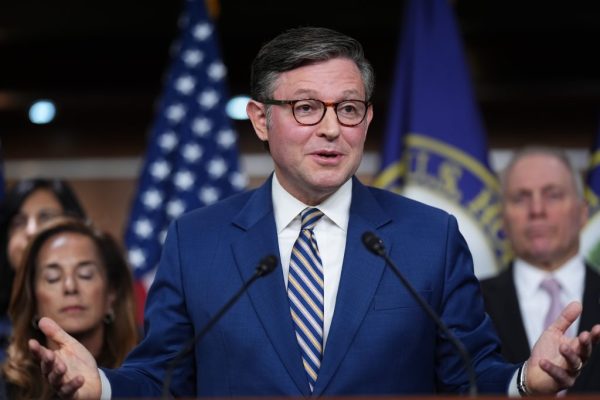
Speaker Mike Johnson‘s (R-LA) jam-packed August recess has brought him all over the country as he fights to defy history by keeping the House majority and deliver President Donald Trump a trifecta for his final two years in office.
Johnson has campaigned with over a dozen candidates over the last three weeks, many of whom are in competitive districts, visiting states as far east as Maine and as far west as the Last Frontier in Alaska.
Recommended Stories
In his latest stop, the speaker made his way to Pennsylvania on Wednesday, where he campaigned with three of the 15 Republican “tossup” seats — Reps. Rob Bresnahan (R-PA), Ryan Mackenzie (R-PA), and Scott Perry (R-PA).
“The August road trip across America became a fixture under John Boehner, who continued campaigning for Republican candidates even after handing over the speaker’s gavel and leaving Congress,” GOP strategist Dennis Lennox told the Washington Examiner. “Raising money and showing up for candidates is what a party leader does.”
“Johnson’s very presence conveys a simple message to influential interests in majority-making districts: Do you want your congressman in the majority with the influence that comes with it?” Lennox said.
Johnson joined Reps. Bill Huizenga (R-MI) and Tom Barrett (R-MI), as well as candidate Michael Bouchard, Tuesday. Barrett, who represents a Lansing-area seat that is one of the most competitive in the country, faces progressive William Lawrence in a boon for the GOP. Lawrence knocked off two establishment-backed moderates.
Bouchard, an Army veteran, is gunning for Rep. John James’s (R-MI) seat as he runs for governor.
The speaker has joined four other vulnerable incumbents during his August travels: Reps. Derek Van Orden (R-WI), Juan Ciscomani (R-AZ), Jen Kiggans (R-VA), and Gabe Evans (R-CO). Evans, similar to Barrett, also caught a break after progressive state Rep. Manny Rutinel defeated former state Rep. Shannon Bird in the Democratic primary, but the race is still expected to be competitive.
“Wisconsin’s 3rd District is so critically important, and Derek is one of President Trump’s strongest allies and advocates in the House,” Johnson said in a video posted Monday. “He’s absolutely essential to all the important things we’re doing for the American people. This is a serious battle, though we cannot take it for granted.”
Johnson headed up to northern Maine to stump for former Gov. Paul LePage as he runs for one of the top flip opportunities for Republicans this cycle. LePage is aiming to flip retiring Rep. Jared Golden’s (D-ME) seat, where Trump won three times. LePage also won the sprawling Maine district during his three runs for governor.
On his nationwide tour, Johnson has highlighted his “Contrast for America” platform, including a stop for former NFL kicker Jay Feely in the Scottsdale, Arizona, area. The platform emphasizes a choice between “common sense” and “crazy” and ties Democrats to the slate of socialist candidates the party has nominated in various seats nationwide.
Johnson also waded into some Democratic-held seats, to pivotal swing districts if Johnson and Republicans want to buck history and grow their narrow majority. He campaigned with Laurie Buckhout, who’s due for a rematch against Rep. Don Davis (D-NC), albeit in a more GOP-leaning seat following redistricting earlier this year.
He also campaigned with John Braun, a state senator running against Rep. Marie Gluesenkamp Perez (D-WA), in the Portland, Oregon, suburbs.
Both Reps. Jeff Crank (R-CO) and Nick Begich (R-AK) also welcomed Johnson, though both candidates are currently favored in their reelection matchups.
MEET THE 10 MEMBERS WITH ONGOING ETHICS INVESTIGATIONS
The speaker still has a hefty travel schedule for the rest of the month as he heads to New York, New Jersey, Texas, Nevada, and New Mexico to promote the policies in the GOP’s One Big Beautiful Bill Act and tout his candidates in crucial battleground areas.
Johnson’s heavy recess schedule comes as he has navigated the narrowest margin in House history. Redistricting efforts across the country have allowed Republicans to emerge with a narrow advantage in seats netted through gerrymandering, providing them with some built-in political insulation before votes are cast in November.