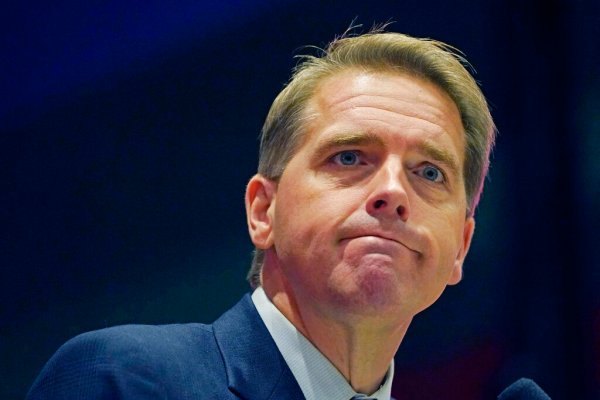
It would be unusual if conservative commentator Scott Jennings left the CNN studio for the White House briefing room as President Donald Trump’s next press secretary, but not unprecedented.
When Pat Buchanan returned to the White House to serve as communications director for President Ronald Reagan in 1985, he had already been a top pundit at a time when Fox News didn’t exist and there still weren’t a lot of conservatives on television.
Recommended Stories
Buchanan had been a syndicated newspaper columnist, a commentator for NBC radio, host of a radio show with liberal pundit Tom Braden, a co-host of CNN’s Crossfire (originally with Braden but most famously with liberal journalist Michael Kinsley), and a founding panelist of two of the most important political talk shows of the time, The McLaughlin Group and Capital Gang.
The conservative brawler had received a master’s degree from the Columbia University Graduate School of Journalism and initially plied his trade as an editorial writer for the St. Louis Globe-Democrat. But he soon became a close political aide to Richard Nixon, following the former vice president along what was at the time a great political comeback from being defeated by John F. Kennedy in the 1960 presidential election to winning the White House eight years later and then being reelected in a 49-state landslide.
Buchanan loyally served Nixon as a speechwriter and strategist until Watergate brought an end to his presidency. He stayed on briefly with Gerald Ford after Nixon resigned in 1974 before becoming one of the top conservative voices in the media. But by Reagan’s second term, after his own 49-state landslide reelection, he needed reinforcements from movement conservatives with substantial communications experience. Enter Buchanan.
Another possible precursor to Jennings was Tony Snow, who, like Buchanan, had been a newspaper editorial writer and radio host who ultimately did a stint as a presidential speechwriter (for George H.W. Bush). Also like Buchanan, Snow wrote a nationally syndicated column (for Creators, the same syndicate). Snow was a popular guest host for conservative talk-radio giant Rush Limbaugh in the 1990s.
In April 2006, President George W. Bush tapped Snow as White House press secretary. Unlike Buchanan, in that capacity he was forward-facing and delivered the daily briefings to reporters. Snow came on as the Iraq war was declining in popularity and Democrats were poised to win the midterm elections. Snow’s vast media experience made him an able defender of the president, something Jennings could draw on in a much uglier political environment.
A Democratic model for Jennings might be Jay Carney, who spent 20 years at Time, eventually becoming the magazine’s Washington bureau chief, before becoming Vice President Joe Biden’s communications director and ultimately President Barack Obama’s White House press secretary. Carney’s prior television work had been less polemical than Buchanan or Snow’s, as he appeared on camera as a political analyst before being enlisted by the Obama-Biden team. Snow was somewhat measured compared to Jennings today; Buchanan in his prime was more of a bomb-thrower (although Snow quipped in the 1990s that Buchanan spoke in the tone of a mugger assuring his victim that nobody would get hurt if the billfold was handed over).
While Jennings has been a popular television personality, podcaster, and columnist, he is more of a political operative by background. His closeness to Sen. Mitch McConnell (R-KY) and past work for George W. Bush might at first appear disqualifying for the Trump White House.
But Jennings has emerged as a leading Trump defender. Republicans of his ilk have warmed to the president since the 2024 campaign. While Trump’s clashes with the GOP governing class are hardly over, some Republicans who were reluctant supporters of his have backed him more fervently on issues like the Iran war than early adopters in media, such as Tucker Carlson.
Kayleigh McEnany cut her teeth as a willing Trump supporter on CNN before becoming White House press secretary. But McEnany’s career trajectory is much more typical of someone in that role: being White House press secretary expanded her media profile and made her into a much bigger television commentator. Dana Perino, who replaced Snow as Bush’s press secretary, and George Stephanopoulos, Bill Clinton’s White House communications director, followed this path to media stardom. Jen Psaki, Biden’s most successful press secretary, has her own show on MS NOW, and his former communications director Kate Bedingfield is a regular on CNN.
This proved true even of Trump comms aides who broke with him near the end of his first term, such as Alyssa Farah Griffin, who is now the main conservative co-host of The View, and Sarah Matthews.
Trump’s current top spokeswoman, White House press secretary Karoline Leavitt, is stepping down at the end of the month. She previously ran for Congress in her home state of New Hampshire.
TWO REASONS TRUMPWORLD THINKS LEAVITT’S REPLACEMENT WILL BE A WOMAN
Of course, Sarah Huckabee Sanders was able to jump from her time as Trump White House press secretary to governor of Arkansas, a job once filled by her father. By the end of his run as White House communications director, Buchanan was a plausible presidential candidate who twice finished second for the Republican nomination. A few years before his first run, Buchanan observed that “the greatest vacuum in American politics is to the right of Ronald Reagan.”
Jennings has also been talked about as a political candidate in his own right. Whether a talking head of his stature wants to become a White House staffer, even a fairly senior one, is another story. But it’s been done before.