Iowa focus group’s warning to Republicans: Farm tariff pain could cost you the Senate

Published August 24, 2026 11:45am ET


Welcome to Monday’s Washington Secrets. A lot has changed in the Senate races during the past week. What was supposed to be an easy hold for Republicans now looks like a proper contest. Today, we have exclusive focus group research from Iowa, detailing the issues that matter to independent voters there and how they will make their decision. It is not good news for Republican hopes of holding the seat vacated by Joni Ernst.

The road to the Senate runs through Iowa.

Technically, Republicans can lose the Hawkeye state and hold the upper chamber. Their three-seat majority means they have a little wiggle room.

But in reality, losing Iowa, where Donald Trump triumphed by more than 13 points just two years ago, would spell the sort of Democratic dominance that would put huge pressure on Republican-held states such as Alaska, Maine, North Carolina, and even Ohio and Texas. It would be game over.

Last week, things shifted in the wrong direction for Republicans. The influential Cook Political Report moved Iowa (and Texas) from its “leans Republican” column to “toss-up.”

To test the terrain, J.L. Partners recruited a panel of six Independent voters — four men, two women; four who described themselves as “moderate,” one who said they were “somewhat left-wing” and one “somewhat right-wing” — to talk about the issues that matter to them.

The results may make difficult reading for Republican strategists, but they also suggest ways to craft a message that could yet see the state stay red.

Top concern: Tariffs and cost of living

No surprises here. It’s always the economy, stupid. Affordability worries propelled Trump to power and have stayed at the top of voters’ concerns ever since.

The problem for Republican Ashley Hinson is that the president is tied to high prices in a very specific way in Iowa.

“It’s all Trump,” said Don, 68, of Chariton. “Trump and Republicans. Higher tariffs.”

He said he didn’t think tariffs were necessarily a bad thing in themselves, “but the shotgun approach at tariffs that Trump is doing… It’s not good business sense.”

Tariffs have been a huge issue in a state where farming communities have struggled with rising costs and falling crop prices.

Jessica, 44, of Grimes, said: “ For our state, I think the biggest issue — just from what I’ve seen online — is that the farming community’s been really messed with by this tariff situation. A lot of farmers are having trouble finding a market for the soybeans, but now that China’s backed out.”

Cancer worries

Iowa has the second-highest cancer rate in the United States. It is growing at a time when rates are declining elsewhere across the country. Those worries are tied to high levels of nitrates in the water.

Don, 68, from Chariton, said: “Cancer is increasing enormously in the state of Iowa. Why? Because we’re dumping so much chemicals into our farm fields that are going into our water supply.”

But participants were skeptical that elected officials could actually change the issues they care about, and criticized politicians for talking rather than actually delivering results. Even when participants had a favorable impression of a candidate, they said they were unsure whether they could actually follow through.

 ”I just don’t think that, like, a senator or a representative or even a governor is really gonna affect it that much,” said Aaron, 36, from Des Moines, who said he considered himself somewhat right-wing.

National politics dominate

Half of the group was largely unaware of the Senate race, the candidates, and their platforms. Even those who had tuned in said they would be voting against the party they liked least.

Overall, they saw the election as a way to define the country’s direction.

“We gotta take Washington back,” was how Scott, 63, from Ames, put it. He describes himself as somewhat left-wing.

“[I’m voting for] Control of Congress, which will rein in the administration… I think Mike Johnson has been incapable of using congressional authority to be that third leg of the stool and has let the administration run rampant,” Scorr said.

On the other hand, Darrell, 71, from Humeston, said: “If it comes down to it, and it’s a really close race, I’ll probably go Republican because it’ll help Trump.”

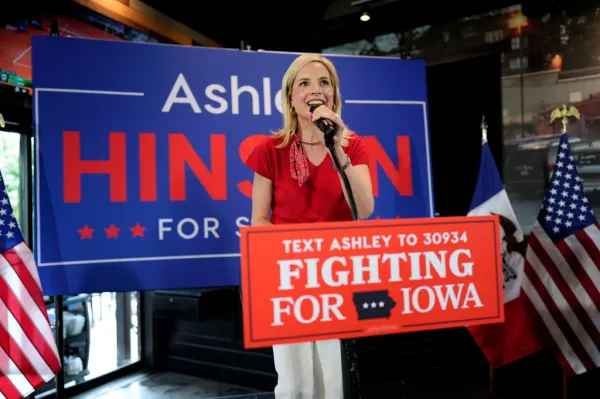
Ashley Hinson

Rep. Ashley Hinson, R-Iowa, arrives at a campaign rally with local residents, Saturday, May 30, 2026, in West Des Moines, Iowa.
Rep. Ashley Hinson, R-Iowa, arrives at a campaign rally with local residents, Saturday, May 30, 2026, in West Des Moines, Iowa. (AP Photo/Charlie Neibergall)

The Republican candidate — a former local TV news anchor who has represented Iowa’s 2nd Congressional District since 2021 — is well regarded by the party hierarchy. That doesn’t matter to the panel.

Participants didn’t seem to know much about her platform (one even thought she was a Democrat at the start of the interview), but recognized her as a Republican moderate, in line with the party’s agenda but not a blind loyalist to the MAGA movement.

“She’s not jumping on the MAGA train,” said Scott. “She’s not using Trump endorsements. I don’t hear anything that scares me about her.”

But there were worries about her support for Trump’s One Big Beautiful Bill Act and her moves to reform Medicare and Medicaid.

“She’s not doing anything for the tariffs, which are hurting our farmers… cutting Medicare and Medicaid, and we have outlying medical facilities shutting down because they can’t afford to stay open,” said Don.

Josh Turek

Iowa state Rep. Josh Turek speaks during a primary election night watch party after winning the Democratic nomination for U.S. Senate, June 2, 2026, in Des Moines, Iowa.
FILE – Iowa state Rep. Josh Turek speaks during a primary election night watch party after winning the Democratic nomination for U.S. Senate, June 2, 2026, in Des Moines, Iowa. (AP Photo/Bryon Houlgrave, File)

Hinson is up against Josh Turek, a two-time basketball Paralympic gold medalist and state legislator.

The Democratic candidate won more support from the panel, largely because he was seen as a political newcomer and underdog rather than as someone offering a platform that excited people. The consensus was that he would do a better job on healthcare than Hinson, even if they were vague on his positions.

“He’s handicapped, in a wheelchair,” is how Don described him. “Three-time [Paralympian]… he’s young and up-and-coming. He’s got a lot of great ideas, and that’s what we need.”

Jessica, 44, from Grimes, said she had the same concerns with him as she did with any politician: “Who’s funding their political campaign, who are their biggest donors and what do they want?… I need to research that.”

But in a sign of the work still to be done by each campaign, none of the participants mentioned either candidate’s plans to address their biggest concerns: cost of living, water quality, cancer, and safeguarding farming.

The verdict

This isn’t a poll. This is six people. It is designed to represent a strand of thinking among Independent voters, to tease out the issues and concerns that drive the headline poll numbers. So with that proviso, this is how the panel said they planned to vote.

  • Scott: Intends to vote for Turek but added that he “wouldn’t be horrified” if Hinson won. He prefers Turek because of what he sees as the Democrat’s focus on action rather than words, and ultimately Scott’s priority was to “take Washington back.”
  • Jessica: She originally thought Hinson was a Democrat, and expressed support for her before she knew which candidate was which. But she said she plans to vote for Turek because she “doesn’t want Republicans in the Senate for Iowa, period.”
  • Darrell: Though he tends to vote for the Republican Party, he said if the election were today, he’d vote for Turek because of his distrust of Hinson. However, he said that if the race were close, he’d likely change to Hinson to retain Trump’s Senate majority.
  • Don: Plans to vote for Turek because of Hinson’s tariff votes, her perceived opposition to Medicaid/Medicare funding protections, and her support for the war in Iran.
  • Aaron: Plans to vote third-party as a protest of the two-party system. Though he tends to vote Republican on the local level, neither Turek nor Hinson motivates him.
  • Denise: Intends to vote for Turek because she feels Hinson would be a continuation of Ernst, and says she will not vote for a Republican this cycle (on the national level).

Secrets‘ view is that this is bad news for Republicans, but it is not the end of the story. Many voters are not much engaged in the races yet. And this was clear from a panel that seemed to know little about the candidates’ platforms. Jessica didn’t even know which candidate was which.

Yet there is still time. Republicans have an opportunity to define the race and their opponent with an advertising blitz once the party’s high command weighs in with its huge war chest. But they have a fight on their hands in a state that was safe territory just two years ago.

Quote of the day

Last week’s Lunch with the FT featured Errol Musk, father to the world’s richest man. He was interviewed over steak at a restaurant on South Africa’s west coast and delivered what author David Pilling called several fork-drop moments during their four-hour conversation.

Like many aging white South Africans, he says he never saw signs of oppression during apartheid.

“I was not in favor of apartheid,” he says. “We never practiced any kind of apartheid at home with our staff.”

If you want to understand more about the man described variously by Elon Musk as a “terrible human being” and “evil,” then the full piece is well worth a read if you have a subscription.

Lunchtime reading

Inside the leftist network working to sabotage Trump’s DC prosecutions: Two Washington Examiner reporters attended a training session for Trump opponents who want to ensure they can get through jury selection without being spotted.

Why Democrats still have a shot at winning the Senate: And this follows on from the Iowa focus group. Michigan and Maine may not have gone quite as planned for Democrats, but voter enthusiasm is high among their supporters, bringing more states into play.

You are reading Washington Secrets, a guide to power and politics in D.C. and beyond. It is written by Rob Crilly, who you can reach at [email protected] with your comments, story tips, and suggestions. If a friend sent you this and you’d like to sign up, click here.