A month ago, on Real Time with Bill Maher, Maher spoke with Mike Rowe about the enormous demand for qualified tradespeople. It was serendipitous that the conversation came as white-collar workers and lawmakers are confronting a different question: What happens to American workers as artificial intelligence transforms the economy?
The debate about the future of blue-collar and white-collar work in the age of AI is interesting because it is one area with cross-partisan overlap. In June, Sen. Bernie Sanders (I-VT) proposed public ownership of major AI companies through an AI sovereign wealth fund. President Donald Trump has floated a considerably different version of the idea: giving the people an ownership interest in leading AI companies.
Recommended Stories

The proposals are radically different, but the convergence is worth noticing. Republicans who spent years warning about socialism have embraced tariffs, subsidies, and industrial policy to reshore strategically important industries. Democrats who once defended globalization have embraced many of the same policies. Progressives and national conservatives, for very different reasons, are entertaining a larger federal role in developing and financing strategically important technologies.
America needs a serious conversation about sovereign wealth funds, free-market capitalism, regional autonomy, industrial policy, and the government’s role in an economy increasingly shaped by artificial intelligence.
For the most part, I favor free trade and free markets, and I like the idea of giving local municipalities more control in data center creation, as proposed by Rep. Tim Burchett (R-TN). However, I also like much of the recent reshoring produced by the successive policies of Trump, former President Joe Biden, and Trump again. I know there is a contradiction there. I live with it daily.
Even Adam Smith left some room for this contradiction. In The Wealth of Nations, Smith generally favored allowing people to direct their own capital but recognized a role for government in providing public works and institutions whose benefits to society could exceed the returns available to an individual investor. He was also deeply suspicious of governments directing private industry.
That tension is useful for the AI era. The question isn’t whether the government should replace markets. It’s whether there are limited circumstances in which markets alone cannot provide something the country has a compelling interest in possessing.
This may be one of the few areas where America’s political factions have more in common than either would like to admit. Progressives worry about workers displaced by AI and want the public to share in the prosperity it generates. National conservatives worry about dependence on China and America’s ability to manufacture strategically important goods. Classical liberals worry, with good reason, about Washington picking winners and losers and “national security” becoming the magical phrase that transforms every corporate handout into industrial policy.
They all have a point.
So build the data centers. Build semiconductor fabs and nuclear plants — mine critical minerals. Let private companies compete, innovate, fail, and make enormous amounts of money.
American precedent exists for the government helping build the infrastructure around technological revolutions. During the early Cold War, federal research spending, defense procurement, and military demand helped create the environment in which America’s semiconductor industry, and eventually Silicon Valley, flourished. Washington didn’t need to own the companies to help create the ecosystem in which they succeeded.
If Washington is now going to go further and take equity, however, it should behave like a disciplined investor rather than an ATM for whichever corporation most effectively attaches “national security” to its slide deck.
Establish rules for what qualifies for investment. Cap exposure to individual companies. Don’t allow strategically important firms to return endlessly for bailouts. If taxpayers assume the downside risk, they should receive some of the upside. Investments should be transparent and diversified, not driven by political favoritism.
If those investments generate substantial returns, the government’s equity could eventually form part of a sovereign wealth fund, allowing people to participate in the next economic boom rather than merely observe it.
With the debt being around $40 trillion, it feels like an awkward time for the White House to start building out its venture capital portfolio.
If we can’t figure this out, here is my proposal: Data World. If we’re going to creep a little closer to China’s economic model, we might as well embrace some of its tackier cultural impulses. Don’t ban data centers. Let’s build them. But like the gold flourishes of the Oval Office, let’s make them tacky but useful.
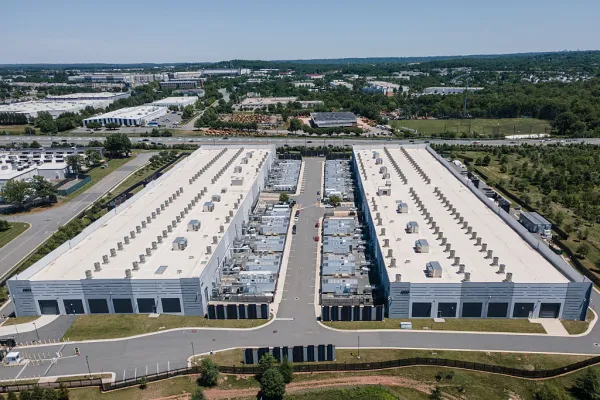
Rather than another enormous anonymous box dropped onto former woodland, make data centers regional tourist attractions. One looks like Paris. Another Tokyo. Another New York. Heck, let’s have a Buc-ee’s-inspired one. Put a sportsbook in the lobby, add restaurants, and build an observation deck where you can watch absolutely nothing happen. If a forest is bulldozed to build it, build an artificial forest inside. Of course. There will be a gift shop and a nightly drone show. Children will inexplicably demand that their parents take them. This has to create at least 15 permanent jobs per location.
The AI revolution isn’t occurring abstractly in the cloud — it will require enormous physical infrastructure and environmental resources. These data centers exist in communities whose residents are being told that these sacrifices are necessary because AI represents the next great economic revolution.
It’s the same question we should ask about industrial policy. If taxpayers assume the risk, what do we receive? If AI creates extraordinary wealth while eliminating existing jobs, how do ordinary people participate in the new economy?
I am not satisfied with any politician’s proposals, like many things the current administration has done. It’s unfair to make data center creation a litmus test for whether you are a loyal Trump Republican, and it doesn’t address larger questions.
Nor do I think the answer is the growing impulse to impose moratoriums on data centers or treat every new AI facility as an environmental and economic menace. The infrastructure has to be built somewhere. The better question is how we build it, who pays for it, and what the communities hosting it receive in return, which is why I like the idea of giving some regional autonomy on this issue.
TRUMP GETS FULL SAY OVER THE WHITE HOUSE LAWN. HIS EPA IS TAKING AWAY YOURS
The federal government is already intervening in strategically important markets. AI will require enormous amounts of physical and financial capital. And neither pure laissez-faire nor central state planning offers a particularly satisfying answer for what’s next.
The interesting debate isn’t whether industrial policy is socialism. It’s what sane industrial policy looks like. And if we can’t figure that out, I’ll see you at Data World.
Patrick McFarland is a client partnerships representative at Quorum.