
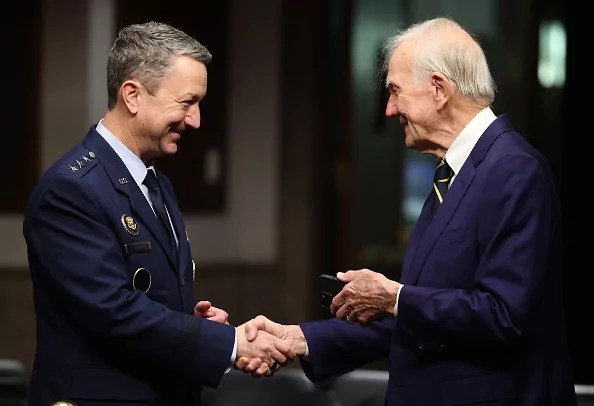
Hung Cao appeared in front of the Senate Armed Services Committee for his confirmation hearing on Tuesday morning.
Pentagon Posture was in attendance for the hearing, which was fairly tame compared to many other congressional hearings featuring Trump-era defense officials. There were no outbursts or interruptions from protesters who have long carried out such protests.
Recommended Stories
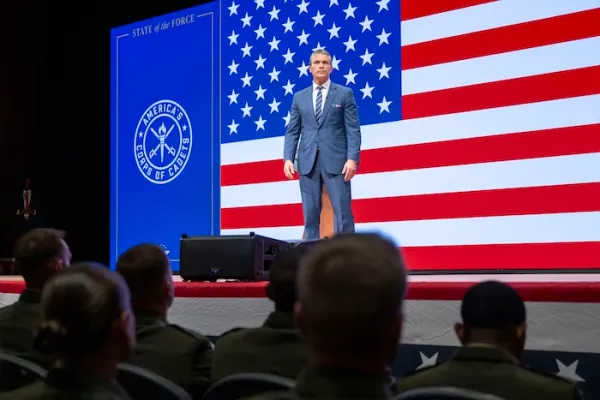
Cao assumed the role of acting secretary on April 22 following the firing of John Phelan. Before that, he had been the undersecretary of the Navy since October 2025. During his time in the Navy, he served as an explosive ordnance disposal officer, and he led missions for special warfare and special operations forces during deployments to Iraq, Afghanistan, and Somalia.
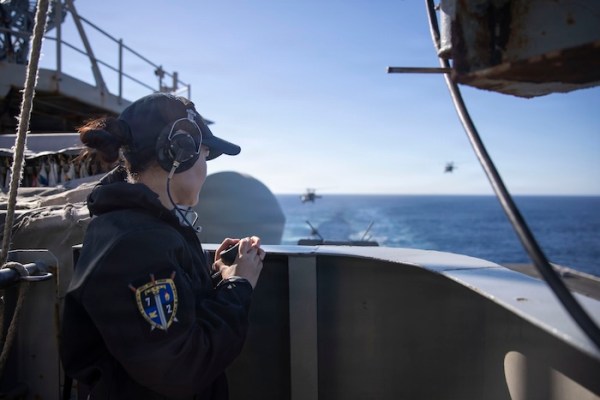
This was Cao’s first time testifying on Capitol Hill in a public hearing since May, and he faced questions about the Iran war, specifically about the well-being of sailors and Marines aboard vessels in the region as well as the physical costs of the conflict.
Notable moments
In September, Cao acknowledged in a letter to Sen. Kirsten Gillibrand (D-NY) that there had been eight sailors from the USS Abraham Lincoln’s carrier strike group who unsuccessfully attempted to commit suicide.
He was asked about the attempted acts of self-harm multiple times during the hearing, and he said, “You see eight suicide attempts; I see eight suicide mitigations because of the challenge we have on board with the deployment resiliency counselors and as well as mental health specialists.”
Cao also got into a disagreement with Gillibrand over a sailor who threw himself overboard. The nominee said the sailor, who jumped overboard with a life preserver on, “was not trying to kill himself,” and that he “admitted” that to the commanding officer, while the New York senator sarcastically asked whether the sailor was trying to “swim to Guam” to avoid his duties.
Cao pushed back on media reports and questions from lawmakers about a lack of food and supplies during the extended deployments in the Middle East. Sen. Mark Kelly (D-AZ) said a parent told him that their child lost 45 pounds in six months due to a lack of food.
The nominee affirmed no U.S. vessel has run out of supplies completely, and he doesn’t like it when a ship gets below two weeks left of supplies. He compared troops complaining about a lack of food to his children “opening up the refrigerator door and saying there’s nothing to eat here.”
Multiple Navy vessels have faced extended deployments in recent years, both before and during the war, straining the service members and the fleet itself. The USS Spruance and USS Michael Murphy returned home over the weekend after 357- and 346-day deployments to the Middle East, respectively, both of which are believed to be longer than any previous destroyer deployment since World War II. Both were deployed as part of the Abraham Lincoln Carrier Strike Group.
In September, Cao acknowledged that Iranian forces “blew the hell out of Bahrain,” a reference to Naval Support Activity Bahrain, home of the U.S. 5th Fleet, and it’s still one of the most candid assessments of damage U.S. bases sustained during the war. His comment was brought up by multiple senators, including in ranking member Jack Reed’s (D-RI) opening remarks, but he did not provide additional information.
During another notable moment, Sen. Mike Rounds (R-SD) urged Cao, and the Pentagon more broadly, to stop Republican-only defense briefings.
“Are you aware that on multiple occasions where there have been classified discussions, my Democrats weren’t invited?” he asked, adding, “I don’t recall that you were necessarily in those meetings or not, but I want a commitment from you, and we’ll ask it from others, that we move this back to a bipartisan basis when it comes to sharing critical information in the defense of this country, and that requires a cooperative effort on your part in the future.”
Cao agreed with Rounds’ request.
Only tangentially related to Cao’s confirmation: Army Maj. Stephen Ramsbottom filed a whistleblower complaint to Congress alleging senior officials ignored warnings and were not adequately prepared for drone threats ahead of the war with Iran. He sat down with 60 Minutes and described the deadly attack at Port Shuaiba, Kuwait, that killed six U.S. service members as “a tactical failure by the Army, our leadership, and myself.”
In response to the report, President Donald Trump posted on social media that the “new people running 60 Minutes are even worse than their predecessors.” He pointed out that the overwhelming majority of Iranian drone and missile attacks were stopped. Twenty-three service members have died in the region since the war began, 11 of those deaths being qualified as “hostile” in the military’s public database.
Key hurdle to overcome
Federal law requires all U.S. service secretaries to have been retired from active duty for seven years, and the only way around the requirement is to get a waiver from both the House and Senate. Cao retired as a captain in 2021, making him short of the mandate by about two years.
Congress has granted this waiver twice in the last 10 years: for Gen. Jim Mattis to serve as secretary of defense in 2017, and for Gen. Lloyd Austin, also for secretary of defense in 2021. Prior to those two recent examples, Congress last utilized this loophole for retired Army chief of staff Gen. George Marshall.
“Hung Cao is the man for the job; we need to give him the waiver and confirm him ASAP. It’s critical to the U.S. Navy,” Sen. Jim Banks (R-IN), who is on the committee, told the Pentagon Posture before the hearing. Sen. Rick Scott (R-FL), another committee member, was less optimistic about having the necessary votes, telling Pentagon Posture prior to the hearing, “I don’t know about that.”
Current Pentagon leaders have often clashed with Democrats on Capitol Hill who have not been in favor of the changes they’ve implemented across the services under Secretary of War Pete Hegseth, making it hard to see widespread bipartisan support for Cao’s confirmation. Cao also won the GOP nomination in 2022 for a House race in Virginia and again in 2024 for a Virginia Senate seat but lost to the Democrat incumbent both times.
He was confirmed as undersecretary in a 52-45 vote. No Democrat voted in favor of his confirmation, and Sen. Lisa Murkowski (R-AK) was the only Republican not to support it.
No Democrat on the committee publicly shared their support for Cao’s nomination during his confirmation hearing, underscoring uncertainty about whether he will have the support needed to get the waiver.
THE GOP’S NATIONAL SECURITY LAME-DUCK PRIORITIES
Unconfirmed nominees
There are several other Pentagon officials operating in an acting capacity who are either awaiting a confirmation hearing or awaiting the president’s nomination. The Army’s top officer and civilian leader are serving in acting capacities after Hegseth fired the people in those positions — Gen. Randy George and Dan Driscoll. On Monday, Trump nominated Gen. Christopher LaNeve, the current acting Army chief of staff, to fill the position.
The president will have better luck getting nominees confirmed during the lame duck session than in the next Congress, where Democrats will have a several-seat majority.
This is Pentagon Posture, written by senior defense reporter Mike Brest. You can follow me on X at @mikebrestdc, my email address is mbrest@washingtonexaminer.com, and I can be reached on Signal at mikebrest.80. Send tips, suggestions, calendar items, or just talk sports with me. If you aren’t already subscribed, do so here, and if you are, sign up a friend!