

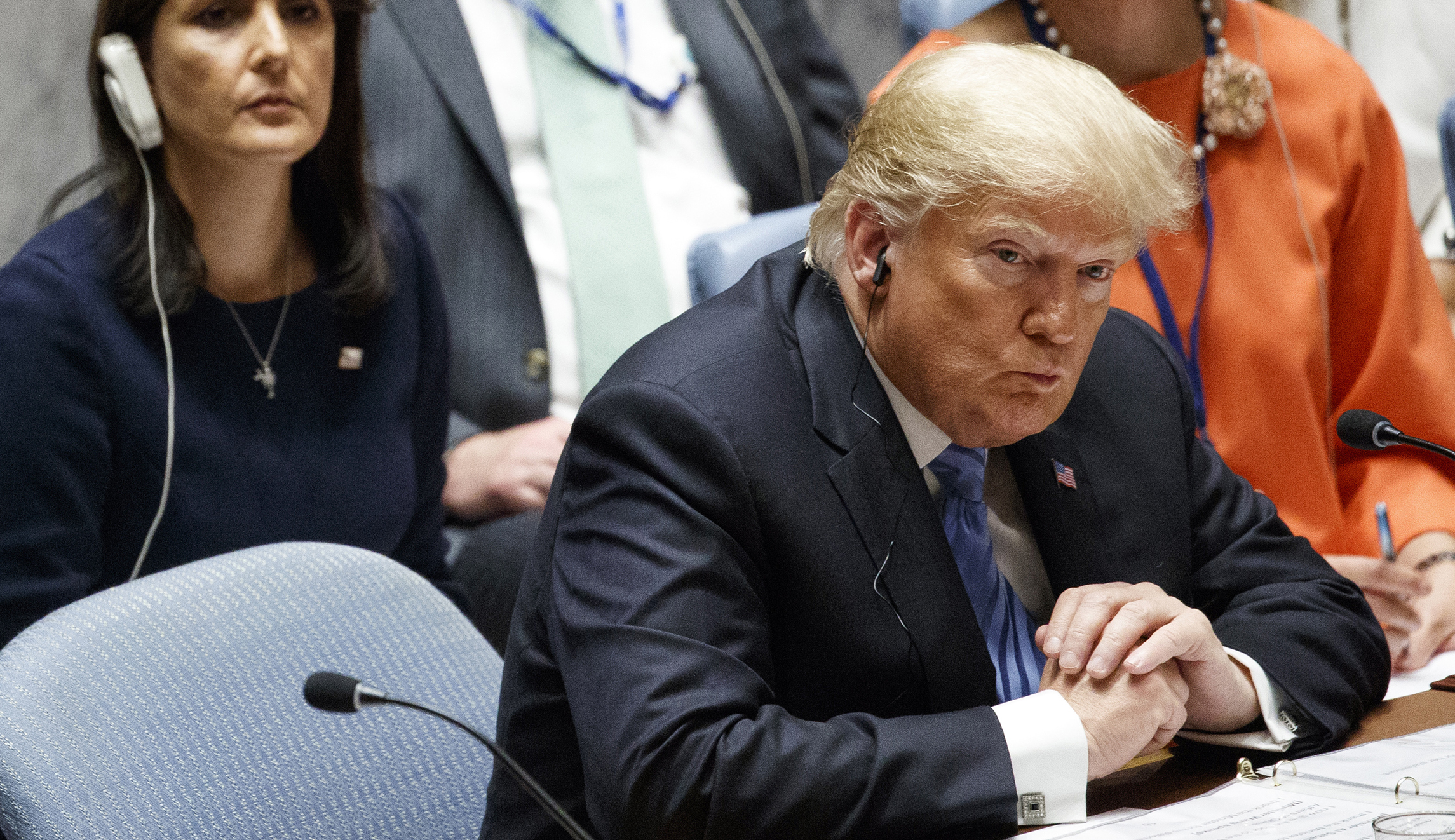
Chairing a United Nations Security Council meeting on Iran on Wednesday, the president found himself alone among the 5 permanent Security Council members in supporting harsher policies toward the Islamic Republic. This isolation was expected. Still, it’s worth digging into why the world is so uninterested in the Trump administration’s strategy on Iran. Because that opposition has more nuanced motivations than some perceive.
First off, let’s consider China and Russia. These states are essentially unconcerned by aggressive Iranian activities because those activities pose little difficulty to their interests. Indeed, Vladimir Putin sees Iranian feuding with Saudi Arabia and Israel as an opportunity to assume a more dominant position as a Middle Eastern power broker. But Iran is also seen as a potential windfall opportunity. Whether in long term energy or telecommunications investments, Beijing and Moscow see Iran as a place to make money while fraying U.S.-led international order and influence in the Middle East. It’s a double win!
Recommended Stories


European interests are more nuanced. Germany, as Ben Weinthal notes, is pretty much in the tank for Iran. But while the British and French governments are skeptical of Iranian behavior and invest significant resources in related intelligence efforts, they also believe that the 2015 nuclear agreement is restraining Iranian expansionism. And while France shares U.S. concerns over Iran’s ballistic missile program, President Macron believes the issue should be addressed alongside the continuing nuclear deal rather than outside it. This explains why the French have been so determined to save the deal with sanctions evasion mechanisms.
Crucially, however, the Europeans do not share the measure of America’s anger over Iranian revolutionary activities in places like Baghdad and Beirut. This is partly because they do not want to invest in a potentially violent showdown with the Iranian hardliners. It’s no small concern in that European governments have allowed the Iranian revolutionary guards and the Iranian intelligence service to infiltrate their territory. As a result, Iran’s ability to carry out attacks on European soil is far more significant than in the United States (although that threat is not low). And that fuels the ultimate European deliberation: fear. The fear that supporting a showdown with Iran will lead to another Iraq War. This means there is next to zero political appetite for supporting the Trump administration in its apparent effort to see the Iranian regime’s collapse.
In short, the Chinese and Russians actively oppose the U.S. conception of interests in Iran, and the Europeans are disinterested in resolving those concerns via the Trump administration’s strategy.
