

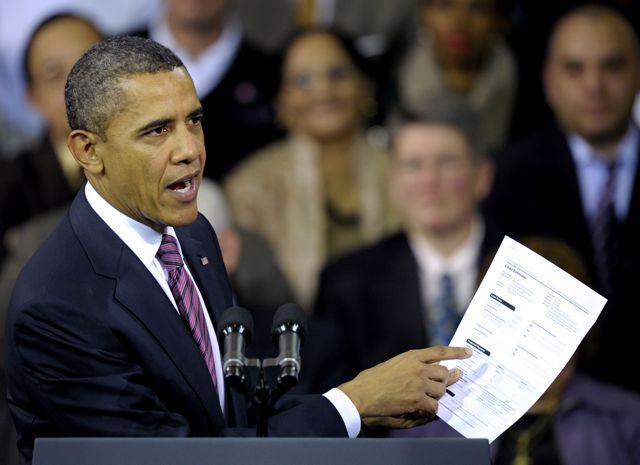
If there were a central theme to President Obama’s meteoric political rise, it was that lawmakers needed to abandon political point-scoring and instead work together to make tough choices to deal with our nation’s problems. With his budget due this month, Obama has one last chance to live up to this promise.
Standing before more than a million cheering fans moments after being sworn into office, Obama lamented “our collective failure to make hard choices and prepare the nation for a new age.”
A month later, after signing into law a $787 billion economic stimulus package, he held what was billed as the White House “Fiscal Responsibility Summit” meant to address deficit concerns and returned to this theme.
“In the coming years, we’ll be forced to make more tough choices, and do much more to address our long-term challenges,” Obama declared.
He continued, “The casual dishonesty of hiding irresponsible spending with clever accounting tricks, the costly overruns, the fraud and abuse, the endless excuses — this is exactly what the American people rejected when they went to the polls. They sent us here to usher in a new era of responsibility in Washington; to start living within our means again, and being straight with them about where their tax dollars are going, and empowering them with the information they need to hold all of us, their representatives, accountable.”
As it turned out, the pivot to “fiscal responsibility” was really about pushing health care legislation, which added trillions to our long-term entitlement obligations and relied on some of the same sort of accounting tricks Obama had once decried.
A Congressional Budget Office report released Tuesday projected that the nation would run a $1.1 trillion deficit and it was still facing a severe long-term debt crisis.
Obama has argued that he supports a “balanced approach” to deficit reduction with a combination of tax increases and spending cuts, but has yet to even put a detailed proposal on the table, instead blaming Republican obstructionism at every turn.
This even though he didn’t address the problem when Democrats were in full control of Congress and ignored the findings of his own fiscal commission. Last year, he released a budget that he soon abandoned and gave two highly publicized speeches purportedly releasing budget plans, but that came up short.
During negotiations over raising the debt ceiling, Obama said he was open to cutting spending on Medicare, Medicaid and Social Security, but Republicans walked away from a deal, a narrative dutifully reported by the press to portray the GOP as the intransigent ones.
But it’s hard to believe he was genuinely serious about making such changes given that he has never actually offered them in the form of a public and scorable budget document.
Republicans have already laid down their marker. With the Ryan budget, they have a plan that balances the long-term budget without raising taxes. Yet Obama has never released his own alternative that accomplishes the same end through his preferred means.
Now, if Obama just wants to use the prospect of Medicare and Medicaid cuts as a bludgeon against Republicans in an election year, there’s certainly a political rationale to that.
But if Obama wants to live up to his promises about putting partisan games aside and making tough choices, he has one last chance when he releases his budget on Feb. 13.
If he wants to have a serious debate this election year, he’ll offer real solutions to the debt crisis that can be debated against those of the Republicans. If he doesn’t, it will once again confirm that his glowing rhetoric was just empty words.
Philip Klein is senior editorial writer for The Examiner. He can be reached at [email protected].
