

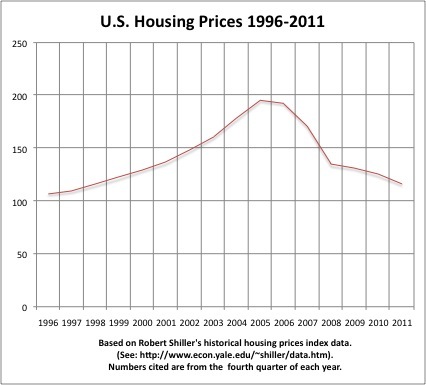
As somebody who started out as a financial reporter in New York before transitioning into political journalism, I was intrigued by Washington Post economic writer Neil Irwin’s item, “Markets to Washington: You know nothing of our work.” (Plus, the “Annie Hall” reference earned an automatic click.) It’s true, as Irwin notes, that markets often behave in counter-intuitive ways that are misunderstood inside the Beltway. But there’s also a danger in letting current market sentiment dictate policy.
I want to focus on one thing in particular that Irwin argues: “The markets are not demanding deficit reduction now.” He makes his case by noting the lack of correlation between bond/currency prices and deficit reduction progress (or lack thereof) in Washington. And I admit, I wouldn’t have been able to predict that interest rates on U.S. debt would remain so low for so long in the face of mounting debt and even a credit rating downgrade. Therefore, I won’t dispute his point that right now, markets aren’t noticeably signaling they want immediate action on deficit reduction. Having said that, it would be a mistake for lawmakers to base their policy decisions on Irwin’s observation, for a number of reasons. One, it’s wrong to assume that market conditions that exist now will continue to persist forever. And two, markets can change trajectory very rapidly, without much warning, and it’s far worse to make policy under emergency conditions than to craft it in a thoughtful manner that hopefully averts an emergency. To give a few recent examples, consider the tech bubble of the 1990s and the housing boom of the last decade.
Stay informed.Stay ahead.
Join Washington Examiner for unlimited access to the news, analysis, and commentary that matter most.
Already a member? Log in
