Byron York: Cruz and Rubio battle in Trump’s shadow

Published January 31, 2016 1:32pm ET


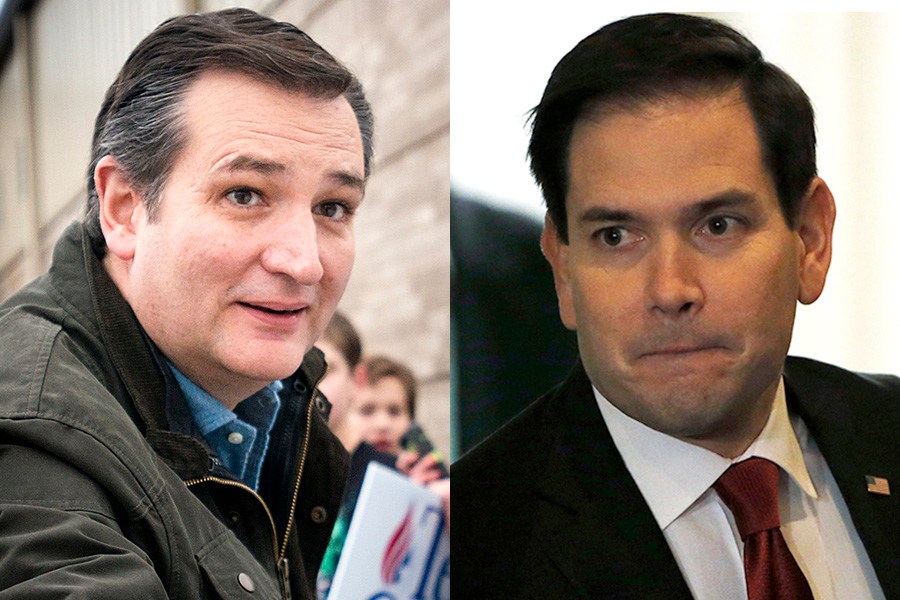
SIOUX CITY, Iowa — The Republican presidential race here in Iowa split into eastern and western fronts on Saturday. Donald Trump flew into the east, by the Mississippi River, appearing in Dubuque and Davenport. Ted Cruz and Marco Rubio went west, to the Missouri River, with stops in Sioux City and Council Bluffs. The western stops were just part of very long days for Cruz and Rubio, and they illustrated the degree to which each man believes it’s necessary to knock down the other, even as Trump continues to lead the race.

Marcomentum — or not?

Saturday began with a real sense of Marcomentum, the idea that Rubio is coming on strong at just the right moment. The Drudge Report featured a piece from The Hill headlined “Buzz builds for Rubio in Iowa,” suggesting Rubio is rising in a way similar to Rick Santorum’s victorious last-minute surge in the 2012 Iowa caucuses.

With Rubio in third place, such reports had a little feeling of wishful punditry to them, and Team Rubio wasn’t buying any effort to set Rubio up with heightened expectations. At the same time, they argued that Rubio does indeed have momentum; Cruz is falling and Rubio is rising, they said, and if the caucuses were held next weekend instead of Monday, the trend lines might intersect and Rubio end up on top. But as it is, they predicted a Cruz victory — setting their opponent up with the heightened expectations. (As for Trump, they don’t believe he has any serious ground operation, which they think will finally become undeniably clear on caucus night.)

That was Saturday morning. Late Saturday afternoon, the Des Moines Register poll, accepted by all as the gold standard of Iowa caucus surveys, was released. The poll showed Trump leading, with 28 percent, Cruz a fairly close second, with 23 percent, and Rubio in third, with 15 percent. In other words, a little progress, but not exactly Marcomentum.

“After months of underperforming in a state where he is perceived as palatable to both establishment and anti-establishment voters, Rubio is up three percentage points since early January,” the Register reported. “But there’s no indication of a surge: His support declined during the four days of polling.”

“Marcomentum is not real,” a top Cruz aide said in a late-night phone conversation Saturday. “The Des Moines Register poll put it to rest.”

For their part, Rubio aides complained bitterly about a Cruz ad using an old, discredited allegation suggesting Rubio had once supported cap-and-trade. They were irritated that Fox News had brought it up in last Thursday’s debate, and Rubio himself was unhappy enough to hit Cruz by name in his Sioux City stump speech.

“Look, this is the last minute of the campaign, this is where desperation kicks in,” Rubio said. “You see some deceitful things going on in the last minute. That’s OK, guys … Ted Cruz has been my friend, and is. He’s decided to run a very deceitful campaign at the end on some things he’s saying. People see through that.”

Ted’s ongoing ethanol nightmare

Cruz devoted one of his stops Saturday to the tiny town of Ida Grove — population 2,142, with 622 registered Republicans. Cruz might not have stopped in such a small place at this late date, but it was part of keeping his promise to do the “Full Grassley,” that is, visit all 99 of Iowa’s counties. Ida County was Cruz’s 98th; he’ll do the 99th on Monday.

In Ida Grove, a man raised his hand and said to Cruz, “You have my vote, you have my wife’s vote, you have my family’s vote.” A promising start, but because Cruz had been attacked for advocating an end to the ethanol mandate, the man continued, “for this room, and for rural Iowans, I would like for you to explain the whole biofuel thing.”

Cruz always takes the question in good humor, as if he is absolutely delighted to spend time discussing one of his biggest vulnerabilities in the race. In Ida Grove, he conceded that he would end the ethanol mandate while at the same time abolishing the federal government’s “blend wall” that limits the amount of ethanol that can be used in gasoline.

It took Cruz more than six minutes to explain his position — as good an example as any of the dictum that in politics, if you’re explaining, you’re losing. In this case, one might think Cruz would win a lot of praise from East Coast conservatives for his courageous free-market rejection of the ethanol mandate. After all, most other candidates — including Rubio — have steered safely clear. But some of those East Coast conservatives can’t stand Cruz, so they stay silent. And Cruz keeps explaining.

By the way, as Cruz spoke, a young boy sat at a table with a pen, filling in pictures in the Ted Cruz coloring book. You didn’t know there was such a thing? It’s titled “We ‘C’ Ted Cruz for President,” and it contains “26 pages of learning and entertainment.” I couldn’t tell for sure, but I think the child was working on the page with an outline of Cruz at a lectern titled, “Committed: Ted Cruz is committed to the Constitution and the American Dream.”

What about the Gang of Eight?

In that late-night conversation with a Cruz strategist, I asked whether he thought Rubio is moving up at all. “No, I don’t,” the strategist said. “Do I think there’s a possibility he will move up? Yes. But I want to keep him down. And the way you keep him down? Amnesty.”

Rubio knows his authorship of the 2013 Senate comprehensive immigration reform bill is still a liability. The way he handles it is, he mostly stays away from discussing the bill, but he doesn’t avoid talking about immigration.

So Rubio makes immigration a part of his stump speech. He talks about having grown up in and living today in a social environment in which everyone — family, friends and neighbors — is an immigrant or the child of immigrants. This, Rubio argues, gives him an understanding of every aspect of the immigration issue. (It seems never to have occurred to Rubio that he might not fully understand the views of Americans who are not immigrants or the children of immigrants.)

There are plenty of Rubio question-and-answer sessions in which no one brings up immigration. But in Sioux City, a man asked Rubio, “Would you take a minute and talk about the so-called ‘Gang of Eight’ situation? You took a lot of flak on that.”

Rubio answered the question at length, beginning with his assertion that immigration is now an Islamic terrorism issue. “ISIS is the No. 1 issue now when it comes to immigration,” Rubio said. “Before anything else.”

It was the kind of question that catches a campaign staffer’s eye — not hostile, but showing concern about an issue of some vulnerability for the candidate. And indeed, Rubio’s people were curious to know whether his answer had satisfied the man.

I told them that I had sought out the man after the event. His name was John Baller, of Sioux City, and he told me that he is a Rubio supporter, and indeed has volunteered to serve as a Rubio precinct captain on Monday night, and he wanted to be better prepared to answer questions on Rubio’s immigration position should those questions come up in caucus. “I think he’s sort of explained that in the national debates, but I just wanted to hear a little bit more,” Baller told me. So on this day, it turned out, Rubio was preaching to the choir.

Trump, Trump, Trump

Trump is always a presence at Cruz and Rubio events. On Saturday, Cruz needled Trump repeatedly for skipping the Republican debate. Cruz even set up an elaborate set-piece in which endorser Phil Robertson, the gray-bearded patriarch of the Duck Dynasty clan who spoke at Cruz’s Sioux City rally, would issue a duck call for Trump in an effort to lure him into debate. (Robertson, by the way, was a remarkably effective surrogate, while Cruz’s other “special guest,” radio’s Glenn Beck, talked for a very long time without saying much about Ted Cruz.)

Asking voters at Cruz and Rubio events who they support often elicits a comment about Trump. My own experience is that earlier in January, voters at Cruz town halls were likely to tell me they were on the fence between Cruz and Trump. Now, they’re more likely to say they’ve chosen Cruz — an anecdotal illustration of the Register’s finding that more Republicans are set in their choices, even though a significant number say they could still change their minds.

Rubio voters seem more likely never to have seriously considered Trump. But even if they did, they’re over it now.

“Trump has been in the news all the time,” a man named Gary Swanson, from Sioux City, told me at Rubio’s Sioux City event. “We were not for him, but then we were kind of on the fence with him. And he makes the statement that he’s so popular that he could shoot a person on Fifth Avenue without losing a vote. Well, he just lost two right here when he said that.” Swanson and the friend who came with him are now supporting Rubio.

On another Trump question, it’s hard to tell how boycotting the debate will affect him; Cruz and Rubio rallies are not exactly the best place to find Trump supporters. But one thing that is clear is that a huge percentage of Iowa Republicans who are trying to make up their minds watched that debate. It just stands to reason; people who were only mildly interested a few months ago are more interested in the final hours before voting, and they turned their attention to the only GOP debate held in Iowa before the caucuses. And Trump, who has been a commanding figure even in debates he didn’t win, wasn’t there. It’s hard not to see that as a mistake on Trump’s part, but we’ll know more later.

Final numbers

Saturday was perhaps the most critical day yet for campaigning. People were off work, the kids were out of school, and a lot of them headed out to see a candidate or two. (All kinds of people; at the Cruz nighttime Sioux City rally, I noticed a woman carrying a baby in a papoose who I had seen at the Rubio morning rally. I asked her who she planned to vote for, and she said, “Of course I support Bernie.”)

As for who will win, it’s good to remember that in 2012, the final Des Moines Register poll before the caucuses was a remarkably good predictor of candidate performance, with one exception.

Back then, on the eve of the 2012 caucuses, the Register pegged Mitt Romney at 24 percent; his final result was 24.5 percent. The paper had Ron Paul at 22 percent; his final result was 21.4 percent. The Register had Newt Gingrich at 12 percent; his final result was 13.3 percent. The only candidate for whom the Register was way off was Santorum; he was at 15 percent in the poll, and finished with 24.6 percent to win the caucus by the slimmest of margins.

Even with Santorum, the Register poll was probably correct at the time it was taken, with his victory the result of an amazing surge in the last 48 post-poll hours.

Could that happen again? Perhaps. But it’s more likely that if we see movement in the last hours, it will be a little slippage on somebody’s part, and a little growth on someone else’s. After all these months of campaigning, the race is what it is.