

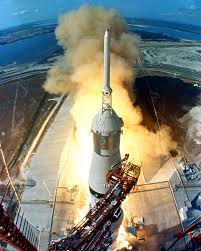
In the months following John F. Kennedy’s 1961 pledge to put men on the moon, NASA conceived a plan wherein an Apollo capsule and its three crewmen would descend to the lunar surface atop a giant, multi-stage rocket; when it was time to go home, the rocket would be powerful enough to blast the capsule, its service module and its astronauts back to Earth. This “direct ascent” plan required an enormously heavy landing vehicle and—consequently—a launch vehicle substantially larger than the immense Saturn V moon rocket. It was too ambitious for the end-of-the-decade deadline, so a new solution was proposed: an independent “Lunar Module” would carry only two men down to the Moon’s surface. The third crewman would remain in lunar orbit in the Apollo capsule, along with all of the heavy sundries needed for the trip home: the service module, heat shield, fuels cells, food, and so forth. This way, only the bare essentials would make the journey to the surface, drastically reducing landing weight and simplifying the lunar touch-down. When it was time to go, the Lunar Module would rejoin the Apollo capsule in orbit.
In July, 1962, eleven aerospace companies entered bids to build the lunar module; in August, the contract was awarded to Grumman Aircraft, desirnger of fighter-planes and light bombers. The LM contract was for 350 million dollars; development ended up costing 2.2 billion. The LM’s weight was paramount; in places, its skin was less than 3 hundredths of an inch thick. NASA offered a bounty of $50,000 to Grumman for every pound the lander shed. A helicopter-style cockpit, with a pilot and copilot seated next to each other, was dropped in favor of having the Astronauts stand for the duration of the flight. Giant glass windows were dropped in favor of tiny triangular port-holes that would give the standing astronauts an adequate field of view. No one knew precisely what sort of terrain the LM would land on, so its legs and feet had to be simultaneously very flexible, very strong and very light. The LM would have four legs, so if one came down on a soft spot, a tripod would remain. Originally, Grumman wanted five legs, but five were too heavy. There would be only one landing engine, and only one take-off engine: there was no space for backups. If either engine failed, the moonwalkers would die. Happily, the LM’s service record was perfect. Not nearly enough credit is given to its chief designer, Thomas Kelly—one of the real, unheralded geniuses of the space race.
Stay informed.Stay ahead.
Join Washington Examiner for unlimited access to the news, analysis, and commentary that matter most.
Already a member? Log in
