

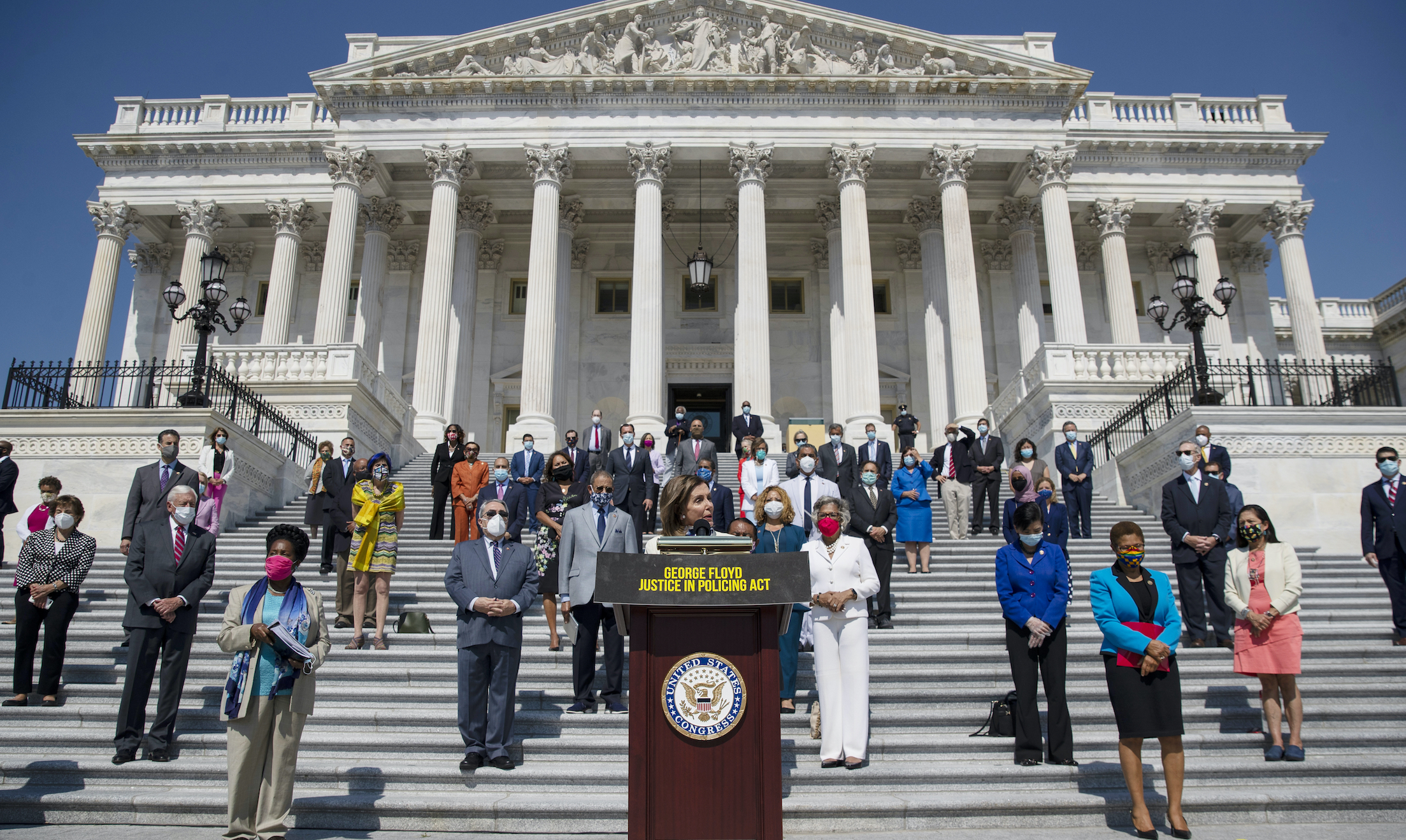
House Democrats passed a reform bill aimed at ending police misconduct and racial bias, but few Republicans supported the measure, and it faces little chance of consideration in the Senate.
“This moment in our great nation’s history demands that we work together across the aisle to fashion legislation that works, legislation that makes a real and lasting difference,” said Rep. Jim Jordan, the top Republican on the House Oversight and Government Reform Committee. “Unfortunately, Democrats haven’t done that. They show no signs of wanting to do that.”
Recommended Stories


Partisan fighting in both chambers this week derailed chances for a bipartisan measure that lawmakers hoped to pass swiftly in response to widespread and continuing civil unrest over the deaths of black Americans in police custody.
Democrats blocked debate on a GOP-authored police reform bill Wednesday in the Senate, rejecting an offer by Republican leaders to try to amend the measure.
The House bill passed easily on Thursday by a vote of 236-181, with all Democratic support and three GOP votes, but party leaders did not allow debate or vote on any Republican amendments.
With Senate action stalled, the two parties are no closer to a deal on a reform measure that can clear Congress. They blamed each other for the impasse.
Republicans said Democrats refused to compromise by forbidding amendments to the House bill.
Democrats said the Senate bill fell far too short to be improved with amendments and noted it was rejected by all major civil rights organizations.
“It is disappointing that the Senate GOP has ignored the voices of hundreds of thousands of people peacefully calling out for justice and progress, day in and day out, week in and week out, for the past month,” Speaker Nancy Pelosi said. “The Senate proposal mimics the words of real reform but takes no action to make any difference. It’s inadequate and unworthy of support.”
The House bill, authored by Congressional Black Caucus Chair Karen Bass, a California Democrat, would ban police use of chokeholds and no-knock warrants at the federal level and incentivize local police departments to prohibit the two tactics. The measure would make it easier to sue police officers for their actions on the job by eliminating qualified immunity, and it lowers the standard for prosecuting officers for misconduct. It would create a national standard for police use of force and increase independent investigations into deaths and serious injuries of individuals while in police custody.
Democrats said their bill is the necessary legislative response to the string of black deaths that appear connected to racial bias and police brutality.
“We need to deal with systemic racing in America, and we can start with police brutality,” said Rep. Hakeem Jeffries, a New York Democrat and chairman of the Democratic Caucus.
The death of George Floyd while in police custody in Minneapolis sparked civil unrest and rioting that has continued for weeks. Floyd, who is black, died after a white police officer knelt on his neck for nearly nine minutes.
Democrats said Floyd is among many black people unjustifiably and disproportionately killed by biased law enforcement.
“The only way that Congress can prove to all the American people that we believe that black lives matter is for all of us, Republicans and Democrats alike, to pass legislation to stop killing black people,” said Rep. Hank Johnson, a Georgia Democrat. “Not tomorrow, not next year, now.”
The GOP and Democratic bills include similar provisions, but many Republicans are opposed to parts of the Democratic bill, including language that would make it easier to sue or prosecute police officers for their actions while on the job.
Republicans said the provision would make it much harder to recruit police if they feared being sued or prosecuted for making mistakes.
“I hope that we work together to address the problems that we’ve seen while making an important distinction not to undermine the important work that police officers do every day, risking their lives to keep us safe,” said Minority Whip Steve Scalise, a Louisiana Republican.
Bass, the author of the bill, recognized the bill cannot pass the GOP-led Senate and said she is ready to work with Republicans on a bipartisan measure.
“There is an historic problem in this country, and we will eventually get there and move forward and have a bill,” Bass said. “I am happy that we will be passing this bill today, but I don’t see this as the end.”
House Democrats blocked a last-ditch effort by Republicans to pass the Senate’s GOP police reform measure. The measure includes a similar ban on chokeholds and data reporting on no-knock warrants and deaths in police custody. It expands body-worn police cameras and makes lynching a federal crime.
Democrats said it did not hold officers accountable or create new standards to ensure an end to racial bias.
“This Senate bill does not rise to the occasion to those who are in the streets,” Rep. Sheila Jackson Lee, a Texas Democrat, said. “It fails the moment.”
