

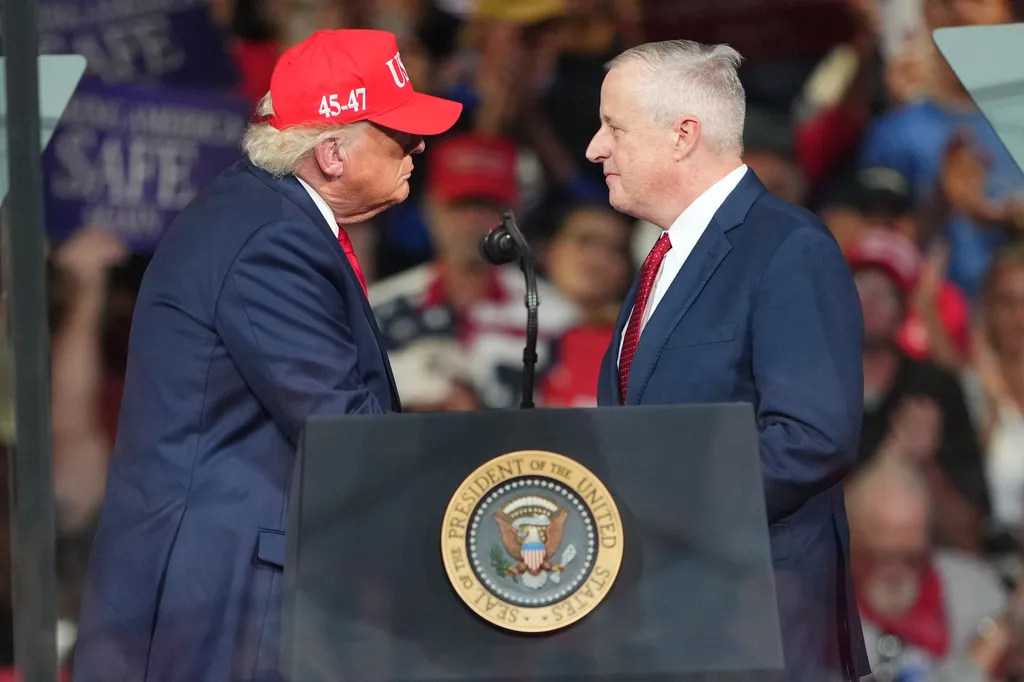
THE SENATE SEAT MOST LIKELY TO FLIP. When strategists on both sides look at the 2026 Senate map, the state at the top of the list of those most likely to switch parties is North Carolina, where Republican Sen. Thom Tillis is retiring, and former Gov. Roy Cooper has a significant lead in the race to replace him.
In the RealClearPolitics average of polls at this moment, Cooper has an 8-point lead over Republican Michael Whatley, a former chairman of the state GOP. Cooper has been in front for the entire race. Going back to March, his solid and steady lead has never been smaller than 6.5 points or larger than 8.5 points.
Stay informed.Stay ahead.
Join Washington Examiner for unlimited access to the news, analysis, and commentary that matter most.
Already a member? Log in
A new poll done for the American Association of Retired Persons by Tony Fabrizio — best known as President Donald Trump’s pollster — and Democratic pollster John Anzalone suggests Republicans are in even more trouble than it earlier appeared. Cooper has an 11-point lead, 53% to 42%, in the new survey.
Why? Much of the answer lies in fundamentals. For example, a president’s job approval rating has long been a strong predictor of midterm election results, and in North Carolina, Trump is deeply underwater, with a 38% job approval rating and a 59% disapproval rating. It’s a disappointing situation for a president who won North Carolina three times, each time with a slightly larger percentage of the vote and a larger raw vote total. In 2016, Trump won North Carolina with 49.83% of the vote and 2,362,631 votes. In 2020, the numbers were 49.93% and 2,758,775 votes. In 2024, it was 50.86% and 2,898,423 votes.
Since taking office, though, Trump’s job approval has fallen steadily. In a series of Elon University polls, Trump’s approval was 45% in February 2025. It fell to 42% in March, 41% in April, 39% in September, 35% in March 2026, and 31% this month — even lower than the AARP poll.
The reasons are the usual. The cost of living is the voters’ top issue, and they especially blame Trump for the increase in gas and diesel prices that occurred after the start of the Iran war seven months ago. Just as they do nationwide, a majority of voters now say they trust Democrats more than Republicans to handle the cost of living.
On Iran, just 31% of respondents in the Elon University poll said they support the war, versus 52% who oppose and 18% who said they were unsure. Only 60% of Republicans support the war, while just 10% of Democrats and 27% of independents support it.
Add to all this the fact that Cooper, who has won six statewide elections, is far better known than Whatley, who has not won any. Cooper also has significantly higher favorable numbers. At the start of the campaign, a lot of North Carolinians had no idea who Whatley was, and since then, attacks from Democrats have helped keep his favorable rating low.
The current situation could send long-term trends in North Carolina in a new direction. The state has not elected a Democrat to the Senate since 2008 (Kay Hagan, who served one term), and only two since 1998 (Hagan and John Edwards, who also served one term).
Now, when Republicans and Democrats consider the balance of the Senate, North Carolina is the first of the net four seats Democrats would need to win to take control of the Senate. On Sunday, political analyst Charlie Cook said, “A year ago, it wasn’t realistic to think that the Senate might flip, but now, it’s very realistic.” North Carolina, he said, is the “open seat [that] goes first.”
