
Welcome to Byron York’s Daily Memo newsletter.
Was this email forwarded to you? Sign up here to receive the newsletter.
REPUBLICANS, DEMOCRATS, AND THE VACCINE. More Republicans than Democrats appear to be “vaccine-hesitant,” that is reluctant, for one reason or another, to take the Covid-19 vaccine. They’ve gotten the treatment you might expect in some quarters of the press. “Right-wing anti-vaccine hysteria is increasing. We’ll all pay the price,” read one headline in the Washington Post. In the New York Times, there was, “Far-Right Extremists Move From ‘Stop the Steal’ to Stop the Vaccine.” The Daily Beast chimed in with “The GOP’s Paranoid Streak From John Birchers to Anti-Vaxxers.” You get the idea.
Recommended Stories
But it’s not hard to imagine a different picture. If President Donald Trump had won re-election, the vaccine skepticism might have leaned more to the other side. We can’t say that for sure, of course, but we do know that during the 2020 presidential campaign, top Democratic leaders, like candidate Joe Biden and running mate Kamala Harris, were laying the groundwork for vaccine skepticism before they won the election. Some media allies followed their lead. After victory and prepared to take office, though, Biden and Harris became full-speed-ahead on the vaccine.
During a CNN interview on September 5, with the vaccine still in development under Trump’s historic Operation Warp Speed, Harris was asked if she would get the vaccine when it was ready. It depends, Harris answered. “I will say that I would not trust Donald Trump,” she continued, “and it would have to be a credible source of information that talks about the efficacy and the reliability of whatever he’s talking about. I will not take his [Trump’s] word for it.”
Subscribe today to the Washington Examiner magazine that will keep you up to date with what’s going on in Washington. SUBSCRIBE NOW: Just $1.00 an issue!
In her October 8 debate with Vice President Mike Pence, Harris was asked, “If the Trump administration approves a vaccine, before or after the election, should Americans take it, and would you take it?” Harris answered that she would take it only if the nation’s top virologist, Dr. Anthony Fauci, recommended it. “But if Donald Trump tells us that we should take it, I’m not taking it,” Harris said.
Later in the debate, Pence told Harris, “Your continuous undermining of confidence in a vaccine is just, it’s just unacceptable.” But at the same time, Joe Biden, the Democratic nominee, was sending the same message. “I trust vaccines, I trust scientists, but I don’t trust Donald Trump,” Biden said in September. “And at this moment the American people can’t, either.”
In October, New York Governor Andrew Cuomo, at the time respected by Democrats despite his disastrous handling of the Covid pandemic in his state, was asked whether he had confidence in the Food and Drug Administration’s approval process for the vaccine. “I’m not that confident, but my opinion doesn’t matter,” Cuomo told ABC News. “I don’t believe the American people are that confident. I think it’s going to be a very skeptical American public about taking the vaccine, and they should be.” During the transition, Cuomo suggested he would bar distribution of the vaccine in New York — an extraordinary step as the pandemic raged — as long as Trump remained president.
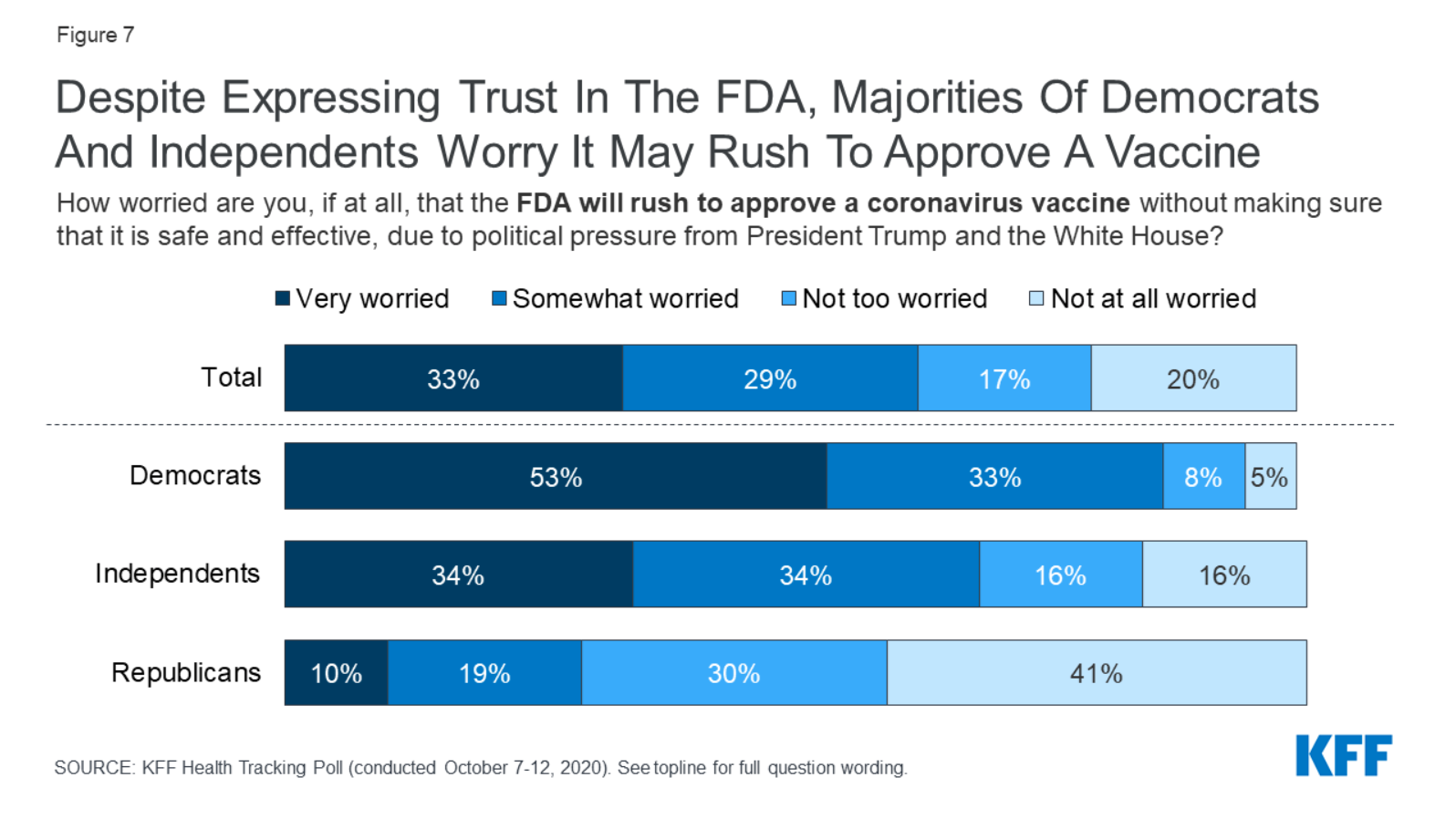
Democratic voters got the message. In an October 2020 Kaiser Family Foundation poll, respondents were asked, “How worried are you, if at all, that the FDA will rush to approve a coronavirus vaccine without making sure that it is safe and effective, due to political pressure from President Trump and the White House?” Eight-six percent of Democrats said they were very or somewhat worried, versus 29 percent of Republicans. From the poll:
A few days after the election in November, the polling organization YouGov reported, “Democrats are 30 points more likely than Republicans to be worried about the speed of vaccine development (90 percent vs. 60 percent). Democrats’ concern about the eventual vaccine’s safety has increased steadily from 79 percent in mid-July — when the United States hit its prior high of coronavirus cases — to 90 percent in recent weeks.”
Although other polls indicated that Democrats were a bit more likely than Republicans to get the vaccine quickly upon release, the fact was, Democratic leaders had encouraged skepticism when skepticism was politically beneficial — during the campaign. After Joe Biden’s victory, Democrats fully embraced the vaccine — the very same vaccine developed under the Trump Operation Warp Speed program — and mounted a help-is-on-the-way public relations campaign.
Had Trump been re-elected, skepticism among some Democrats might have expanded and hardened into an opposition to the Covid vaccine similar to what we see among some Republicans today. It was rushed! they might say. Scientists were pressured! Trump corrupted the approval process! Yes, that is speculation. But it is a fact that some Democrats were saying one thing about the vaccine before the election and another thing after.
Traditional anti-vax thinking has mostly been confined to a small group on the fringes of the left. But in today’s supercharged political environment, there is a partisan element to some Americans’ attitudes toward vaccines, because there is a partisan element to their attitudes toward everything. That applies to Democrats as well as Republicans.
For a deeper dive into many of the topics covered in the Daily Memo, please listen to my podcast, The Byron York Show — available on the Ricochet Audio Network and everywhere else podcasts can be found. You can use this link to subscribe.