Hungary at the center of world politics as dramatic election approaches

Published April 11, 2026 2:00pm ET


The Sword of Damocles dangles over the head of Hungary’s leader as the Sunday election threatens to unseat him after more than a decade and a half of governance.

Prime Minister Viktor Orban’s Fidesz party is currently polling at 39%, a double-digit deficit against Tisza — led by his rival, Peter Magyar — which is polling at 50%.

At most other times, a Hungarian election is a sideshow compared to the politics of more muscular nations. The country is small, with a population hovering just above 10 million, yet it finds itself at the center of world politics. Part of that relevance has been chance, and part has been a decision.

Tisza threatens to upheave a right-wing government that has been in power since 2010, offering a U-turn on key geopolitical relationships that will have ramifications spilling over into the European Union, NATO, and the Russia-Ukraine war.

Hungarian Prime Minister Viktor Orban prepares for his election rally.
Hungarian Prime Minister Viktor Orban prepares for his election rally in Szekesfehervar, Hungary, Friday, April 10, 2026. (AP Photo/Petr David Josek)

A test of Trump’s international influence

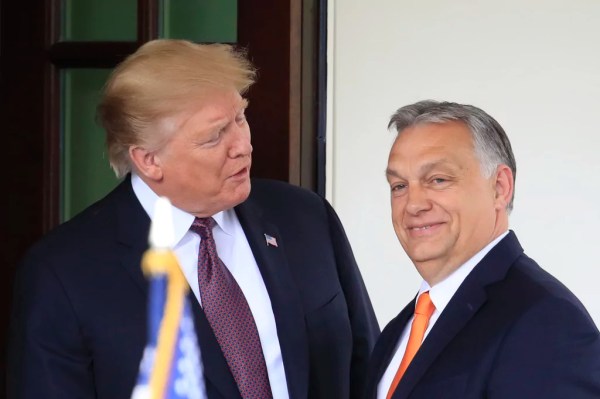
Orban has benefited immensely from his friendship with President Donald Trump, who is urging Hungarians to “GET OUT AND VOTE FOR VIKTOR ORBÁN” and calling the leader “truly strong and powerful.”

The two leaders have enjoyed a close relationship since Trump’s first term. Even after Trump lost his reelection bid in 2020, his Hungarian counterpart did not leave his side, visiting him at Mar-a-lago in 2024.

Budapest and Washington see themselves as aligned in broad ideological commitments: strident nationalism, Christianity-centered civics, and distaste for out-of-touch technocrats running institutions such as the United Nations and the EU.

“There is so much that united the United States and Hungary. And unfortunately, there have been too few people who have been willing to stand up for the values of Western civilization,” Vice President JD Vance told a Hungarian audience earlier this week. “Viktor Orban is the rare exception that has unfortunately proved the rule.”

Trump dispatched Vance to stump for Orban ahead of the Sunday election, and the vice president rose to the challenge, calling the prime minister a true “statesman” and a “constructive partner for peace” compared to the “bureaucrats in Brussels” who he accused of working against Hungary’s interests.

Hungarian Prime Minister Viktor Orban and U.S. Vice President JD Vance.
Hungarian Prime Minister Viktor Orban, left, and U.S. Vice President JD Vance gesture at the end of a pre-election rally in Budapest, Hungary, Tuesday, April 7, 2026. (AP Photo/Denes Erdos)

Thoroughly entangled in the election and intrinsically tied to the victory or defeat of Fidesz, Vance asserted that while “of course [the U.S. is] going to work with whoever wins the Hungarian election, because we love the people of Hungary,” that is not a possibility because “Viktor Orban is going to win the next election.”

Trump affirmed that political blood oath on Thursday: “I AM WITH HIM ALL THE WAY!”

If Orban goes down, it will be a black mark against Washington’s capacity to influence foreign elections and uplift embattled allies.

A Russian fox in the European hen house

If one term has defined the past week of Hungarian politics, it is “foreign interference.” Seemingly everyone is in agreement that someone is pulling the strings behind the election, but no one can agree on whether it’s Washington, Brussels, Moscow, or Kyiv.

As the White House has put its weight behind the Hungarian government in the lead-up to the election, the much-maligned “bureaucrats in Brussels” have been throwing everything but the kitchen sink to ensure Tisza is victorious.

Orban’s government has not been shy about its sympathies for Russia and distaste for EU overreach. The Hungarian veto has become a consistent roadblock to otherwise unanimous decisions within the alliance, such as packages to support the Ukrainian war effort.

In contrast, Magyar’s campaign has been defined by his role as a European Parliament member and his faith in that institution. Europhiles see Tisza’s success as the most efficient avenue for ridding the alliance of Russian influence and bringing Hungary back into line with their vision.

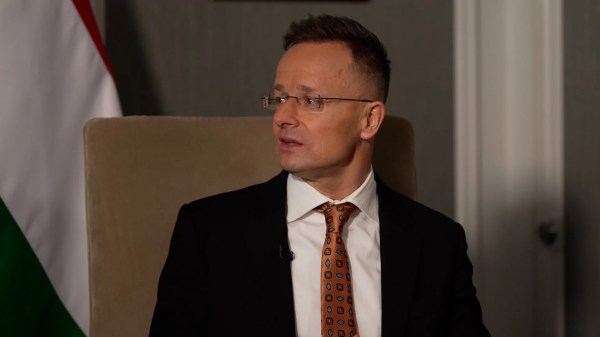
A flurry of reports emerged in American and Hungarian outlets this week, leaking transcripts and audio recordings of Orban and Foreign Minister Peter Szijjarto speaking with Russian leaders. The tapes appear to have been recorded clandestinely, and Hungary is accusing foreign intelligence of undermining the integrity of the elections.

One report, first published in Bloomberg, showed that Orban told Russian President Vladimir Putin in October of last year: “In any matter where I can be of assistance, I am at your service.” The transcripts also show the prime minister comparing Hungary to the mouse that frees a lion caught by a net in a classic Aesop fable, and telling the Russian president, “I say the same to Trump.”

Szijjarto’s phone conversations with Russian Foreign Minister Sergey Lavrov on the sidelines of an EU summit have also been leaked, revealing that the foreign minister kept the Kremlin informed of EU debates regarding the future of Ukrainian membership in the confederation.

Budapest and Washington have also accused Brussels of interfering in the elections through legislation that introduced wide restrictions on political activity and advertising on social media. An arrangement they claim benefits the opposition.

Orban has repeatedly accused the Facebook algorithm of “basically working against the government parties.”

The EU has contended that it is simply “acting in a way to ensure that elections are always the sole choice of our citizens and nobody else.”

“What the European bureaucrats have been doing is to set out a strong framework to make sure that the elections remain in the hands of our citizen,” a spokesperson for the European Commission said Wednesday. “Who is silencing political voices? It is online platforms. Who is manipulating algorithms? Again, online platforms. Who is boosting the visibility of the preferred choice? Online platforms.”

The fragility of the right-wing alliance

If Orban loses the coming election, it will be a tough blow to the White House’s movement to build an international alliance of right-wing, nationalist countries to stand athwart globalism.

“Internationally, the coming vote could have … significant repercussions,” the Atlantic Council of the United States assessed in a Tuesday report. “Trump would also lose a key European partner at a time when transatlantic relations are becoming increasingly strained.”

Trump laid bare this vision for trans-Atlantic partnership in the latest National Security Strategy document, which urged American diplomats to “stand up for genuine democracy, freedom of expression, and unapologetic celebrations of European nations’ individual character and history.”

“America encourages its political allies in Europe to promote this revival of spirit, and the growing influence of patriotic European parties indeed gives cause for great optimism,” the report stated.

Orban’s government has been on-message with this campaign for years, spearheading on-the-ground efforts to build a supportive coalition within the continent.

“The pendulum has gone very far to the liberal direction, especially in Europe, where the liberal mainstream basically overruled everything, and the liberal mainstream cannot digest conservative success,” Szijjarto told the Washington Examiner last year. “But we are very committed to push this pendulum back and build an alliance — maybe global — of patriotic forces.”

Peter Magyar stands on stage amid smoke in the colors of the Hungarian flag.
Peter Magyar, the former husband of one-time justice minister and Orban ally Judit Varga, holds a smoke-candle after his speech on Hungary’s National Day in Budapest on Friday, March 15, 2024. (AP Photo/Denes Erdos, File)

Orban helped form the Patriots for Europe party in 2024, a pan-conservative movement within the European Parliament that currently sits as the body’s third-largest faction.

He also imported the Conservative Political Action Conference to Hungary in 2022, with annual conferences that bring right-wing activists from across the U.S. and Europe.

The populist opposition in other European nations — Alternative for Germany, Reform UK, National Rally in France, Vox in Spain, and others — have benefited immensely from this coordination.

A Tisza victory will likely end the close relationship between these disparate European movements as Magyar seeks to show his support for Europeanism. It would also shatter the image of a Trump-centered populist movement abroad, calling into question whether Washington’s vision is a workable strategy.

Such a blow to international right-wing cohesion could not come at a worse time, as Trump’s belligerence toward Europe and NATO allies has strained relationships between the White House and nationalists abroad.

HUNGARIAN SUCCESS IN BEFRIENDING AMERICAN CONSERVATIVES ON DISPLAY AS ORBAN FACES DOWN POSSIBLE DEFEAT

The more Europe diplomatically drifts from alignment with the U.S., the more Europeans will seek to consolidate their own positions and resources on the continent.

The thoroughly entrenched establishment in Brussels stands poised to benefit most from this inward turn, and the disparate European populists could find their Make America Great Again-centric network — stripped of Orban as a local lieutenant — scattered in the wind.