

This essay is a part of The Right Way Forward, Restoring America’s new think tank debate series in which leading conservative institutions argue the defining questions of the post-Trump era. Read about the series here.
For over a century and a half, a predominant theme on the political Right has been its association with the American business community. Whether it was the construction of the transcontinental railroad in the 1860s, industry-supporting tariffs during the 1920s, or supply-side economics in the 1980s, the modern Right has remained a political home for business — if not always the free market — since its inception.
Stay informed.Stay ahead.
Join Washington Examiner for unlimited access to the news, analysis, and commentary that matter most.
Already a member? Log in
Likewise, while the Right has attempted to make overtures toward organized labor over the years, particularly during the Teddy Roosevelt and Eisenhower–Nixon eras, some of its most successful presidents have been celebrated for their anti-union stances. In 1919, Gov. Calvin Coolidge called in the Massachusetts State Guard to restore order in the midst of the Boston police strike — a move that would launch him into the presidency — while Ronald Reagan famously fired over 10,000 striking air traffic controllers in 1981.
But today, the calculus is starting to change. During the 2022 railway strike, Sens. Marco Rubio (R-FL), Ted Cruz (R-TX), and Josh Hawley (R-MO) sided with unions in seeking paid sick leave for workers. Afterwards, Cruz went so far as to declare that the GOP was “a blue-collar party,” while Rubio decried “Wall Street’s drive for efficiency” that turns railroad workers into “little more than line items on a spreadsheet.”
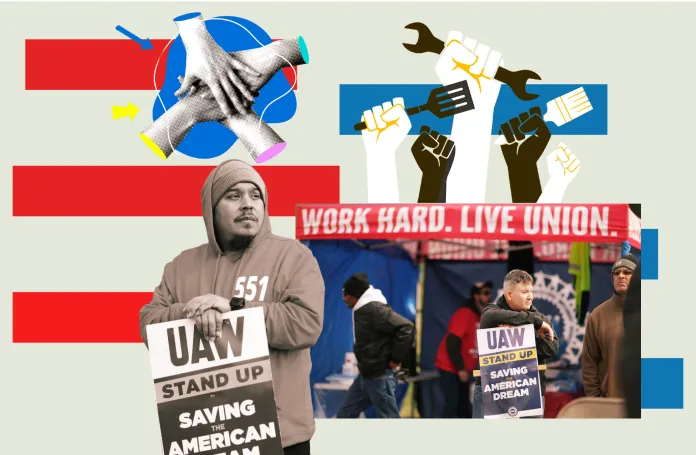
Organized labor’s standing within the Republican Party reached even greater heights in the run-up to President Donald Trump’s reelection. In 2023, then-candidate Trump notably skipped the second primary debate to visit striking UAW autoworkers in Michigan. Teamsters President Sean O’Brien famously secured central billing as a primetime speaker at the GOP’s 2024 convention. Both Vice President JD Vance and Hawley openly identify as anti-right-to-work, taking a political stance that was unthinkable on the Right as recently as five years ago.
But for all the press coverage this growing pro-labor wing of the Republican Party has received, it still remains a distinct minority. While six Republicans voted in favor of paid sick leave during the 2022 railway strike, 42 still remained opposed. Hawley’s Faster Labor Contracts Act, which is meant to expedite negotiations of labor contracts for unions, has only garnered support from one other Republican in the Senate and a mere 17 out of 218 Republicans in the House.
The Right’s ambiguity around organized labor is perhaps best seen in Trump’s nomination of former Rep. Lori Chavez-DeRemer to serve as labor secretary. Chavez-DeRemer was a pointedly pro-union Republican in the House during her tenure on Capitol Hill, including supporting the union-backed PRO Act, which, among other provisions, would have effectively overridden state right-to-work laws.
But during her nomination hearings, Chavez-DeRemer backtracked on her support for the PRO Act and generally struck a more pro-business stance. During her time as labor secretary, Chavez-DeRemer’s agency has largely toed the line with past Republican administrations, including recently siding in favor of preserving the rights of independent contractors not to be forcibly reclassified as full-scale employees (reclassification has been a longtime political priority for unions). With news of Chavez-DeRemer’s recent resignation, it’s unclear if the next labor secretary will change the trajectory of the agency significantly or not.
But the Right will not be able to keep up its sphinx-like demeanor toward labor indefinitely. In recent years, unions have enjoyed a string of political victories, from repealing public sector collective bargaining reforms in Utah to overturning right-to-work in Michigan and Missouri. Virginia also recently passed legislation to mandate collective bargaining for government workers, while the commonwealth’s right-to-work law may soon be overturned as well. Union power is extending into new spheres, too, as states like Massachusetts and California have recently allowed gig workers to join unions.
THE RIGHT WAY FORWARD: THE ROLE OF THE STATE IN THE ECONOMY
In the face of its growing crackup over organized labor, the Right is badly in need of developing a labor policy that is pro-worker without being pro-union. The best bet would be to coalesce around a flexible work agenda that empowers workers to achieve autonomy and agency in their employment arrangements.
This policy agenda could take many different forms, but it might include championing the independent contracting status of gig workers while simultaneously expanding so-called portable benefit models that provide these workers with funds to access workplace benefits. This provides a more nimble, nuanced alternative to reclassifying them as employees or unionizing them. Or right-leaning politicians could seek to address issues like just-in-time scheduling, a common sore spot for workers in many industries, by striking a grand bargain with the business community regarding overtime averaging.
By focusing on flexibility rather than cribbing the union political playbook, the Right can take a pro-worker stance without needing to fully repudiate its pro-business instincts. To be sure, the political Right has real tensions it must grapple with when it comes to organized labor. But it also has an opportunity. There’s still time for it to stake out a position as pro-worker rather than pro-union, and in doing so, articulate a modern labor policy for the 21st century.
Jarrett Dieterle is a legal policy fellow for the Manhattan Institute.