

In Focus delivers deeper coverage of the political, cultural, and ideological issues shaping America. Published daily by senior writers and experts, these in-depth pieces go beyond the headlines to give readers the full picture. You can find our full list of In Focus pieces here.
As the Trump administration and Vice President JD Vance intensify efforts to crack down on wasteful federal spending, one of the federal government’s largest green-energy projects has largely escaped serious scrutiny: the U.S. Postal Service’s nearly $10 billion electric vehicle modernization effort.
Recommended Stories


The “greening” of the USPS fleet was central to former President Joe Biden’s climate agenda and the Inflation Reduction Act, which directed billions toward replacing aging mail trucks with a new generation of electric delivery vehicles.
But years into the effort, inspectors general, lawmakers, and outside analysts are raising concerns over delays, unused vehicles, infrastructure failures, and mounting financial pressure at an agency already warning that it could run out of cash by 2027.
A September 2025 Office of Inspector General audit found the Postal Service had acquired 7,465 Ford E-Transit electric delivery vehicles by June 2025, but remained 1,785 vehicles behind schedule. More than 6,000 vehicles were sitting unused in storage lots around the country, some for as long as 14 months, because many postal facilities still lacked completed charging infrastructure or compatible delivery routes.
Auditors warned the delays would postpone more than $78 million in projected savings between fiscal 2025 and fiscal 2026.
USPS spokeswoman Kim Frum defended the modernization effort, telling the Washington Examiner the agency still expects to acquire 106,480 new vehicles through 2028, including at least 66,000 battery-electric vehicles.
“So far, the upgrade of the delivery fleet is proceeding at pace,” Frum said. “However, initiating any brand-new purpose-built vehicle production and facility will always have adjustments that need to be addressed along the way.”
Still, critics question why the project has largely avoided the kind of aggressive oversight the administration has applied elsewhere.
“This is distressing,” Kevin Kosar, a senior fellow at the American Enterprise Institute who studies USPS operations, told the Washington Examiner. “The whole situation is a mess.”
In March, President Donald Trump signed an executive order establishing a federal task force focused on rooting out waste, fraud, and abuse across federal agencies. The initiative has operated alongside the administration’s broader Department of Government Efficiency effort, which has aggressively targeted federal contracts, staffing, and agency spending for cuts and restructuring.
Still, those familiar with the administration’s anti-fraud initiative indicated the USPS modernization effort currently falls outside the scope of the White House fraud task force despite mounting concerns surrounding delays and costs.
“President Trump pledged to slash waste, fraud, and abuse across the federal government,” White House spokesman Kush Desai said in a statement to the Washington Examiner. “The Trump administration continues to work with the USPS to most effectively and efficiently deliver for the American people.”
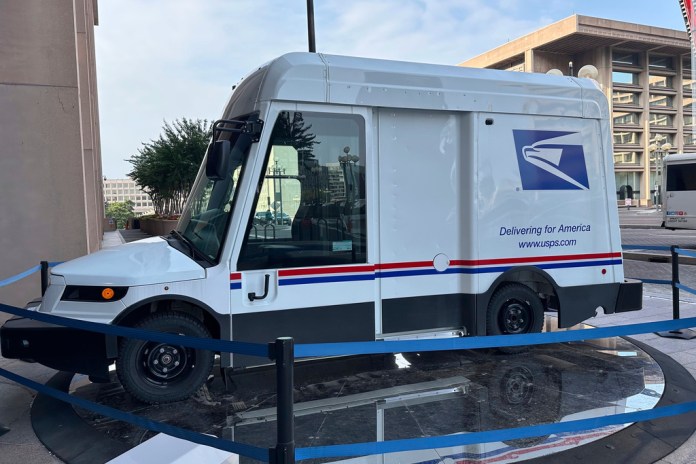
Kosar said part of the hesitation may stem from the USPS’s unusual political position and enduring popularity with voters.
“The Postal Service is still generally beloved,” he said. “If you’re a populist Republican from a rural district, your voters are dependent on the Postal Service because it carries so many small packages out there.”
That political reality, he suggested, may be one reason the USPS has avoided the level of scrutiny other agencies have faced as the administration pushes to slash federal spending and overhaul government operations. At the same time, Kosar argued the Postal Service was pushed into a politically driven EV transition while simultaneously trying to modernize deteriorating facilities and stabilize its finances.
“During the Biden administration, there was this great push to get the Postal Service to have electric vehicles, which basically put a thumb on the scale, and then money was attached to it,” Kosar said.
He also pointed to infrastructure challenges facing USPS facilities.
“Louis DeJoy would frequently say postal facilities were so out of date that he was afraid to plug in a new coffee maker there for fear of shorting the place out,” Kosar said. “Putting in all new wiring systems was not only very expensive, but it’s very time-intensive.”
Some fiscal watchdogs argue the problems reflect broader problems inside the USPS that extend far beyond delayed vehicles.
“It’s a total mess, and the first question you have to ask yourself is, when the USPS is losing $9 billion a year, why is it spending $80,000 on EVs?” said Ross Marchand, executive director of the Taxpayers Protection Alliance.
Marchand said he expected the DOGE to more aggressively scrutinize USPS spending after Trump returned to office.
“When I heard that DOGE was coming in to root out waste at the Postal Service, I was excited,” he said. “But they didn’t do anything to slow the pace of postal spending.”
Others questioned whether the Postal Service’s EV goals are even practical across large swaths of the country.
Tom Schatz, president of Citizens Against Government Waste, said a fully electric fleet may work in urban areas but becomes far more complicated in rural states where carriers travel long distances daily.
“You can’t have 100% electric vehicles,” Schatz said. “Maybe in urban areas. But when you’re out in the middle of the country, the nearest post office could be 100 miles away from somebody’s home.”
“In places like Montana or North Dakota, the distances are certainly too much for having an all-electric vehicle fleet,” he added.
Schatz argued the infrastructure costs tied to charging stations and facility upgrades deserve far more congressional scrutiny.
“They have to spend the money for the infrastructure, for the charging stations,” he said. “Electric vehicles have a place, but the analysis needs to be made whether it’s worth the cost.”
The Postal Service’s modernization challenges also surfaced during a Senate Homeland Security and Governmental Affairs Committee hearing last week.
Sen. Rand Paul (R-KY) criticized USPS leadership over “the fleet electrification, the multibillion-dollar network redesign, the capital projects without a clear return,” arguing the projects were “expensive choices” rather than unavoidable costs.
Paul also warned that the USPS was “spending money it does not have on infrastructure it may not need.”
Sen. James Lankford (R-OK) separately criticized “the electric vehicles that were purchased by [the] previous administration with no chargers, and some of the waste that was done there.”
Postmaster General David Steiner did not directly defend the EV rollout during the hearing, instead arguing the Postal Service faces a fundamentally “broken business model” constrained by congressional mandates and long-standing financial pressures.
“We are out of cash,” Steiner told lawmakers. “If we had to pay all of our bills today, we could not pay all of our bills today.”
Sen. Gary Peters (D-MI) also acknowledged the agency’s deteriorating financial condition despite years of restructuring and modernization efforts.
“The Delivering for America plan has not worked,” Peters said. “Costs are up, service is down, and customers are paying the price.”
Despite the setbacks, the USPS continues to insist the modernization effort remains necessary to replace an aging fleet that auditors say has exceeded its intended service life by years and lacks many modern safety features.
