

In Focus delivers deeper coverage of the political, cultural, and ideological issues shaping America. Published daily by senior writers and experts, these in-depth pieces go beyond the headlines to give readers the full picture. You can find our full list of In Focus pieces here.
The Smoot-Hawley Tariff Act of 1930 did not generate much revenue for the federal government or succeed at protecting American producers from foreign competition. Instead, it sank the United States deeper into the Great Depression and has long been effectively superseded by legislation that shifted the focus of trade policymaking into international agreements.
Recommended Stories


Yet, as we predicted one year ago, the White House considers Section 338 of the Smoot-Hawley Tariff Act its “Plan B,” which, when used by the administration, may once again cause serious harm to our economy.
Under the Constitution, the tariff power belongs exclusively to the legislative branch. Under Section 338, Congress authorized the president to impose tariffs of up to 50% on countries that engaged in discriminatory trade practices against the U.S. Although this section has sat dormant for 95 years, the White House invoked it for the first time on July 20 to impose a new 50% tariff on Canadian imports, ranging from wine to hockey sticks, without regard for the U.S.-Mexico-Canada Agreement’s protections.
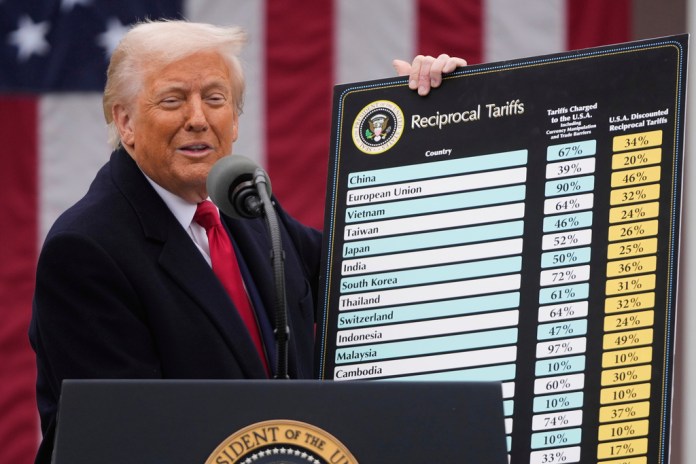
Since “Liberation Day” on April 2, 2025, the administration has pivoted from statute to statute for its tariff-of-the-month club to prolong its illegal regime of taxing imports. Many of its claims have been inconsistent and contrary to well-established economic history.
Under penalty of perjury, Commerce Secretary Howard Lutnick told the Federal Circuit that “without the viability of [International Emergency Economic Powers Act] tariffs, the United States would be weakened and lose the essential tool to address this national emergency most efficiently” (emphasis added).
Because of such claims, the courts allowed the government to collect tariff revenue while litigation continued. But the Supreme Court ultimately rejected Lutnick’s claims in February.
Yet, within hours of the Supreme Court’s decision striking down the IEEPA tariffs, the administration announced a new 10% global tariff under Section 122 of the Trade Act of 1974. Several states and small businesses are currently challenging the Section 122 tariffs and the government’s attempts to conflate two technical terms that are not the same: a “balance of payments deficit” and a “trade deficit.” The solicitor general, representing the government, even argued in Learning Resources v. Trump that “trade deficits” are “conceptually distinct from balance-of-payments deficits.”
Section 122’s “balance of payments deficit” has never been used because the provision became obsolete in 1976 when the U.S. abandoned the Bretton Woods exchange rate system. A “balance of payments deficit” was a natural consequence of fixed exchange rates, when the value of the dollar was pegged to gold and when other foreign currencies were pegged to the dollar.
Now, not waiting for a final ruling on its Section 122 tariffs, the White House attempts to resurrect a dormant clause from the long-buried Smoot-Hawley Tariff Act, Section 338. The consequences of the administration’s tariff regime have already been similar to those of Smoot-Hawley in the Great Depression: an explosion of new or ramped-up lobbying contracts, job losses for families, and increased prices for many goods. Smoot-Hawley was disastrous then and is leading to the same problems now.
In fact, most economic historians agree that Smoot-Hawley is one of three main interventionist economic policies that contributed to the title of the “Great Depression,” the others being monetary mismanagement by the Federal Reserve and an income tax hike in 1932. Intended to protect American producers, the tariff instead proved that attempts to fend off foreign competition harm the entire economy, thereby harming American industries.
Only four years after passing Smoot-Hawley, Congress realized its mistake and amended it to begin dismantling the disastrous tariffs. Enacted in 1934, the Reciprocal Trade Agreements Act authorized the president to lower tariff rates by up to 50% through reciprocal negotiations with other nations. Other measures, such as the Trade Expansion Act of 1962, established specific procedures and required investigations before the president could impose retaliatory tariffs as originally envisioned in Section 338.
In particular, Section 252 of the 1962 law laid out the conditions under which the president may initiate retaliatory measures against foreign countries that “oppress the commerce of the United States.” Additional amendments to the Trade Act of 1974 laid out the procedures for launching an investigation of any foreign “burden or restriction” on American commerce. Collectively, these statutory provisions govern the investigation process, including public hearings on the proposed countermeasures, and impose limits on how long these tariffs may remain in effect. It’s also noteworthy that both the 1962 and 1974 laws contemplated this tool being used against countries that impede “the expansion of trade on a mutually advantageous basis” — not as a basis for new protectionism.
In practice, these and other statutes “supersede” Section 338 of Smoot-Hawley. They replace its vague provisions with specific statutory definitions, restrictions, and procedural requirements that the president must follow. Until the administration needed another theory to impose broad tariffs, Section 338 has long been considered an obsolete relic.
WARREN HARDING AND THE BRAVEST PRESIDENTIAL SPEECH IN US HISTORY
Yet, so long as the courts allow the government to collect tariff revenue while litigating these cases, the administration does not need a legitimate legal theory to defend Section 338. It does not need legitimate legal theories for any of the cases against its tariffs. Instead, the government needs only a multitude of theories to occupy the courts while it collects revenue from families and wields tariffs to pressure foreign allies and foes alike.
The administration has demonstrated that it is willing and able to propose novel legal theories as needed to extend its illegal tariff regime, even if they are ultimately rejected by the courts. If Congress or the courts do not reiterate that the power to tax, and therefore impose tariffs, belongs exclusively to Congress, the economy will suffer, and the public will continue to pay the costs.
Phillip W. Magness is a senior fellow at the Independent Institute and the David J. Theroux chairman in political Eeconomy. J. Marc Wheat is the general counsel for Advancing American Freedom.
