

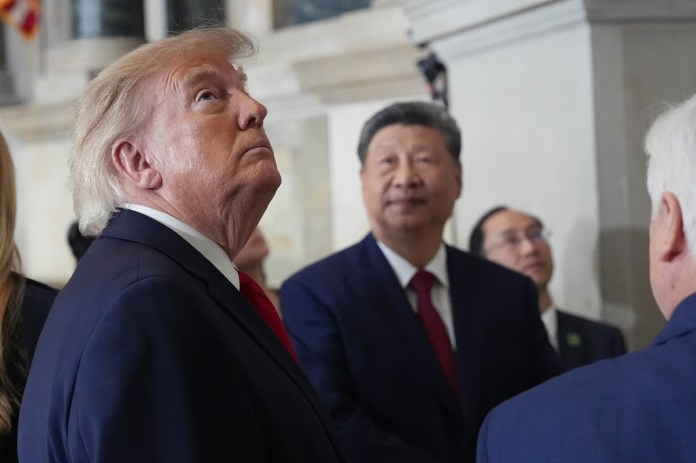
The recent summit meeting between President Donald Trump and Chinese President Xi Jinping appears to have concluded without any significant agreement on any of the many disputes dividing the two countries. That should not worry observers. It merely shows that both sides are still circling one another like sumo wrestlers, watching the other closely to try and find a weakness to exploit.
Summits like this used to be a common feature of the Cold War. Every nation knew there were two superpowers vying for global dominance: the United States and the Soviet Union. When the heads of state (or political leaders, as the real power in the Soviet Union often rested with the premier rather than the president) met, all knew that the two represented two strong, near equal powers.
Stay informed.Stay ahead.
Join Washington Examiner for unlimited access to the news, analysis, and commentary that matter most.
Already a member? Log in
The Soviet Union’s collapse in 1991 ushered in the period of American unipolarity. There was no need for major bilateral summits as there was no single nation that could even come close to matching American might. People as a result forgot what these meetings meant and how they were used to advance each nation’s statecraft.
Trump’s respectful greeting of the Chinese dictator shows he understands he was meeting a serious rival. One can argue as to whether China is America’s equal, much as there were disputes as to the Soviet Union’s relative strength during the Cold War. No one, however, doubts that China’s economy and military pose significant threats to American and Western global hegemony.
That means Trump was wise to treat Xi graciously, despite the complaints of some that he was too kind to a man who presides over an aggressive, techno-totalitarian state that engages in some of the worst human rights practices imaginable. China’s chokehold on the world’s supply of refined rare earth minerals means it has a powerful lever to deploy in economic conflict. Its economy is also inextricably intertwined with the world’s, meaning it alone of all the nations Trump has tried to bully has the means to cause America significant pain.
Xi, on the other hand, needs to assess what Trump really wants from China. Trump is predictably unpredictable when it comes to strategy and tactics, but he usually signals what he wants as a bottom line from any relationship. With respect to Greenland, for example, he made it clear from the outset that he needed America to have a significantly freer hand in building and maintaining defense infrastructure on the massive island. Bluster, inducements, threats — all were designed to find out how best to get the island’s sovereign, Denmark, to give him what he wanted. The recently concluded deal shows that, for all the collateral damage those actions may have caused, Trump got exactly what he needed.
Trump has yet to signal what he wants from China. If he wants a lower trade deficit, there are ways to accomplish that. If he wants a less aggressive global presence from China, there are ways to accomplish that. The fact that he continues to pursue both objectives simultaneously, as well as some other less crucial ones, means Xi has yet to ascertain how to deal with his cagey adversary.
Trump likely has the same thoughts regarding Xi. If Xi is hell-bent to obtain control of Taiwan, that implies one course of action. If Trump determines that Xi can be persuaded — or bought off — from pursuing that, that implies another course of action. Similar considerations apply to China’s pursuit of economic advantage in critical sectors and in its push for global influence through its investment and military basing strategies.
It behooved both men, then, to arrange a meeting without high expectations the better to conduct psychological reconnaissance on the other.
This strategic dance is in America’s interest right now, especially as it is tied down in the Iran war. Our military is not in position to effectively contest a Chinese move on Taiwan so long as the bulk of our active Navy and high-precision munitions are tied down there. Delaying any eventual conflict without forfeiting American interests in Taiwan or the region is the right strategic move.
Delaying any major confrontation also benefits Xi. His military might is growing, but it may not yet be powerful enough to risk challenging even a weakened U.S. China’s domestic economic problems — relatively low growth, massive private sector debt — means Xi doesn’t have the firm economic basis for provoking the world’s largest economy. Playing for time suits him, too.
SALLY HEMINGS AND HER CHILDREN WERE HERITAGE AMERICANS
These considerations do not mean tensions between the two superpowers have lessened. Quite the contrary. America and China remain locked in a battle as China seeks to displace American global hegemony, if not become the hegemon itself, while America tries to hold on to as much of its power as it can. Sooner or later, whether through war, economic conflict, or proxy battles, these unreconcilable goals will force a confrontation.
For now, however, all is well. We shall see in the coming months what each leader has taken away from their meeting, and what the next moves on the strategic chessboard will be.
