

After eight years, Democrats still can’t understand the management style of President Donald Trump. That continued confusion was on display at a recent hearing on Capitol Hill discussing successful reform efforts at the United Nations enacted by the president’s team serving in New York at the U.S. Mission to the U.N. Rep. Dina Titus (D-NV) scoffed at Trump’s decision to nominate Ambassador Jeff Bartos to the body, confronting Bartos directly: “As I understand it, you had no prior government service, no diplomatic experience, and nothing really to recommend you to serve in this role, because you’re a real estate lawyer.”
The U.S. mission account on X reveled in the challenge, posting the clip with the caption, “Actually, the Rep. from Nevada is right! [Bartos] is not a career politician. He’s bringing a business leader’s resolve to reforming the UN.”
Recommended Stories


Despite the acrimonious nature of the hearing, U.S. Ambassador to the U.N. Mike Waltz and Bartos have an unlikely defender in their work in Congress: Sen. John Fetterman (D-PA). Fetterman told the Washington Examiner that they are “doing a great job holding the organization accountable.” Fetterman’s friendship with Bartos has a fascinating origin story: They were opponents in a race for lieutenant governor. The two formed what observers called a “political bromance” and led Fetterman to introduce Bartos at his confirmation hearing, declaring, “Jeff is a native of PA, a good friend, and has the skills and determination to bring integrity back to the United Nations on behalf of our great country.”
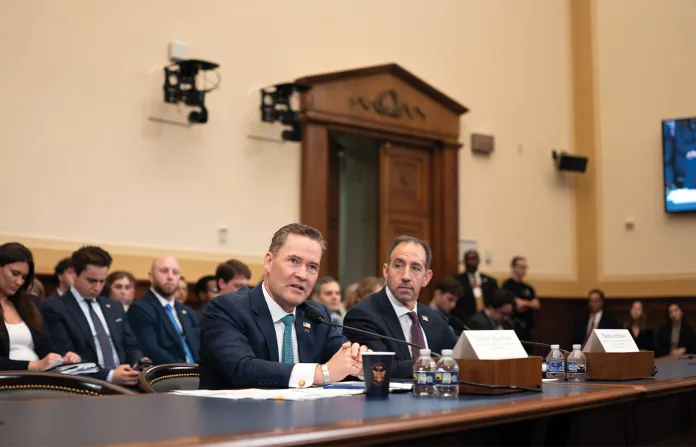
Rather than dispatch another career diplomat steeped in the customs and etiquette of international organizations, Trump has assembled an unlikely leadership team. At its head is Waltz, the former Green Beret and congressman. Alongside him is Bartos, a Pennsylvania businessman nominated as deputy ambassador for management and reform. Between them, they represent an unusual combination of experiences for an institution traditionally populated by foreign policy professionals: One spent years leading soldiers in combat, and the other spent decades building businesses, managing employees, balancing budgets, and asking uncomfortable questions whenever an organization ceased to perform as it should.
Jonathan Schanzer, the executive director of the Foundation for Defense of Democracies, has known Bartos since the two were in college. He told the Washington Examiner, “It was his dogged determination to enter politics, and his successful team approach in Pennsylvania, that ultimately earned him a seat at the table” at the U.N.
Neither man speaks about the U.N. quite the way diplomats usually do, which is perhaps the secret to their success.
Listening to the pair testify before the House Foreign Affairs Committee in late July, Waltz spoke repeatedly about mission, while Bartos returned again and again to leadership, execution, incentives, and accountability. They sounded less like ambassadors explaining American foreign policy than executives conducting a turnaround.
“My charge from President Trump is to help the U.N. realize its potential,” Waltz told lawmakers. “We are getting the United Nations back to basics, back to maintaining the peace and maintaining security around the world.” He argued that the organization had “tried to become all things to all people” while its budget had tripled over the past 25 years. “I don’t think we’ve seen a tripling of peace break out around the world.”
During our conversation immediately after the hearing, Bartos talked far less about geopolitics than about organizational behavior. He described the U.N. not as a uniquely broken institution but as one suffering from problems familiar to anyone who has spent time trying to rescue a struggling company.
“What wasn’t there before we got to post was the leadership,” he told the Washington Examiner. “The Trump administration has brought the leadership that so many reform advocates have been yearning for for their entire careers.”
An experiment is now unfolding inside the U.N. It is not simply an effort to trim budgets or eliminate redundant programs. It is a test of a broader proposition: whether one of the world’s oldest and most complicated bureaucracies can be revived by applying the habits of successful businesses — clear missions, disciplined leadership, aligned incentives, and relentless execution — to an institution that many had long ago concluded was simply too large and dysfunctional to reform.
If Waltz supplies the strategic vision, Bartos is the one responsible for translating philosophy into management. Ask him what he’s proudest of, and he doesn’t begin with reform or speeches before the General Assembly. Instead, he starts talking about troop reimbursements, procurement formulas, pension obligations, warehouse logistics, and the caloric requirements for peacekeepers stationed in some of the world’s most dangerous places. It is not glamorous work, nor is it the sort of thing that typically generates headlines. It is, however, the work that determines whether a bureaucracy actually functions.
Throughout our conversation after the hearing on Capitol Hill, Bartos repeatedly returned to the same idea: Large institutions often fail for reasons that have little to do with ideology and everything to do with incentives. Organizations reward the behavior they encourage. If employees are compensated regardless of performance, performance inevitably suffers. If managers cannot remove poor performers, mediocrity becomes institutionalized. If nobody regularly asks whether a process still serves its original purpose, the process itself eventually becomes the purpose.
Those observations are hardly revolutionary in the private sector. Yet Bartos argues they have too often been absent from discussions about the U.N., where debates tend to revolve around diplomacy rather than management.
The administration‘s reforms, therefore, begin with questions that sound almost mundane. Why are troops receiving rations based on approximately 4,600 calories a day when modern military standards suggest significantly less would be sufficient? Why does the U.N. continue maintaining compensation and pension structures that have largely disappeared from both government and private industry?
Individually, none of those changes transforms the institution. Together, Bartos believes, they begin changing something far more important than a balance sheet — they begin changing expectations.
The same philosophy underlies a series of larger reforms already underway. Over the past year, the administration has led efforts that have reduced roughly 4,000 civilian positions across the U.N. system and helped secure more than $1 billion in budget reductions. In an organization where virtually every meaningful decision requires the agreement of 193 member states, even incremental reforms represent unusually difficult victories. As Waltz reminded lawmakers during the hearing, “We cut [the budget] by $1 billion over the last six months alone. And by the way, that requires consensus of all 190 countries to agree on every line of the budget.”
“Consensus” is worth emphasizing because it challenges the caricature often offered by both supporters and critics of the Trump administration. The United States cannot simply dictate reforms to the U.N. Every significant change requires persuading governments that frequently disagree on nearly everything else. Bartos speaks about that process less as political combat than as relationship-building. “Honor your word,” he told lawmakers. “Do what you say you’re going to do.” Reform, he insists, depends less on confrontation than on earning credibility over time.
It would be easy to mistake all of this for an exercise in austerity if not for another part of Bartos’s job — one that has taken him thousands of miles from conference rooms in New York.
Earlier this year, he traveled to the northeastern corner of the Central African Republic, not far from the Sudanese border, where hundreds of thousands of refugees have fled atrocities committed during Sudan’s brutal civil war. There, he watched humanitarian workers from multiple U.N. agencies operate camps providing food, clean water, medical care, sanitation, and shelter to families who had escaped violence that the U.S. has described, in parts of the conflict, as genocide.
Bartos speaks about that trip with an admiration that borders on reverence.
“I’ve never been around a group of people who are risking their lives for total strangers at that scale,” he told the Washington Examiner. “They’re not leaving hell to get to a hotel in Ibiza. They’re leaving hell to get to something slightly better than hell.”
That experience complicates the simplistic narrative that the administration’s approach to the U.N. is merely one of aggression. Both Waltz and Bartos argue that reform is intended to strengthen precisely these kinds of operations by eliminating duplication elsewhere. During the hearing, Waltz described consolidating warehouses, logistics, and administrative support across aid agencies so that a greater share of humanitarian funding reaches victims rather than supporting what he called a nongovernmental organization industrial complex. “We are putting the U.N. on a diet,” he said. “A healthier U.N. is a more useful U.N.”
For Bartos, there is no contradiction between admiring the humanitarian workers he met in Africa and aggressively pursuing bureaucratic reform in New York. Quite the opposite. The people risking their lives in refugee camps deserve an institution that works as efficiently as they do.
For all the attention paid to billion-dollar budget reductions and management reforms, Bartos insists those victories represent only the beginning of the project.
The culture change in how diplomacy is conducted and messaged at the U.S. mission is notable, too. Take an event that happened this summer. Over the Fourth of July weekend, aboard the USS New York during the Navy’s celebration of America’s 250th anniversary, former Israeli hostage Alon Ohel joined singer-songwriter John Ondrasik of Five for Fighting in an emotional musical performance organized with the assistance of the U.S. mission.
Of the event, Ondrasik told the Washington Examiner, “It was his will and passion that brought my Freedom 250 performance … to be. I can’t think of a better person to join Mike Waltz at the U.N. and bring some sanity to an organization long overdue for a reboot.”
“The financial reforms,” Bartos told the Washington Examiner, “are actually the easier part.”
The harder part, the real challenge, will be changing the culture.
One example has come to symbolize that challenge more than any spreadsheet ever could.
While the U.S. was pushing through budget reforms and restructuring peacekeeping operations, another part of the U.N. continued generating headlines for altogether different reasons. Francesca Albanese, the U.N. special rapporteur focused on the so-called occupied Palestinian territories, repeatedly drew condemnation from the U.S. and several allied governments for statements they viewed as antisemitic and for rhetoric they argued blurred the distinction between Israel and Hamas. Rather than distancing itself, the institution continued allowing Albanese to operate under the U.N. banner.
For Bartos, the issue is not merely Albanese herself — it is what her continued prominence says about institutional incentives.
“It’s impossible for me to reconcile that the same organization risking their lives working in Central Africa with one that allows a lunatic like Francesca Albanese to put on the U.N. uniform and spew her vile, anti-American, anti-West, anti-capitalist, anti-Jewish, anti-Israel vitriol.” In the private sector, he argued, “your brand would be destroyed.”
Now working alongside Bartos at the U.S. mission, former deputy special envoy to combat antisemitism Ellie Cohanim captured that frustration after Bartos publicly criticized Albanese’s recent open letter declaring that “America is subjugated by the Jewish lobby.” “Ladies & Gentlemen,” Cohanim wrote on the controversy, “welcome to the UN & the woman whom [Bartos] has rightfully slammed as a ‘lunatic.'” She contrasted Albanese’s continued standing within the institution with U.S. efforts to confront terrorism and secure the release of hostages, asking how an organization created to preserve peace had reached a point where such rhetoric could coexist with its stated mission.
That tension, between the institution’s ideals and some of the voices it elevates, illustrates why Bartos believes the next phase of reform will be immeasurably more difficult than the first.
Just days after our conversation, a controversy erupted at the U.N. when the French and American missions faced off about the very reforms Bartos had testified about days earlier. The U.S. mission posted a clip of Bartos testifying about how the “U.N. human rights system has been losing credibility for decades.” The French mission posted that clip, declaring, “The U.S. used to be a beacon of human rights. Not anymore. Today, it stands alongside North Korea, Nicaragua, Mali & Russia, isolated. And the world no longer listens to it.”
The next day, the American delegation staged a walkout during France’s remarks, and the Senate Foreign Relations Committee ominously posted, “This is disappointing and shows just how opposed some are to sorely needed UN reform,” specifically naming Volker Turk, the U.N. high commissioner for human rights. “Without real and systemic change, the U.S. will be forced to reconsider its entire relationship with the UN.”
Asked afterward whether the clash with France and the controversy with Turk changed his assessment of the challenge ahead, Bartos suggested the real battle had barely begun.
“By slashing the U.N.’s budget and cutting over 4,000 bureaucratic posts over the past six months, we have made consequential and durable reforms to the U.N.’s spending problem. While we continue to work every day on additional fiscal reforms, we are focused on reforming and repairing the institutional rot that former U.N. Ambassador Daniel Patrick Moynihan eloquently called out in his Nov. 10, 1975, General Assembly speech. Stay tuned.”
‘MAKE THE UN GREAT AGAIN?’ NOT WITH THESE WOKE FRONT-RUNNERS TO LEAD IT
Moynihan’s address has become one of the defining speeches in the history of American diplomacy at the U.N. Speaking after the General Assembly adopted its infamous resolution equating Zionism with racism, he accused the institution of abandoning truth for politics and warned that an organization founded to defend liberty was instead lending legitimacy to authoritarianism and prejudice. Bartos shared that he reads it monthly, using it as a reference for what the U.S. mission is trying to accomplish 51 years later.
Bartos believes the budget battles were the easy part. Cutting spending required persuading member states to embrace better management. Repairing an institution whose incentives, culture, and moral credibility have eroded over decades will require something far more difficult. If the administration’s first test was whether it could make the U.N. run more efficiently, its greatest test still lies ahead: whether it can persuade the institution to remember what it was created to stand for.
Bethany Mandel (@bethanyshondark) is a homeschooling mother of six and co-host of The Mom Wars podcast.
