

A small moment in Hulu’s riveting new series Furious reveals the depth of the show’s preoccupation with female revenge. Investigating a crime scene with an officer who is also her abusive former boyfriend, FBI agent Alice Black (Emmy Rossum) secures a pair of blood-stained scissors and hands them over to her ex. Yet, just for an instant, we see something darker in her expression. She’d clearly prefer to stab him in his guilt-ridden face.
Stay informed.Stay ahead.
Join Washington Examiner for unlimited access to the news, analysis, and commentary that matter most.
Already a member? Log in
The harm men do to women — and that women do back to them — is the dominant theme of Hulu’s eight-part production, now streaming weekly following its premiere in late July. Alice, an FBI rookie who once worked for the New York City Police Department, has been called in to investigate a homicide disguised as a drug overdose. The dead man was the son of a prominent billionaire. Could his new girlfriend, strangely absent from neighborhood security footage, be to blame?
That young woman, played by a startlingly good Lola Petticrew (Say Nothing), goes by many names over the course of the series but is billed as Catherine Grace. A former victim of child sex trafficking, Catherine has developed a murderous modus operandi: track down, seduce, and poison the men responsible for her ill treatment. Through the first four episodes alone, at least as many bodies pile up, killed or left for dead by a woman who invites explicit comparison to the mythological sufferer Medusa. “She’s a victim,” one fed says of our lethal antiheroine, “but it doesn’t make her a good person. It turns her into a monster.”
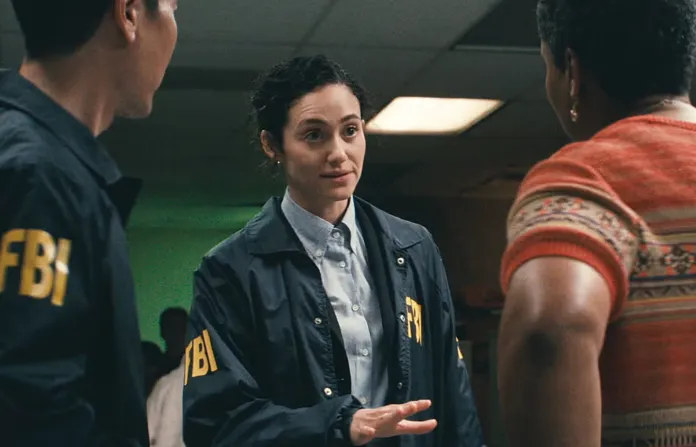
Furious is, on its surface, a simple cat-and-mouse thriller of the kind regularly produced for big and small screens. But the show is also a character study of greater-than-usual sophistication — a worthy heir to its most famous forerunner, the Oscar-winning film version of The Silence of the Lambs (1991). A pitiless scourge of the Epstein class, Catherine is also a compassionate nurse to Alden (Steve Way), a muscular dystrophy patient for whom she works as a home healthcare aide. Alice, for her part, is nearly as fascinating as Jodie Foster’s iconic Clarice Starling. Having survived a childhood not entirely unlike that of the woman whom she pursues, the young agent is similarly contradictory and fierce.
The show’s supporting players inhabit a layered headspace of their own. NYPD detective Marshall Connelly (Jake Lacy), the aforementioned bad ex, is plainly a villain but is just as visibly consumed with regret. Though we wish she could, it is no affront to believability that Alice can’t make herself stop loving him. Also intriguing is Scoot McNairy (Halt and Catch Fire) as Detective Danny Kelly, a once-close friend torn between rescuing Alice and abandoning her to her folly. Best of all is journeywoman Quincy Tyler Bernstine, who gives an award-worthy performance as Nora Washington, Alice’s wise and funny FBI mentor. Asked by our protagonist to account for her erudition, Nora serves up the quip of the series: “I’m not a former cop, I went to a fancy school, and I’m very smart.” Trust me, the moment comes off as endearing rather than smug.
Furious needs its lighter scenes to deliver us from what could otherwise be an oppressive tone. Even with them, the series is not for the faint of heart. Note, for instance, the brutality with which Catherine dispatches an abuse-enabling lawyer played by Campbell Scott. What separates the show from lesser efforts is that it is too intelligent to allow its emotional palette to fade entirely to gray. Yes, the series is often violent, but it is also clever, surprising, amusing, and oddly sweet.
Created by veteran showrunner Elizabeth Meriwether (New Girl), Furious is loosely based on Bob Rafelson’s 1987 neo-noir thriller Black Widow, in which Debra Winger’s Justice Department analyst pursues Theresa Russell’s serial killer of men. As befits its era, that film assigns Russell’s character no motive beyond a love of money. She wants it, and her victims have it. Furious, no less a representative of our own age, is unable to fathom female violence except as an outgrowth of righteous wrath. A line from Nora gives away the game: “Obviously any woman who becomes a serial killer is a victim of something.” Obviously? They should have told that to Rafelson, the Five Easy Pieces (1970) auteur who died in 2022, whose near-perfect picture spends a drum-tight 102 minutes demonstrating the opposite.
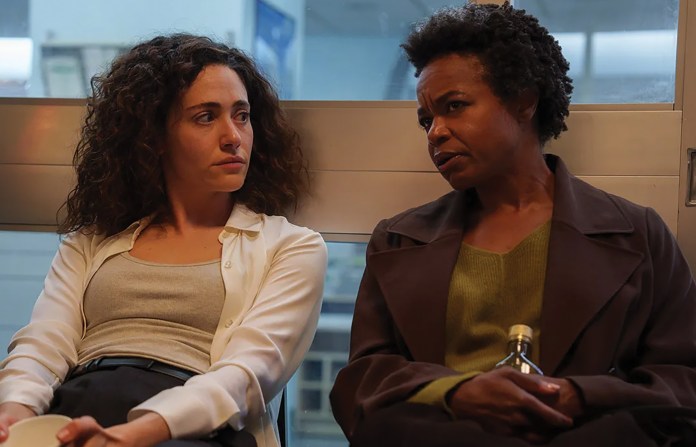
Ah, but we would have better luck spitting into the wind than denouncing a television show for its concessions to vogue anxieties. Coming in 2050: a Catherine who kills male-featured anthropomorphic bots. The miracle of Furious is that it succeeds despite its paternalistic treatment of the fairer sex — despite, for that matter, stretching Rafelson’s taut tale to a now-standard six hours and change. The show’s writing and pacing are simply too good to be brought low. And one would have to go back to the 1980s-era police procedural Cagney & Lacey to find two overlapping female performances this strong. Tyne Daly and Sharon Gless, winners between them of six Lead Actress Emmys in a row, may finally have met their match.
REVIEW: WILL FERRELL’S ‘THE HAWK’ IS UNFUNNY AND UNINSPIRED
It is difficult to overstate how effective Furious’s two stars are in this production. Having wasted her youth on Showtime’s execrable satire Shameless (2011-2021), Rossum now establishes herself as a masterful portrayer of psychological weakness and strength. Her Alice is a hypnotically self-destructive figure. Petticrew, meanwhile, builds on her much-praised work in Say Nothing, Hulu’s 2024 Irish Republican Army drama based on a book by Patrick Radden Keefe. As she did on that show, the young woman gives an utterly fearless performance as an ingenue pushed by circumstances to the emotional brink.
But perhaps even I am now letting Catherine off the hook. The character is, after all, irredeemably wicked, never mind the arguably more outrageous evils that men have done to her. Looked at a certain way, the figure of Catherine exists to show us the person whom Alice might herself have become. Except Alice doesn’t. Take that as the show’s most important lesson. We always have a choice.
Graham Hillard is the TV critic for the Washington Examiner magazine.
