
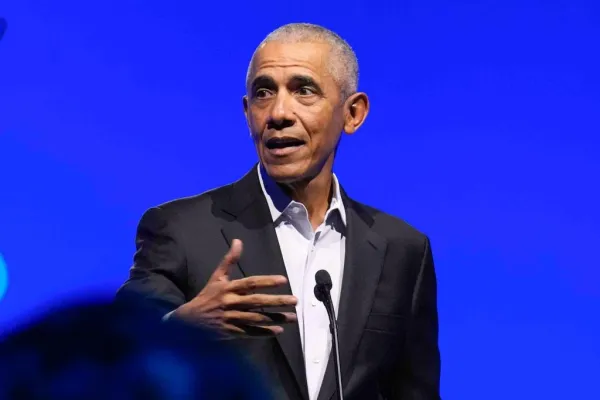
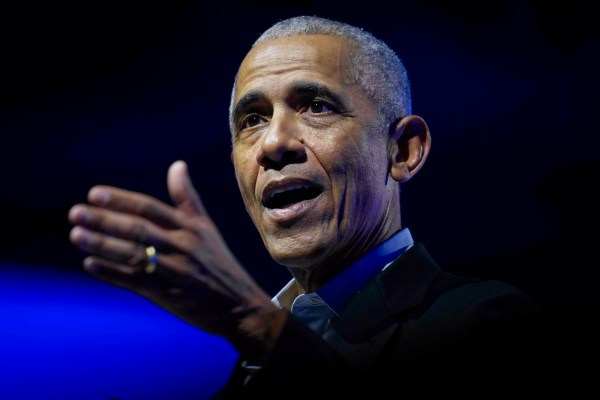
Speaking to the incoming Democratic House majority, former President Barack Obama reminded us why he was one of the most divisive and damaging American leaders. As usual, he looked cool and handsome in a dark suit and crisp white shirt. He also spoke in his usual modulated tones, betokening thoughtfulness. But again, as usual, his words were poison.
He claimed that all eight times he delivered his State of the Union speeches to Congress, he was struck by a contrast between the Republicans and Democrats in front of him. This is how he characterized them: “On one side … everybody looked the same … just like a golf country club. … Then, on the Democratic side, you just had America, you had everybody.”
Recommended Stories
It’s worth noting in passing that Obama feels free to mock mostly white middle-aged or older Republicans as all looking the same, a framing he’d condemn as hateful stereotyping if it were said by a white man about a racial or other minority group.
But set aside Obama’s take-it-for-granted hypocrisy. More deeply, but inadvertently, revealing was the conclusion he drew. He said Democrats should recognize that their diversity means there will be “genuine differences in your caucus, and big debates and disagreements … and these disagreements are representative of the people of your district.”
Hang on a moment. If ethnic, racial, religious, and geographical differences in the Democratic caucus reflect their voters, isn’t it also true that the greater similarity among Republicans equally represents a great mass of Americans whose racial characteristics, values, and opinions tend to make them more alike than unlike each other?
Obama’s logic points to a truth. Republicans generally represent voters who dislike the racial balkanization of America, who cleave to the founders’ values and the Constitution, and who are themselves more likely to be descended from Europeans, that much defamed ethnicity that conceived of America and brought it into being. These voters like the America they were bequeathed by history, and they elect people who want to conserve it. That is, they are more conservative.
When Obama, at the House podium, looked out into the chamber, the truth before his eyes was that the whole audience, Republicans and Democrats, represented America. He “had everybody,” to use his words, because the audience was made up not only of his own party, divided into the castes and subgroups it cherishes, but also those he dismisses as identical members of a country club.
If, under Obama’s guidance, Democrats recognize the “big debates and disagreements’ in their caucus as representative of different voters, it’s cheap, narrow-minded, and divisive not to recognize that the people on the other side of the aisle with whom they also disagree represent their districts, too. Their voters, more similar to each other, are just as much America.
IN HAITI, BUEKELE CRACKS DOWN WHERE UN FAILED
Maybe even more, for they do not fixate on “change,” the way Obama always has — “change” was the battle cry of his presidential campaigns — and they do not send their representatives to Washington to “reimagine how government can work and politics can work.” They want it to work the way it has in the past. They don’t want the revolutionary approach that Obama urged to his partisan descendants.
They want America to remain America. Obama and his party don’t want the nation to remain what it is. They won’t even acknowledge that those who vote that way are also America.