

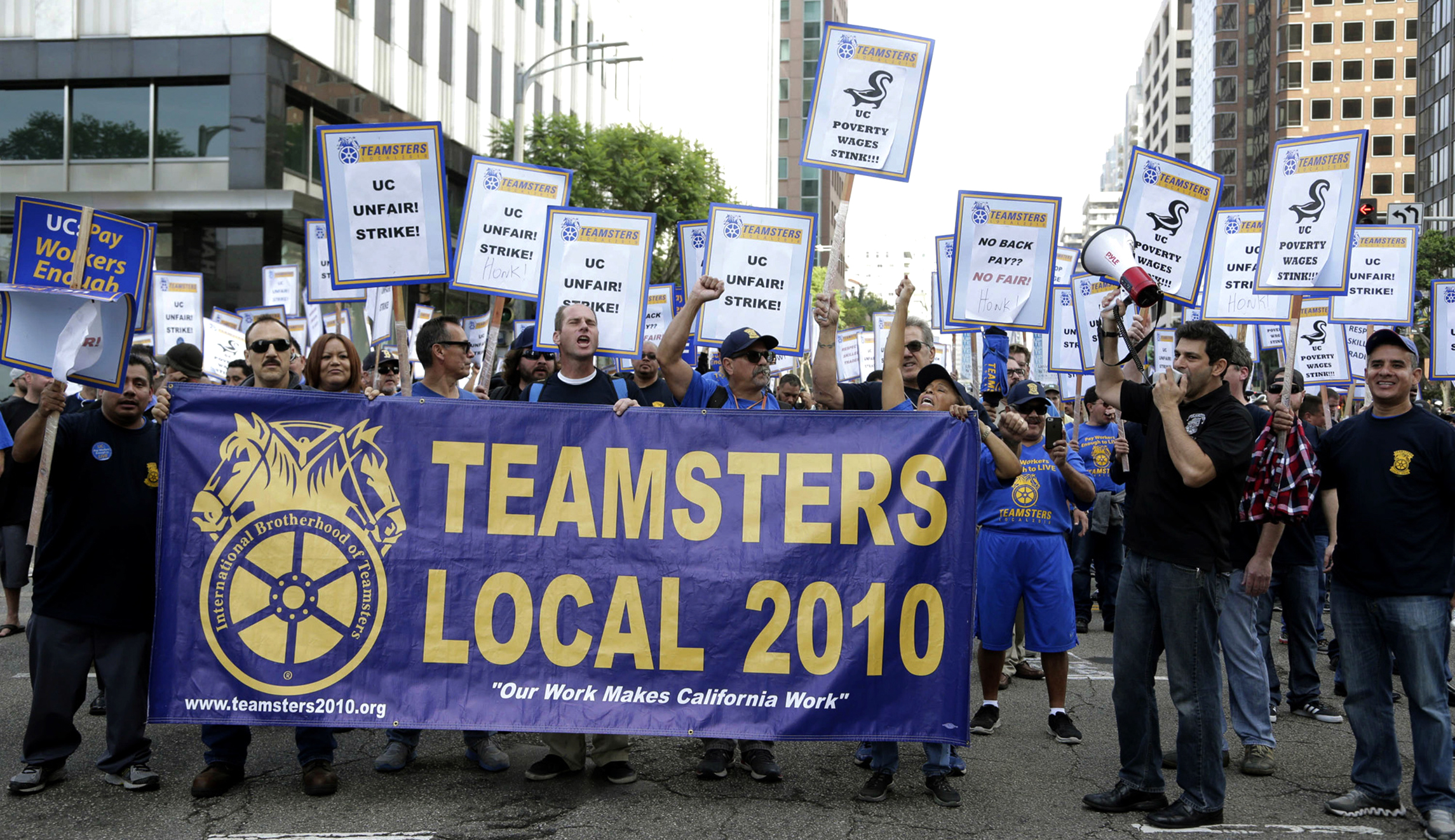
The Supreme Court drew a sharp line between public and private workers when it barred governments from automatically deducting “fair share” fees from the paychecks of nonunion members who benefit from collective bargaining.
The 5-4 decision in Janus v. American Federation of State, County and Municipal Employees alarmed labor groups representing corporate employees nonetheless.
Recommended Stories


Made possible by President Trump’s appointment of Associate Justice Neil Gorsuch after a Republican-controlled Senate blocked consideration of former President Barack Obama’s nominee during his last year in office, the decision is “an attempt to limit the collective voices of not only government workers, but those in the private sector as well,” said the Teamsters Union, which represents 1.4 million workers in the U.S., Canada and Puerto Rico. About 200,000 of them hold government jobs.
The ruling was widely viewed as a serious blow to organized labor overall, which has often supported Democrats, since it may drain the coffers of public-sector unions that have grown more powerful in the past three decades even as membership in private-sector groups declined.
About 34 percent of government workers were union members in 2017, compared with just 6.5 percent of corporate employees, according to the Bureau of Labor Statistics. The combined membership rate of about 10.7 percent was roughly half that of 1983.
The majority’s decision in Janus, built around the First Amendment’s prohibition of government controls on free speech, is “just the latest tactic of corporations and wealthy donors who want to take away our freedom at work,” said Robert Martinez, president of the International Association of Aerospace Workers and Machinists.
In overturning the court’s 1977 ruling in Abood v. Detroit Board of Education, which allowed governments to deduct fees for collective bargaining but not for political activities, the majority said very different questions were raised by the government allowing such charges in the private sector and requiring them for public employees.
The earlier case was “decided when public-sector unionism was a relatively new phenomenon,” Associate Justice Samuel Alito wrote for the majority. “Today, however, public-sector union membership has surpassed that in the private sector, and that ascendancy corresponds with a parallel increase in public spending.”
Under the ruling’s finding that the First Amendment is violated when money is taken from nonconsenting employees for a public-sector union, agencies must obtain affirmative consent from workers before gathering the fees — basically, employees will have to opt in, rather than opt out.
“By agreeing to pay, nonmembers are waiving their First Amendment rights, and such a waiver cannot be presumed,” Alito wrote.
Since the ruling is tailored to what a government can require, it would have no direct application to the private sector, said Harold Datz, an adjunct professor at Georgetown Law Center who served as chief counsel to successive chairmen of the National Labor Relations Board before retiring in 2007.
“There could be some private employers who would seek to extend it,” Datz noted, “but it would require an extension. It is not within the four corners of the decision.”
The ruling counted only Republican nominees among its supporters, while the minority’s dissent, written by Justice Elena Kagan, was backed by justices chosen by Democratic presidents.
The partisan lines mirror the political activity of organized labor: Over the past three decades, the vast majority of campaign contributions from unions have gone to Democratic candidates. They received 88 percent of $217 million in total contributions in 2016 and 81 percent so far this year, according to the Center for Responsive Politics.
While the majority was narrow, however, the makeup of the court now that President Trump gets a second appointment due to the retirement of Associate Justice Anthony M. Kennedy means the ruling is unlikely to be reversed in the near future.
“This decision, to a certain extent, is going to hurt unions in the public sector,” Datz said. “If you dry up the financial means of support, you make that union less effective as a bargaining representative. And if unions in the public sector are less effective because they no longer have a steady stream of income, I think employees in the public sector may become soured on unions precisely because they cannot perform as effectively as they have in the past.”
The ruling is likely to worsen income inequality in the U.S., argued Marc Perrone, president of the United Food and Commercial Workers International Union, who accused the high court of ignoring the benefits of organized labor. The median salary for workers represented by unions is $11,000 a year higher than their non-union peers, several of the groups noted.
“The Supreme Court’s ruling is at a time when so many Americans are struggling just to make ends meet,” Teamsters President Jim Hoffa said. “The Teamsters and our allies in the labor movement will redouble our efforts to ensure that working men and women have a voice on the job.”
The Machinists’ Martinez promised much the same. “The radical right will never defeat a wave of working people joining together for a better life,” he said. “This is war, and working people are going to fight back.”
